Guides
Drone Spraying Corn (Maize) in 2026: Tall-Crop Jobs Ground Sprayers Miss
Corn spraying with drones in 2026: which jobs suit tall maize, a contractor example, University of Missouri cost figures and Kentucky fungicide trial results.
- Prepared by
- DEWKITE Sales Team
- Published
- Reading time
- 3 min
- Sources
- 3
Key takeaways
- 1Tall corn after tasselling is where drones earn most: ground rigs struggle to get in, and aircraft are limited by trees, power lines and small fields.
- 2A 2019 University of Kentucky trial sprayed fungicide at the R1 stage and measured a 22.8 bu/ac yield gain, but disease pressure decides whether any spray pays.
- 3Missouri extension economists priced drone ownership at roughly US$12.27 an acre for a farm and US$7.39 for a contractor, with contract work at about US$16.
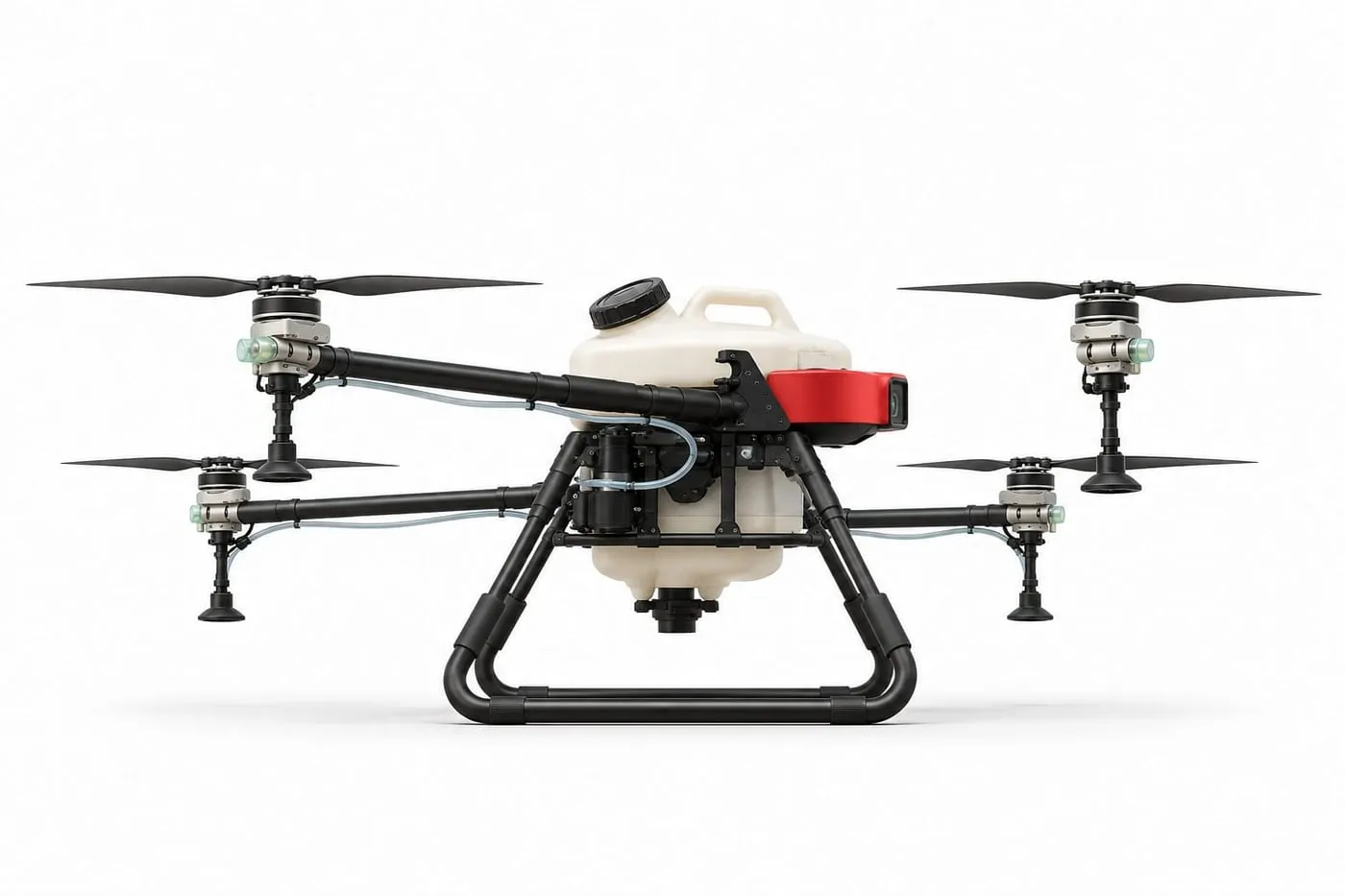
- 4Example estimate: a 50 L drone covers about 52 ha in six flying hours, so 100 ha is done in two days.
- 5Never promise a yield result; sell timing, access and records.
Contents
Short answer: Drone spraying suits corn best after the crop is tall, from the late vegetative stages through tasselling, when ground sprayers cannot enter without damage and aircraft are limited by field size, trees and lines. In 2026 the business case rests on timing, access and records, not on a promise of extra yield: Kentucky saw 22.8 bu/ac extra in one trial, other studies saw little.
What does a corn season look like for a contractor?
| Stage | Job | Why a drone helps | Notes |
|---|---|---|---|
| Early crop | Weed control | Ground rigs also work | Not the drone’s strongest job |
| Rapid growth | Insecticide, for example armyworm | Quick response | See fall armyworm drones |
| Tasselling to R1 | Fungicide, foliar feed | Corn is over 2 m tall | Short window |
| Late | Cover crop seeding | Spreader on tall corn | Check seed rate |
Example (estimate): a contractor has 100 ha of fungicide to apply in a 7-10 day window. An Agri 50 flying an 8 m swath makes about 8.6 ha an hour, so roughly 52 ha in six flying hours. Two days finish 100 ha. A single 50 L machine can cover about 350-500 ha in one window of 7-10 days at six hours a day. At the Missouri contractor reference of about US$16 per acre (roughly US$40 per hectare), 100 ha would bring about US$4,000 in the US; use your local price instead.
What does it cost to run a drone on corn?
University of Missouri Extension (G1274, 2025) calculated total cost per acre for owning a spray drone: US$12.27 for a farmer spraying 1,000 acres a year and US$7.39 for a contractor spraying 4,000 acres a year. Contractors charged about US$16 per acre; aircraft fungicide was about US$12.50 per acre. The document works from 6.5 acres per load (about 2.6 ha) and a machine life of 8,000 acres.
| Source | Figure | Meaning |
|---|---|---|
| Farmer-owned, 1,000 ac a year | US$12.27/ac | High cost per acre at low use |
| Contractor, 4,000 ac a year | US$7.39/ac | Use spreads the cost |
| Contract price | ~US$16/ac | Margin for the contractor |
| Aircraft fungicide | ~US$12.50/ac | Competing price |
These are US numbers; they show the logic of utilisation, not your local price.
Is drone fungicide on corn worth it?
It depends on disease pressure. The 2019 Kentucky trial (Adair, Taylor and Green counties, four replications of 10 acres each) sprayed at R1 and recorded a 22.8 bu/ac yield gain, with coverage checked on water-sensitive paper, less grey leaf spot and costs similar to other aerial methods. Kentucky researchers said about 6-12 bu/ac is needed to cover the cost. In 2025, the University of Kentucky reported a boom in drone corn spraying and a two-year comparison against high-clearance ground rigs, noting untreated leaf disease can cost about US$15 per acre. Tell customers to scout fields first; see drone vs knapsack spraying for the method comparison.
Can drones spray tall corn well?
Ground machines often give better canopy coverage, as the Kentucky work noted, but the drone delivers enough product to the leaf in the trials. Fly lower and slower, keep to the label minimum volume and always check coverage.
Which table helps choose between spray methods?
| Method | Small fields | Trees and lines | Wet ground | Coverage |
|---|---|---|---|---|
| Drone | Good | Good | Good | Lower, enough in trials |
| Aircraft | Weak | Limited | Good | High on big blocks |
| High-clearance rig | Good | Good | Weak | High |
Best for …
Best for a contractor starting on corn: Agri 50. It finishes about 52 ha in a six-hour estimate and is rated at 22 ha/h.
Best for large maize farms and big windows: Agri 100. Choose it when 100 ha a day is the target; it holds 100 L and is rated at 35 ha/h.
Best for small plots in mixed farming: Agri 30. Light to move between fields, with 30 L and a reference price from US$3,000.
Next, read how many drones a fleet needs, cost per hectare and soybean spraying. Dealer terms are on the dealer programme page.
Questions dealers ask
- Can you spray corn with a drone?
- Yes. Drones fly over tall corn for fungicide, foliar feed and insecticide. Keep to label rates, fly low enough for the canopy and test coverage on water-sensitive paper.
- How much does drone spraying cost per acre?
- Missouri figures from 2025 show contract drone work near US$16 an acre and aircraft fungicide near US$12.50. They describe the United States only, so collect local quotes before you price.
- Is drone fungicide on corn worth it?
- Only when disease pressure is high enough. Kentucky researchers said roughly 6-12 bu/ac of extra yield is needed to pay the spray cost; their 2019 trial reached 22.8 bu/ac. Other regions saw smaller or no gains.
- Can drones spray tall corn?
- Yes. Drones are not blocked by tall rows. Fly lower and slower for canopy penetration and keep a safe distance from poles and lines.
- Drone or airplane for corn fungicide?
- Aircraft cover big blocks fast. Drones win on small fields, fields with trees or lines, and wet fields. Missouri figures put aircraft fungicide at about US$12.50 per acre.
References
- [1]UK study shows promise for drone fungicide applications. University of Kentucky College of Agriculture, 2020.
- [2]Using drones to protect Kentucky corn: UK researchers lead precision agriculture study. University of Kentucky, 2025.
- [3]Economics of Drone Ownership for Agricultural Spray Applications (G1274). University of Missouri Extension, 2025.