Guides
How Many Spray Drones Do You Need for 500, 1,000 or 5,000 Hectares? (2026)
A formula and a 2026 table for the number of spray drones you need for 500, 1,000 or 5,000 hectares, by tank class and spray window, with spare and crew counts.
- Prepared by
- DEWKITE Sales Team
- Published
- Reading time
- 4 min
- Sources
- 5
Key takeaways
- 1Drones needed = hectares ÷ (hectares per drone-hour × spray hours in the window), rounded up, plus one spare.
- 2With our planning rule, one 100 L-class drone sprays about 432 ha in a 40-hour week and about 1,296 ha in three weeks (estimate).
- 3A 1,000 ha job needs one drone in a three-week window but three in a one-week window; add a spare either way.
- 4Spray volume changes the count: Kentucky's model shows 5 gal/acre takes roughly twice as long as 2 gal/acre.
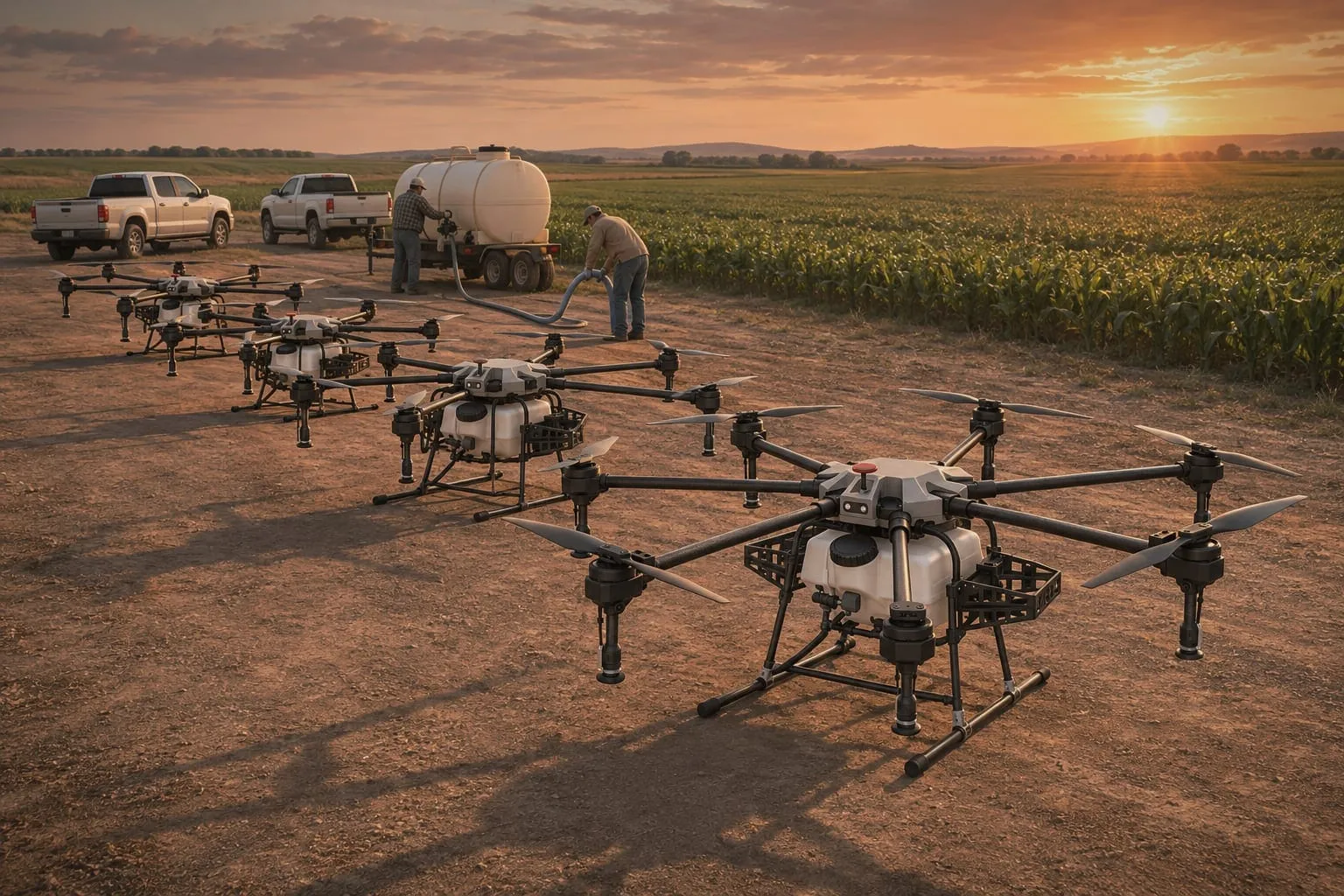
- 5The ground kit scales with the fleet: two people, a charging set and a water supply for every drone in the air.
Contents
- 01The fleet account in one table
- 02What counts as the spray window, and how many hours does it hold?
- 03How does spray volume change the number of drones?
- 04Is our rule too cautious?
- 05Is one big drone better than several small ones?
- 06What does each drone need on the ground?
- 07How should a dealer quote a fleet?
Short answer: In 2026 the formula is drones needed = hectares ÷ (hectares per drone-hour × spray hours in your window), rounded up, plus one spare. 1,000 hectares in a three-week window needs one 100 L-class drone on paper and two in practice; shrink the window to one week and you need three. For 5,000 ha, plan four to five drones over three weeks.
The fleet account in one table
The figures use our cautious planning rule (effective swath × 1.08 ha/h, from the hectares-per-hour guide) and a 40-hour spraying week. They are estimates before any spare drone.
| Area | Window | 50 L class (8 m effective) | 100 L class (10 m) | 150 L class (11 m) |
|---|---|---|---|---|
| One drone can spray | 40 h, about 1 week | 346 ha | 432 ha | 475 ha |
| One drone can spray | 120 h, about 3 weeks | 1,037 ha | 1,296 ha | 1,426 ha |
| Drones for 500 ha | 40 h | 2 | 2 | 2 |
| Drones for 500 ha | 120 h | 1 | 1 | 1 |
| Drones for 1,000 ha | 40 h | 3 | 3 | 3 |
| Drones for 1,000 ha | 120 h | 1 | 1 | 1 |
| Drones for 5,000 ha | 40 h | 15 | 12 | 11 |
| Drones for 5,000 ha | 120 h | 5 | 4 | 4 |
Example (estimate): 1,000 ha with 100 L drones in three weeks. Output is 10 m × 1.08 = 10.8 ha/h. The window is 3 weeks × 40 h = 120 h. One drone covers 10.8 × 120 = 1,296 ha, so 1,000 ÷ 1,296 = 0.77. Round up to 1, add a spare, and the fleet is 2. A 50 L drone needs 0.96 of a drone for the same job: one machine with no margin, so buy two.
What counts as the spray window, and how many hours does it hold?
Plan on about 40 flyable hours a week for three weeks, unless the label or crop says otherwise. The window is the number of days the label and the crop stage allow, and the University of Kentucky’s sizing model uses 120 hours because three weeks is the shortest corn-fungicide window there; wheat at heading can be as short as one to two weeks. A service provider that travels further can stretch the work to about 60 days. Count flyable hours only: if rain or wind stop you two days in five, cut the hours by 40 % before you divide.
How does spray volume change the number of drones?
Kentucky’s model shows that 5 gal/acre (about 47 L/ha) takes roughly twice as long as 2 gal/acre (about 19 L/ha). A 40 L drone’s three-week area falls from 3,872 acres (about 1,567 ha) at 2 gal/acre to 1,611 acres (about 652 ha) at 5 gal/acre. If your product needs 40 L/ha or more, start by doubling the hours the table assumes, then test on a real field.
Is our rule too cautious?
Probably a little. Kentucky’s model gives a three-week maximum of 5,974 acres (about 2,418 ha) for a 72 L drone at 2 gal/acre, about twice our 1,296 ha for a 100 L machine. We keep the lower number on purpose: a promise to a grower should hold on a bad week. Replace it with your own logged hectares per hour after the first season.
Is one big drone better than several small ones?
On cost per acre, usually yes. Kentucky’s worked example is 3,000 acres (about 1,214 ha) in three weeks: four 8 L drones cost about US$14.18 per acre against about US$6.50 per acre for one 40 L drone (model values). Larger tanks cut landings and wages per hectare. Our 100 L guide holds the two-versus-three fleet account, so we do not repeat it here.
What does each drone need on the ground?
- Crew. Purdue describes two people per spray drone in the United States without a waiver, so a four-drone fleet means eight people (see the crew guide).
- Power. One charger set per drone and enough batteries to keep it flying; the battery guide gives the count.
- Water. Purdue’s example: 200 acres (81 ha) at 2 gal/acre needs at least 400 gal (about 1,500 L), plus rinse water. 1,000 ha at 19 L/ha is about 19,000 L (example).
How should a dealer quote a fleet?
Quote the fleet, not the machine. Example: a farm group with 1,000 ha and a one-week window needs three Agri 100 plus one spare. At the reference range of US$ 22,700–29,100 per set, four sets come to US$ 90,800–116,400 FOB before generators, trailer and freight. The same farm with a three-week window needs one working drone plus a spare, US$ 45,400–58,200. Show the buyer both lines and let the window decide. See Agri 100, the fleet management guide and the dealer program.
Questions dealers ask
- How many acres can an ag drone spray in a day?
- WeedSmart reports 125–200 ha a day for drones in Australian broadacre, depending on spray type, weather and flight speed. Our cautious planning rule gives about 65–78 ha per day for a 100–150 L machine, so use the lower figure until you have measured your own.
- What is the flight time needed for a 40-acre field?
- About 1.5 hours of spraying (estimate). The field is close to 16 ha, and a 100 L drone with a 10 m effective swath handles around 10.8 ha/h. Travel and set-up are extra.
- How many people do I need per drone?
- The US rules Purdue describes ask for two people per spray drone without a waiver, so plan crews in pairs. Other countries differ, so check with your aviation authority.
- Do I need a spare drone?
- If the spray window is short, yes. A drone that is down for two days in a three-week window costs about 130 ha of output at our planning rate. One spare per three or four working drones is a sensible starting rule, with a parts kit for the rest.
- How many drones for 500 hectares?
- Two in a one-week window, one in a three-week window, in all three tank classes of the table. Add a spare drone or a parts kit so a fault does not stop the job.
- Can four drones cover 5,000 hectares?
- In a three-week window the 100 L class needs 3.86 drones on paper, so four work with no margin. Plan for five, or accept a longer window.
References
- [1]AEN-174 Drone Sprayer Sizing for Agricultural Applications. University of Kentucky Cooperative Extension.
- [2]G1274 Economics of Drone Ownership for Agricultural Spray Applications. University of Missouri Extension.
- [3]The Evolution of Spray Drones: operational set-up in the field (PPP-154). Purdue Pesticide Programs.
- [4]The Evolution of Spray Drones: current challenges (PPP-154). Purdue Pesticide Programs.
- [5]Drone spraying and spreading technology update. WeedSmart.