Guides
Best Drone for Orchard Spraying on Slopes (2026): What Contractors Should Buy
Choosing a drone for orchard spraying in 2026: canopy penetration, terrain following, tank size, coverage data against air-blast rigs and the contractor case.
- Prepared by
- DEWKITE Sales Team
- Published
- Reading time
- 3 min
- Sources
- 4
Key takeaways
- 1For orchards the best drone is rarely the biggest: look for strong downwash, adjustable droplet size, reliable terrain following and a tank that matches a high spray volume.
- 2On slopes and terraces a 30-50 L machine is usually easiest to run; flat, large orchards and contractors can use 50-72 L.
- 3Do not sell a drone as a full replacement for an air-blast sprayer: in an Auburn peach orchard study the air-blast rig covered 58.77 % of the target against 6.55 % for the best drone setting.
- 4Orchard jobs often need about three times the liquid per hectare of field crops, so refilling and batteries limit output more than flight time.
- 5The strongest business case is work a tractor cannot do: wet ground, steep slopes and night spraying.
Contents
Short answer: The best drone for orchard spraying in 2026 is a 30-50 L multirotor with strong downwash, radar terrain following and adjustable droplet size for slopes and terraces, and a 50-72 L machine for contractors on flatter ground. Be honest with buyers: research shows a drone gives lower canopy coverage than an air-blast sprayer, so sell it for the work a tractor cannot do.
What does an orchard job look like in numbers?
| Item | Field crop | Orchard (example) | Effect |
|---|---|---|---|
| Spray volume | ~15 L/ha | ~45 L/ha | About three times the liquid |
| Hectares per 30 L tank | 2 ha | 0.67 ha | More refills |
| Limiting factor | Battery | Mixing and refilling | Add a loader |
Example (estimate): a 30 L tank at 15 L/ha covers 2 ha; at 45 L/ha it covers only 0.67 ha. A contractor needs a two-person crew, several battery sets and a mixing tank at the row end. A US dealer guide makes the same point: tree crops use about three times the liquid, so the tank, not flight time, caps the day. See how many batteries a drone needs.
Can a drone spray as well as an air-blast sprayer?
No, on canopy coverage. In a peach orchard study at Auburn University the air-blast sprayer reached 58.77 % coverage and 193.11 droplets/cm2; the best drone fruit-tree mode reached 6.55 % and 90.09 droplets/cm2. Rotary flight modes in a simulated canopy gave 20.81 %. The same work found drone canopy penetration is effective and uses less product. For a buyer that means: choose the tool by job.
| Situation | Better tool | Reason |
|---|---|---|
| Even, large orchard, dry ground | Air-blast sprayer | Higher coverage |
| Soaked soil after rain | Drone | No tyres on wet ground |
| Steep slope or terrace | Drone | No tractor access |
| Night spraying, low wind | Drone | Cited by Penn State growers |
Which size fits which orchard?
| Orchard | Difficulty | Suggested model |
|---|---|---|
| Terraced mango, litchi, nuts | Slope, tight rows | Agri 30 Hex, Agri 40 |
| Dense dwarf apples (180+ trees/acre) | Narrow rows, drift | Agri 30, Agri 50 |
| Large flat orchard, contractor | Refill time | Agri 50, Agri 72 |
| Banana or tea | Special crop rules | See banana and tea |
What do growers worry about?
Penn State reported that 95 % of surveyed growers wanted to try drones, and their main worries were spray volume, coverage and the effect of growth-regulator sprays. Night spraying, when wind is low and pollinators are less active, was a named benefit.
Is there a business case for contractors?
Yes, in the right niche. PACSys (South Africa, 2022) listed aircraft at R400-500/ha and drone service at R300-400/ha, and training one pilot at R60,000-70,000 over about six months. Treat that as one country’s public data from a drone dealer, not a global price.
Example (estimate): a 50 L machine with an 8 m effective swath flies about 8.6 ha per hour on open ground (8 m x 6 m/s x 50 %). With three refills and battery swaps per hour, half of that is a more honest orchard figure, about 4 ha per hour.
Best for …
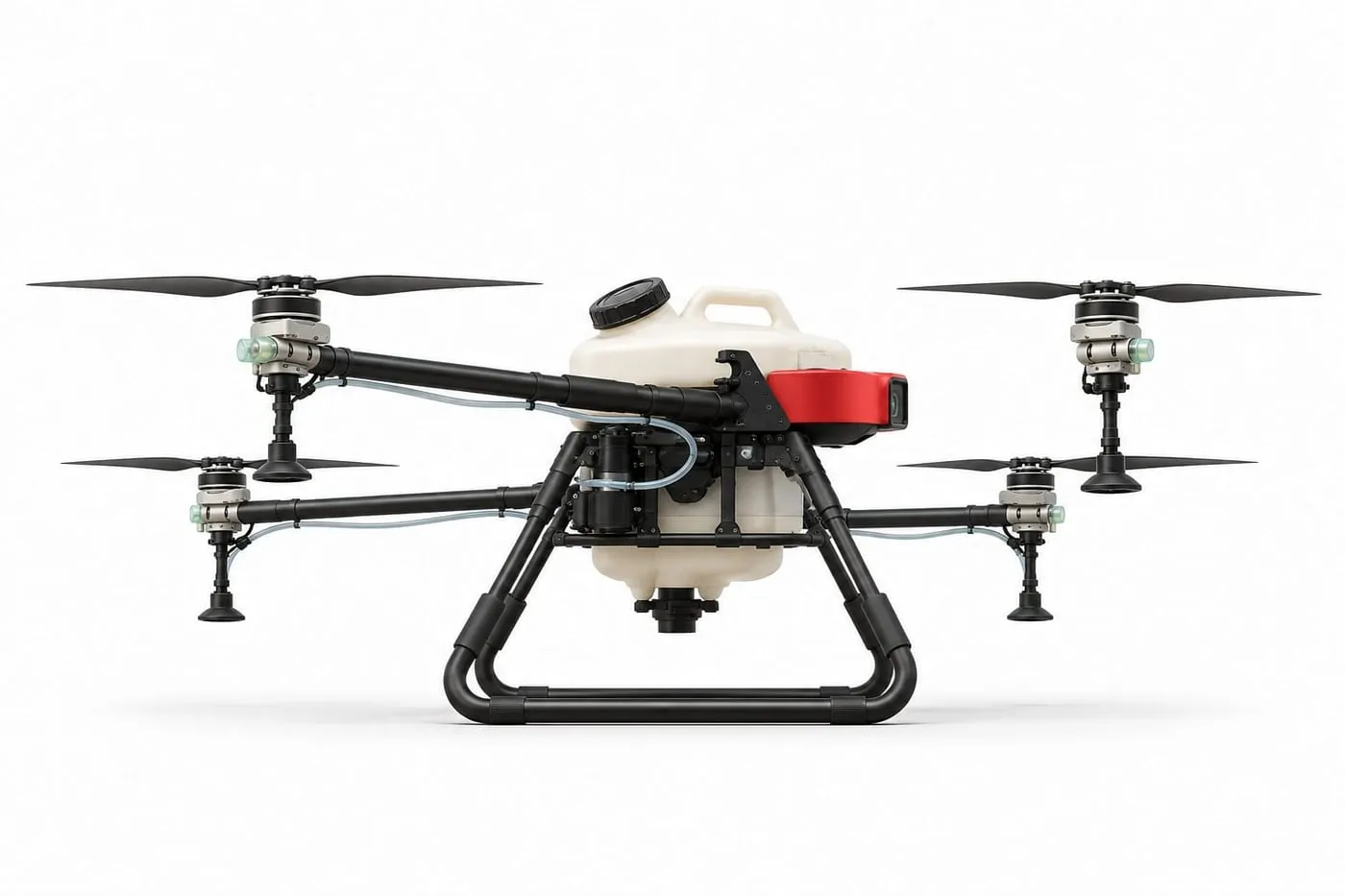
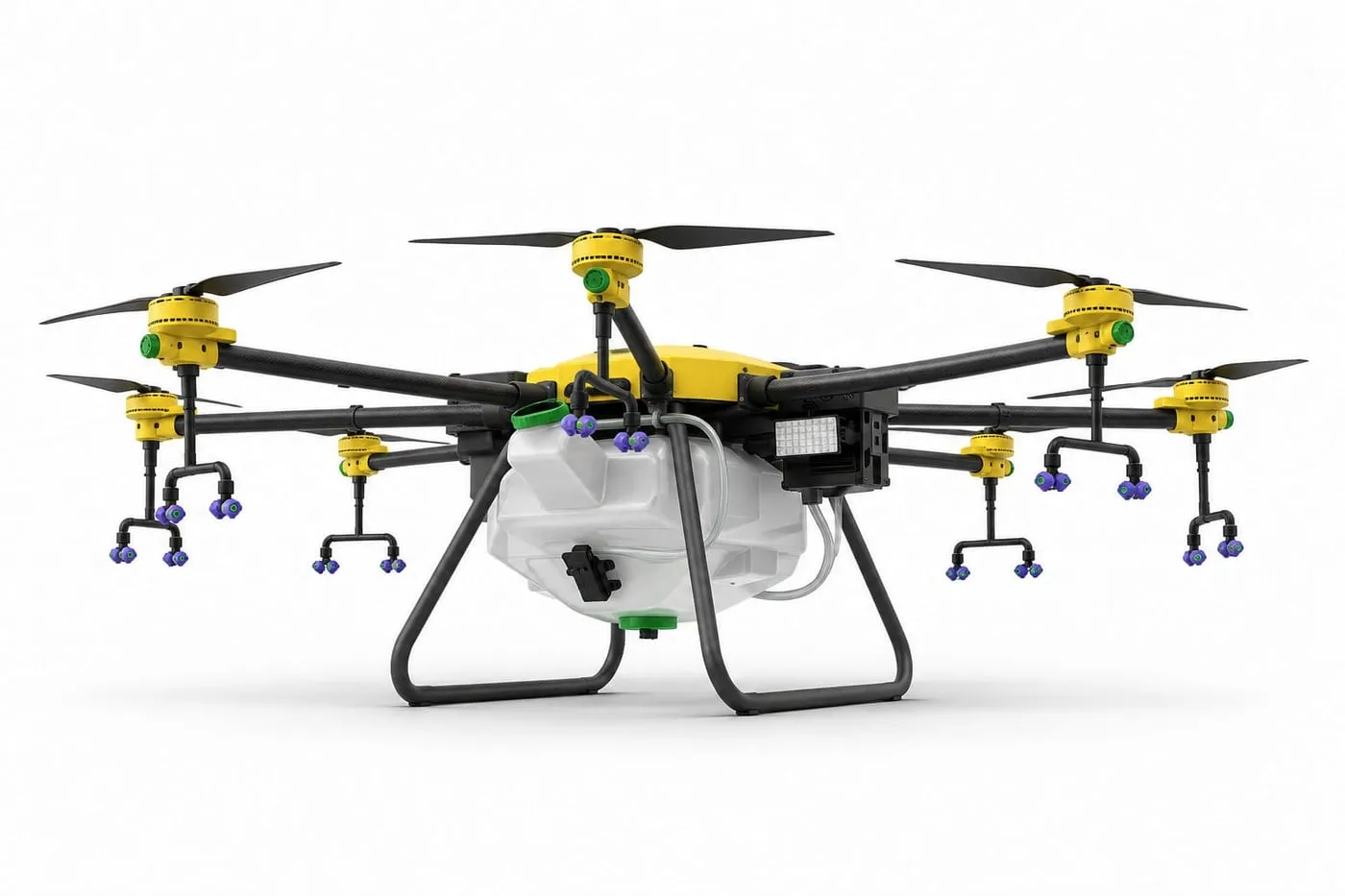
Best for hillside and terraced orchards: Agri 30 Hex. Six arms give a steady platform on slopes, with 30 L on board and a 6-9 m swath.
Best for first-time orchard contractors: Agri 50. It carries enough liquid for dense canopies (50 L) and is listed at US$8,900-21,100.
Best for a crew that wants high pressure: Agri 72. Its eight-rotor frame and high-pressure nozzles suit long rows, with 72 L and a US$15,400-16,400 range.
Compare frame layouts in hexacopter vs octocopter, and see how a drone service is priced in drone spraying service. South African buyers can read the KwaZulu-Natal market page, and dealers can open the dealer programme.
Questions dealers ask
- Which agricultural drone is best for orchards on hillsides?
- Pick a multirotor in the 30-50 L range with terrain-following radar and adjustable nozzles. Terraces favour the smaller Agri 30 Hex or Agri 40; contractors with long rows and gentler ground can step up to Agri 50 or Agri 72.
- Can a drone spray as well as an air-blast sprayer?
- Not on canopy coverage in the research reviewed here. Drones can still give enough product on the leaf for some jobs, and they reach places an air-blast rig cannot. Match the job to the tool.
- What spray volume do orchards need with a drone?
- Follow the label and local advice. As an industry rule of thumb quoted by a US dealer, tree crops need roughly 5-10 US gallons per acre, about three times a field crop. Use that only for planning your refills.
- Do drones work on terraced orchards?
- Yes, when the drone follows terrain by radar and the pilot flies each terrace row by row. Training matters more than the model, so budget for it.
- How much do orchard contractors charge?
- Public South African figures from 2022 put aircraft at R400-500 per hectare and a drone service at R300-400 per hectare. Prices differ widely by country, so ask local contractors.
References
- [1]Optimization and Evaluation of Drone Operational Parameters for Enhanced Spray Efficiency in a Peach Tree Orchard. Auburn University.
- [2]Are drones the future of tree fruit production? Researchers investigate. Penn State, 2025.
- [3]Best Ag Sprayer Drone for Your Farm: 2026 Buyer's Guide. Talos Drones (dealer), 2026.
- [4]Drones Offer Targeted Pest Control in Orchards. PACSys, South Africa, 2022.