Guides
Drone Spraying in Tea Plantations (2026): Slopes, Pests and Service Models
Tea plantation drone spraying in 2026: parameters from a 2025 tea-garden trial, slope flying, the Kenya estate service contract, and a fleet-hours example.
- Prepared by
- DEWKITE Sales Team
- Published
- Reading time
- 3 min
- Sources
- 4
Key takeaways
- 1Tea suits drones where the land is steep, rows are dense and hand spraying is slow; the value is time and product volume, not replacing pickers.
- 2A 2025 Agronomy paper found that lowering the flying height from 5 to 2 m and speed from 5 to 3 m/s raised penetration of the tea canopy for a larger-tank drone.
- 3In Kenya, Fahari Aviation signed in 2022 to treat more than 3,000 acres (about 1,200 ha) of Sasini subsidiary Kipkebe tea in about two weeks; the saving claim is the vendor's.
- 4Example: 1,000 ha per round needs about 23 machine-days, or three machines for about eight days.
- 5Smallholder co-ops usually need a shared service, and we found no public smallholder drone trial data to quote.
Contents
Short answer: Drones suit tea where the slope is steep, rows are dense and hand spraying is slow. The value is time and even application, not replacing pickers. In 2026 the dependable model is a service: an estate or co-op hires a trained crew, and a dealer supplies 30-50 L machines, batteries and spare parts. Settings must be tuned for the canopy, and slope flying needs trained pilots.
What do tea trials say about settings?
A 2025 Agronomy paper tested two large drones in tea gardens in China. The table gives its main findings.
| Parameter | Tested range | What happened |
|---|---|---|
| Spray volume, smaller-tank drone | 30-90 L/ha | More volume, more coverage and droplets |
| Spray volume, larger-tank drone | 60-150 L/ha | Same trend |
| Deposits, larger drone vs smaller | 1.4 times on canopy surface, 2.9 times inside | Same settings |
| Flying height | 5 m down to 2 m | Penetration rose |
| Flying speed | 5 m/s down to 3 m/s | Penetration rose |
The practical lesson: a larger tank with strong downwash helps, and flying lower and slower gets product into the canopy. Treat the values as a starting trial, not a label.
How does the Kenya model work?
In August 2022, The Standard reported that Fahari Aviation, the drone unit of Kenya Airways, signed to deliver fertiliser and spraying services to Kipkebe Ltd, a Sasini subsidiary in Kericho, aiming to cover 3,000+ acres (about 1,200 ha) in about two weeks, with the possibility of extending to other Sasini estates. The company said it could save about 50 % of cost and time, which is the operator’s claim, not an independent result. Aviation Week also covered the contract.
| Customer | Contract | Machines | Dealer role |
|---|---|---|---|
| Large estate | Season package per area | Own fleet or service | Machines, training, parts |
| Smallholder co-op or factory network | Service per hectare | Shared service | Service point, rental |
| Contractor | Per hectare | 2-5 machines | Finance, batteries |
What does a round cost in time?
Example (estimate): one round across 1,000 ha. At about 8.6 ha an hour, an Agri 50 on an 8 m swath treats about 43 ha in a five-hour flying day, so the round takes about 23 machine-days: three machines for about eight days. Slopes lower the rate, so the real figure is higher.
How should pilots fly slopes?
Vendor guidance from China says that on a 60-degree slope the pilot may need to fly row by row and watch that rotors on the slope side do not touch the tea bushes. That is a manufacturer’s statement we have not tested ourselves, so train pilots on your own slopes before taking contracts. See pilot training.
What about Sri Lanka, India and Vietnam?
A 2019 Krishi Jagran report, reprinted by History of Ceylon Tea, recorded a speaker in Guwahati discussing drones for monitoring tea pests to reduce pesticide use. We found no independent spraying trial for Sri Lanka or Vietnam, and none for Kenyan smallholders, so we do not invent figures. Tea export markets also set residue limits, so follow the label and the buyer’s standards.
How can smallholders use a drone?
A co-op or a factory outgrower scheme can buy a service per hectare more easily than each farm buying a machine. A dealer can run a service point, rent machines and supply parts. See drones for cooperatives.
Best for …
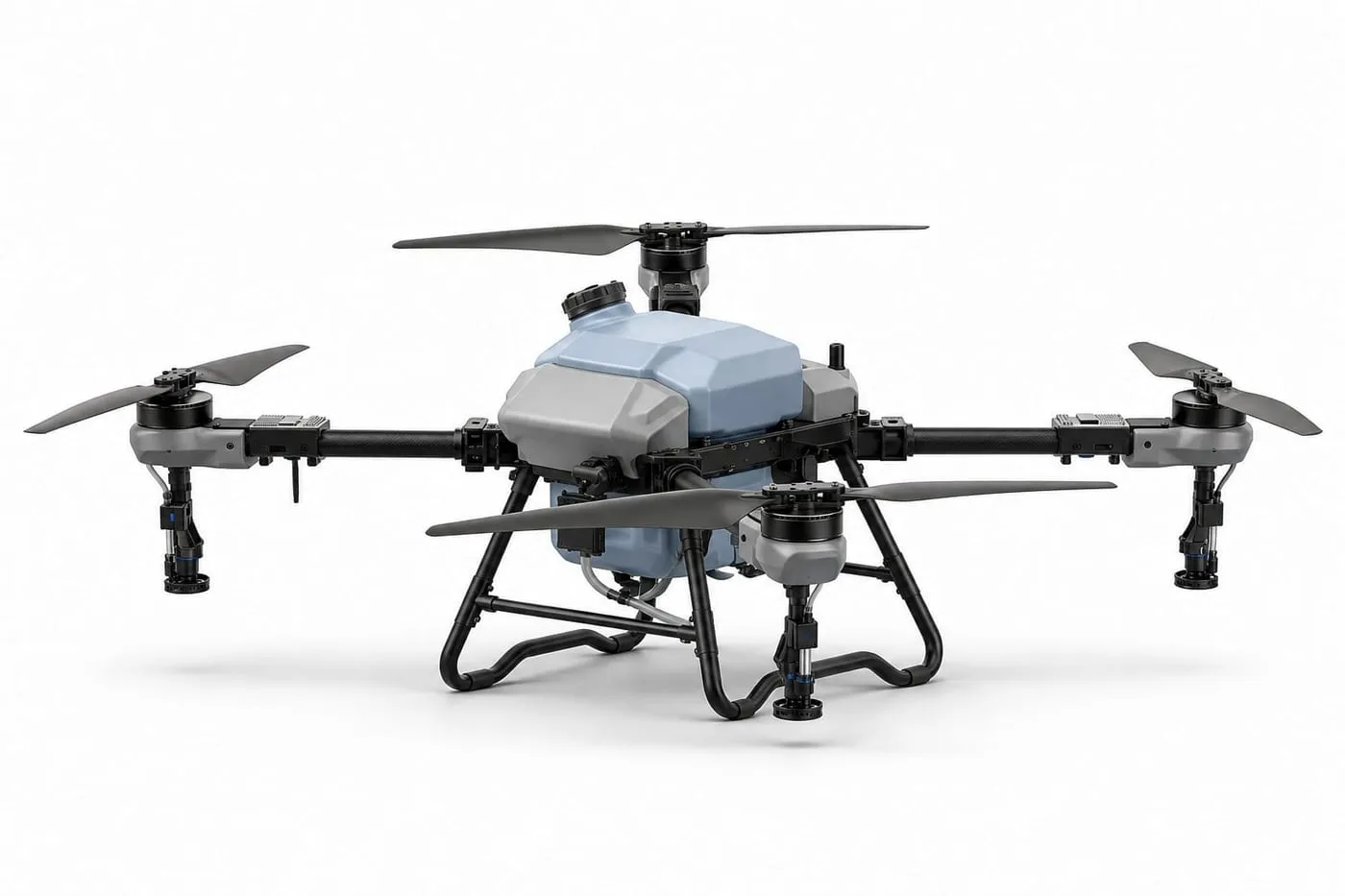
Best for steep estates: Agri 30 Hex. Six arms keep it steady on steep rows; 30 L is easy to refill at a road-side station.
Best for mid-sized estates: Agri 40. A typical-value ~40 L tank and a US$3,000-11,000 range for estates outgrowing a 30 L machine.
Best for service contractors: Agri 50. Roughly 43 ha a day on gentle ground in our estimate, with a rated 22 ha/h.
Slope lessons carry over from orchard spraying. Pricing is in drone spraying service; then see Kenya and the dealer programme.
Questions dealers ask
- Can drones spray tea plantations on slopes?
- Yes, with terrain following, trained pilots and lower speed. On steep slopes the pilot may need to fly row by row, and the slope-side rotors can come close to tea plants, so training matters.
- What is the best drone for tea garden spraying?
- A 30-50 L multirotor with strong downwash and adjustable flying height. Agri 30, Agri 40 and Agri 50 suit slopes; the right choice depends on road access and refill distance.
- How much pesticide do drones save in tea?
- We found no independent figure we can verify for your country. A vendor reported savings of about 50 % in cost and time in Kenya. Plan on measured results from your own demonstrations.
- How many hectares of tea can a drone spray in a day?
- On gentle ground our estimate is about 43 ha in a five-hour day for a 50 L machine; slopes usually lower it.
- Are drones used in Kenya tea estates?
- Yes. In 2022, Fahari Aviation, a Kenya Airways unit, signed to provide fertiliser and spraying services to Sasini subsidiary Kipkebe in Kericho.
References
- [1]Optimizing Unmanned Aerial Vehicle Operational Parameters to Improve Pest Control Efficacy and Decrease Pesticide Dosage in Tea Gardens. Agronomy 15(2):431, 2025.
- [2]KQ's drone unit to offer agricultural services to Sasini subsidiary. The Standard, 2022.
- [3]Fahari Aviation scales up use of drone technology for agriculture. Aviation Week.
- [4]Tea Industry Considers Using Drones for Effective Crop Management. History of Ceylon Tea, reprinting Krishi Jagran, 2019.