Guides
How Many Batteries Does an Agricultural Drone Need? (2026 Guide)
Three batteries per drone is the usual 2026 start; four or five if charging is slow. The formula, charging table, generator size, fuel use and cost per hectare.
- Prepared by
- DEWKITE Sales Team
- Published
- Reading time
- 3 min
- Sources
- 6
Key takeaways
- 1Most spray drones run on three batteries in 2026: one in the air, one charging and one spare, if the charger refills a pack in about one sortie.
- 2Formula: packs charging = (charge + cooling time) ÷ sortie cycle, rounded up; total per drone = 1 in the air + packs charging + 1 spare.
- 3Slow chargers or hot weather push the count to four or five packs per drone, so write the charging set into the quote.
- 4Fast charging needs a generator that delivers more than about 9.5 kW while running (Purdue), and a maker's lab test puts fuel use near 0.75 L of petrol per pack.
- 5At 1,000 cycles and US$2,500 a pack (Missouri assumptions) battery wear costs about US$0.95 per hectare; at 500 cycles, about US$1.90.
Contents
Short answer: In 2026 most spray drones need three batteries: one in the air, one charging and one spare, provided the charger refills a pack in about the time a sortie takes. Slower chargers or hot days push it to four or five. The formula is packs charging = ⌈(charge + cooling time) ÷ sortie cycle⌉, and total per drone = 1 in the air + packs charging + 1 spare.
The battery account in one table
Example sortie cycle: 8 minutes of flying plus 2 minutes on the ground to refill and swap, so 10 minutes in total.
| Charging speed | Charge + cooling time | Packs charging | Total per drone |
|---|---|---|---|
| Fast: high-power or water-cooled set | 10 min | 1 | 3 |
| Medium | 20 min | 2 | 4 |
| Slow: small-drone charger | 30 min | 3 | 5 |
Example: charge plus cooling takes 20 minutes and the cycle is 10, so 20 ÷ 10 = 2 packs charging, and 1 + 2 + 1 = 4 packs per drone. The same formula for two drones with fast charging gives two in the air, two charging and one spare: the five-pack set Missouri Extension assumes for a custom applicator with two drones. Its single-farm set, one drone with three packs, is the first row.
How long does one battery last in the air?
Usually 5–15 minutes with a full tank, according to Ohio State’s fact sheet; Purdue notes that an empty drone may fly 15 minutes while a loaded one flies six to eight. Our data sheets list full-load hover times of 4 minutes (Agri 150), 8 minutes (Agri 100) and 7 minutes (Agri 50). Purdue advises swapping the pack every time you refill the tank, and warns that bigger tanks also shorten battery life, so take the cycle time from your own test flight, not from the empty-drone figure.
What generator do you need to charge them?
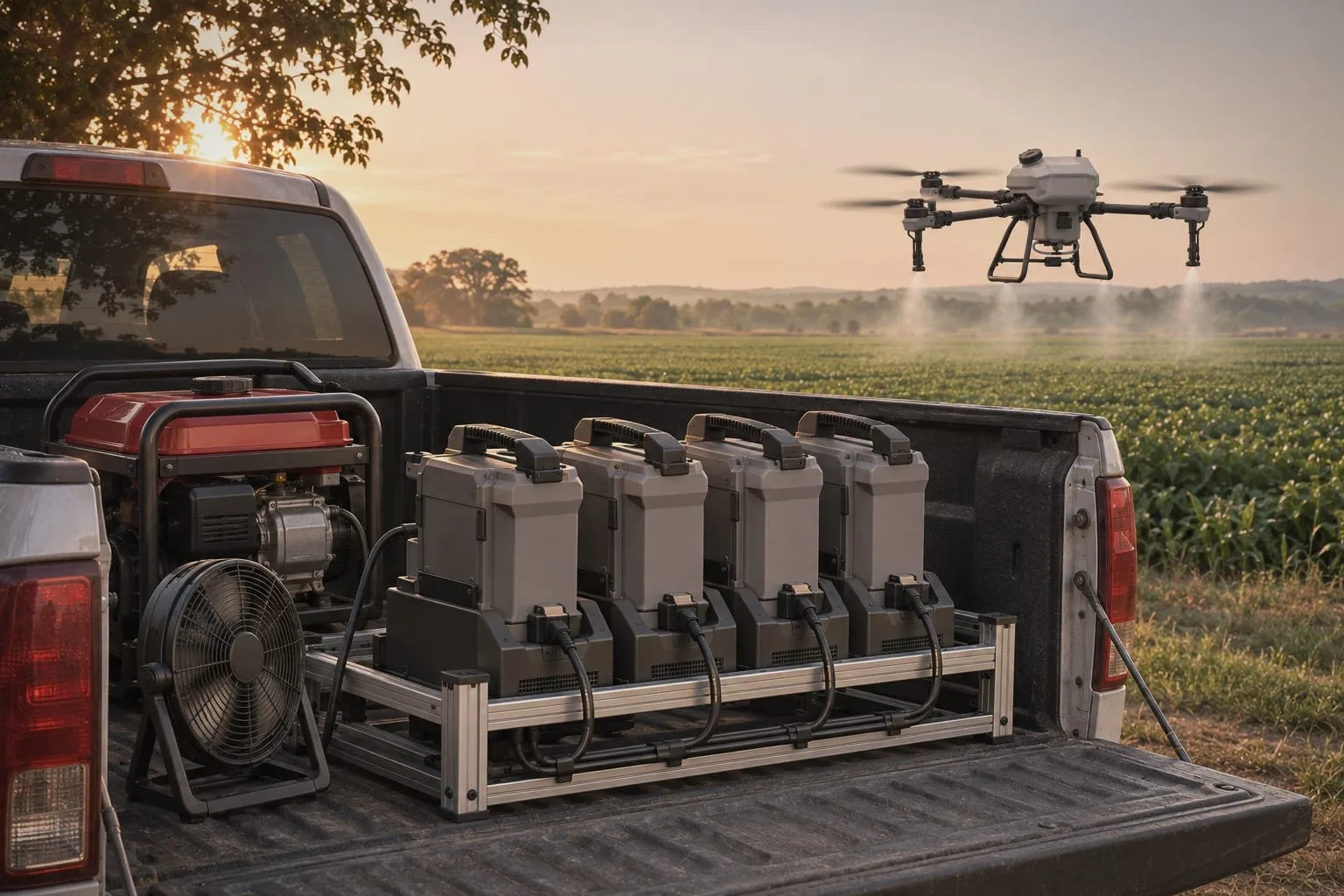
One that delivers more than about 9.5 kW while running, if you want fast charging. That is Purdue’s figure for a 240 V, 50 A supply, and it adds that air-cooled petrol sets are not built for 12 hours a day at 27–32 °C; some operators moved to liquid-cooled diesel. Makers’ figures sit in the same range: one lists an 11.5 kW generator that charges a pack from 30 to 95 % in 8–9 minutes, another a 9 kW set with a 9 minute charge. The Agri 150 package lists a 7,200 W charger, so budget a generator comfortably above that. Never run a generator inside a closed trailer.
How much fuel does charging burn?
About 0.75 L of petrol per charge in a maker’s laboratory test: 10 L charged a pack of a 40 L-class drone 13.37 times, from 20 to 95 %. It is a maker figure, not a field result. Example: 60 sorties a day need about 60 × 0.75 = 45 L of petrol for charging alone. Use that line in a customer’s running-cost sheet, and link it to the generator guide.
How many cycles does a battery last, and what does it cost per hectare?
Missouri Extension assumes 1,000 charge cycles or five years of use, whichever comes first, at US$2,500 a pack (a US-brand assumption, not our price). The formula is battery cost per hectare = pack price ÷ (cycles × hectares per sortie).
Example (Missouri assumptions): US$2,500 ÷ 1,000 cycles = US$2.50 per sortie. At 6.5 acres (about 2.6 ha) per sortie that is about US$0.95/ha. At 500 cycles the same pack costs about US$1.90/ha. Put your quoted pack price into the formula before you promise a customer a running cost; the battery replacement guide goes deeper.
What should the dealer’s quote list?
Write the charging set into the quote next to the drone: number of packs, number of chargers, generator rating, cables and cooling. A customer who finds on the first morning that one generator cannot feed two chargers blames the drone, not the quote. Batteries are also the part customers re-order most, so list them on the spare parts page with a price per pack and the expected cycle count. For models in the 50–150 L class see Agri 50, Agri 100 and Agri 150, and for stock levels the spare parts list. The dealer program starts at one unit.
Questions dealers ask
- How long does a drone battery need to charge?
- Makers of fast systems quote 8–11 minutes for a pack with a large generator. Our data sheets list 10–20 minutes for the Agri 30 (30–99 %), 20 minutes for the Agri 50R and about 30 minutes for the Agri 10 / 20 and Agri 30R.
- How many batteries and what generator does a 50 L drone need?
- Three packs with fast charging, four or five with slower charging. For the generator, take the charger's rated input from the data sheet and add the water pump and cooling fan; Purdue puts a 240 V, 50 A fast-charging supply above about 9.5 kW running.
- Does hot weather change the battery count?
- It can. One maker notes that above about 35 °C back-to-back sorties may not be possible without cooling. Add a pack, shade the charging area and ask the supplier whether the quoted charge time includes cooling.
- How many charge cycles does an agricultural drone battery last?
- Missouri Extension assumes 1,000 cycles or five years, whichever comes first. Several of our data sheets list 300–500 cycles (Agri 10 / 20, Agri 30, Agri 30R / 50R), so use the figure for your model.
- Should I buy extra batteries to be safe?
- Keep one spare, but not many more. Missouri Extension notes the cheapest strategy is to limit extra packs, because they age in the box as well as in the field. Buy more only when the crew waits for a charge.
- How many batteries come with the drone?
- It depends on the package. The Agri 150 package lists three batteries and a 7,200 W charger. We confirm the exact set on each quotation, so ask for packs, chargers and cables as separate lines.
References
- [1]Drones for Spraying Pesticides – Opportunities and Challenges. The Ohio State University CFAES.
- [2]G1274 Economics of Drone Ownership for Agricultural Spray Applications. University of Missouri Extension.
- [3]The Evolution of Spray Drones: operational set-up in the field (PPP-154). Purdue Pesticide Programs.
- [4]DJI AGRAS T100 specifications. DJI (manufacturer data).
- [5]Agras T50 and T25 battery systems. DJI (manufacturer laboratory data).
- [6]XAG P100 Pro. XAG (manufacturer data).