Guides
Spraying Wheat With Drones: How Many Machines Does a 5,000 ha Window Need?
Wheat spraying drones in 2026: fungicide windows of 2-5 days, how many machines 5,000 ha needs, ear coverage trial data and rules for large farms.
- Prepared by
- DEWKITE Sales Team
- Published
- Reading time
- 3 min
- Sources
- 6
Key takeaways
- 1Wheat fungicide is a window problem: a spray timed on fully emerged ears may have only about 2 to 5 days, so the question is machine-hours in the window.
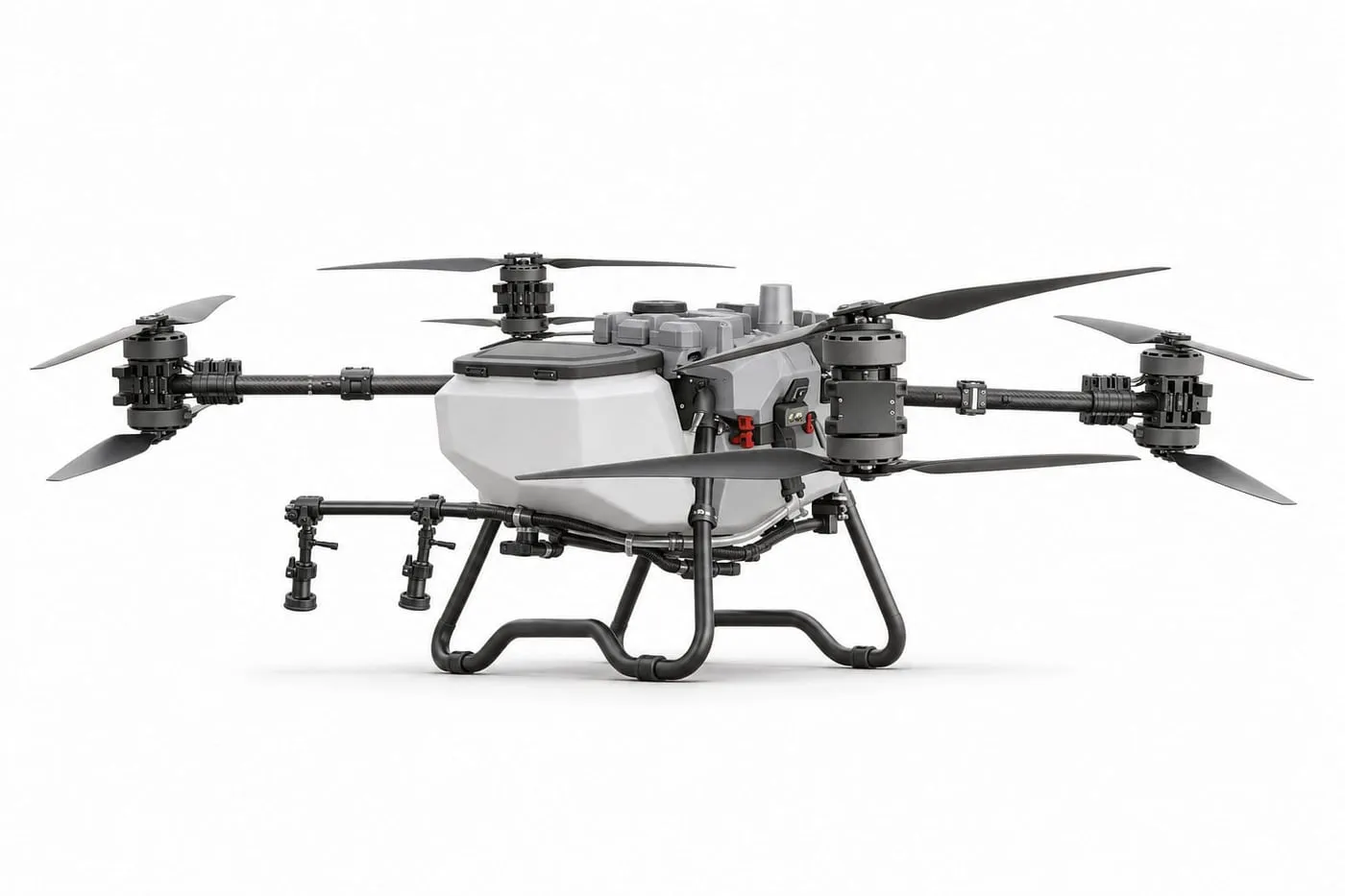
- 2Example: 5,000 ha in a 3-day window at 8 flying hours a day needs about 6 Agri 100 machines, 6 Agri 150, or 10 Agri 50.
- 3A Canadian trial found a 50 L/ha drone gave ear coverage similar to a helicopter and 64% higher deposition density, but a 175 L/ha ground boom covered ears far better.
- 4Faster flight does not improve coverage: speed lowers deposition and raises drift risk, and a 10 m/s ground speed balanced both in one 2025 trial.
- 5Wheat drone rules differ from country to country, so read the label and ask the local authority before you quote.
Contents
Short answer: In 2026 a large wheat farm should size a drone fleet by the spray window, not by the season. A fungicide timed on fully emerged ears can have only about 2 to 5 days, so 5,000 ha in three days needs about six Agri 100 machines on paper. Drones cover wheat ears less thoroughly than a ground boom, so sell them where the window is tight or the ground is wet.
How many machines does a 5,000 ha window need?
Example: a 3-day window with 8 flying hours a day gives 24 hours per machine. Reference work rates come from our product listings.
| Machine | Work rate used | Hectares per machine in 24 h | Machines for 5,000 ha |
|---|---|---|---|
| Agri 150 | 40 ha/h | 960 ha | 6 (5.2 rounded up) |
| Agri 100 | 35 ha/h | 840 ha | 6 (5.95 rounded up) |
| Agri 50 | 22 ha/h | 528 ha | 10 (9.5 rounded up) |
| Agri 30 | 10 ha/h | 240 ha | 21 |
The figures ignore refilling, battery swaps and field moves, so a real fleet is bigger or the window longer. See fleet size for how to add those losses.
Do drones cover wheat heads as well as a ground sprayer?
The best evidence is from Sprayers 101, a Canadian research site.
| Finding | Detail |
|---|---|
| Timing | Fusarium head blight spray window of about 2 to 5 days once 75% of ears have emerged |
| Drone against helicopter | 50 L/ha by drone gave ear coverage similar to a helicopter, with 64% higher deposition density |
| Drone against ground boom | A ground boom at 175 L/ha covered ears far more than aerial application at 50 L/ha |
| Speed | At 6, 10 and 14 m/s, swath width levelled off around 8 to 10 m/s; 10 m/s balanced deposition and evenness; doubling the spray volume did not raise total deposition |
| Wind | A crosswind shifted the deposition peak 1 to 5 m downwind |
| Canopy | Effective swath was 20 to 30% narrower over a crop canopy than over bare ground |
That is a trial with a 100 L class drone, not a promise for every model. Faster ground speed cuts deposition and raises drift risk.
Can drones spray wheat fungicide at flowering?
Yes if the product label allows it and you accept the coverage trade-off. The Crop Protection Network guide says spray drones are not a one-size-fits-all fungicide tool. Kansas State University advises low and slow flying for fungicides, where coverage matters, and a little higher for herbicides, where drift matters most. It suggests flying about 8 to 12 feet (2.4 to 3.7 m) above the canopy.
A Canadian note applies when you plan a sale: at the time of the 2023 trial, Canada had no approved pesticide product for drone application, and the work was under a research authorisation. Check every product label in your country.
Where are the large wheat farms?
| Market | Wheat figure | Business type |
|---|---|---|
| Kazakhstan | About 12.2 million ha harvested (2025/26, USDA) | Big farms and contractors |
| Australia | Record 25.2 million ha winter crop area (ABARES, March 2026) | Large farms, contractors, clear aviation rules; see Australia |
| Kenya | About 90,000 ha harvested (2025/26, USDA) | Mid-size farms, co-operatives; see Kenya |
For Kazakhstan and Kenya we found no drone-spraying rules; ask the civil aviation and plant-protection authorities.
What about top-dressing wheat by drone?
An Agri 100 carries a 120 kg spreader, so granular nitrogen top-dressing is the second job. It earns after the fungicide season when the machines are free. Calibrate the spreader on the fertiliser you will use, and keep a clean record of rates per hectare.
What should a dealer say to a wheat grower?
Do not say “better coverage”. Say window capacity, wet-field access and the ability to start the moment the ears emerge. Offer a trial with water-sensitive paper on a ground-sprayed strip next to a drone strip. For corn and soybean accounts see corn, and for dealer support see the dealer programme.
Questions dealers ask
- Can drones spray wheat fungicide at flowering?
- Yes, but a drone is not a one-size-fits-all fungicide tool, as the Crop Protection Network guide says. Check the product label, the wheat growth stage and your coverage target before you promise a timing.
- Do drones cover wheat heads as well as a ground sprayer?
- No. In the Canadian trial a ground boom at 175 L/ha gave far higher ear coverage than aerial application at 50 L/ha. Drones give similar ear coverage to helicopters and are useful when the ground is wet or the window is short.
- How many drones for 5,000 hectares of wheat?
- In a three-day window at 8 flying hours a day, about 6 Agri 100, 6 Agri 150 or 10 Agri 50 machines. This ignores refilling and battery swaps, so real fleets need more.
- What wind speed is too high for drone spraying?
- Kansas State University suggests roughly 3 to 7 mph (about 5 to 11 km/h) as a suitable wind range, with temperatures of about 15 to 29 °C. Drift risk rises outside that range.
- How much does drone spraying wheat cost per acre?
- No wheat-specific price list was found for the regions we cover. Build your price from flying hours, battery sets, water and mixing labour, then check it against local contractor quotes.
References
- [1]Wheat Head Coverage from Rotary Drones. Sprayers 101.
- [2]Wind and Flight Speed Shape Drone Spray Coverage. Sprayers 101.
- [3]Best Management Practices for Safe and Effective Pesticide Application using Drones. Sprayers 101.
- [4]Spray Drones: Benefits and Management Considerations. Kansas State University.
- [5]Best Practices for Foliar Fungicide Applications with Spray Drones (CPN-4013). Crop Protection Network.
- [6]Kazakhstan: production. USDA Foreign Agricultural Service.