Guides
Crew Structure for a Drone Spraying Team in 2026
How big should a drone spraying crew be in 2026? Roles, crew size by fleet, a working day in hours, wage example and the safety jobs on site.
- Prepared by
- DEWKITE Sales Team
- Published
- Reading time
- 3 min
- Sources
- 8
Key takeaways
- 1One spray drone needs at least two people: a pilot and a helper who mixes, loads and watches; where each drone also needs a visual observer, the headcount doubles.
- 2In our plan two 100 L drones run on 3 people and four 50 L drones on 5, with mixing, driving and battery work shared.
- 3A contractor's working day in the Missouri model is about 11 hours, of which 6.5 are spraying; plan wages on 11 hours, not 6.
- 4Wind, inversion and heat set the shifts: keep to light-to-moderate wind, skip any inversion, and use idle hours for charging and cleaning.
- 5Give every crew member a written job: someone must own the work record, the battery log and the safety kit.
Contents
Short answer: A drone spraying crew in 2026 is two people per drone at the safe minimum, and in practice 3 people for two large drones and about 5 for four 50 L drones when mixing, driving and battery work are shared. Where rules require a visual observer per drone, count two people per machine. A working day is about 11 paid hours for 6.5 hours of spraying in Missouri’s contractor model, which changes the wage sum.
How many people does a drone spraying crew need?
Example crew sizes. The “our plan” column is the assumption in our business plan; the last column is the count where each drone needs an observer, as Purdue says for the United States without a waiver.
| Fleet | Crew in our plan | Roles | With an observer per drone |
|---|---|---|---|
| 1 drone | 2 | Pilot; helper who mixes, loads and tends batteries | 2 |
| 2 × Agri 100 | 3 | 2 pilots; 1 mixer-loader who also drives and tends batteries | 4 |
| 4 × Agri 50 | 5 | 4 pilots; 1 mixer-loader and driver | 8 |
Purdue notes that a 2024 approval lets one pilot fly three large drones, but then the same crew of two has three drones to refill. More drones per pilot means more work on the ground, not less.
What does each crew member do?
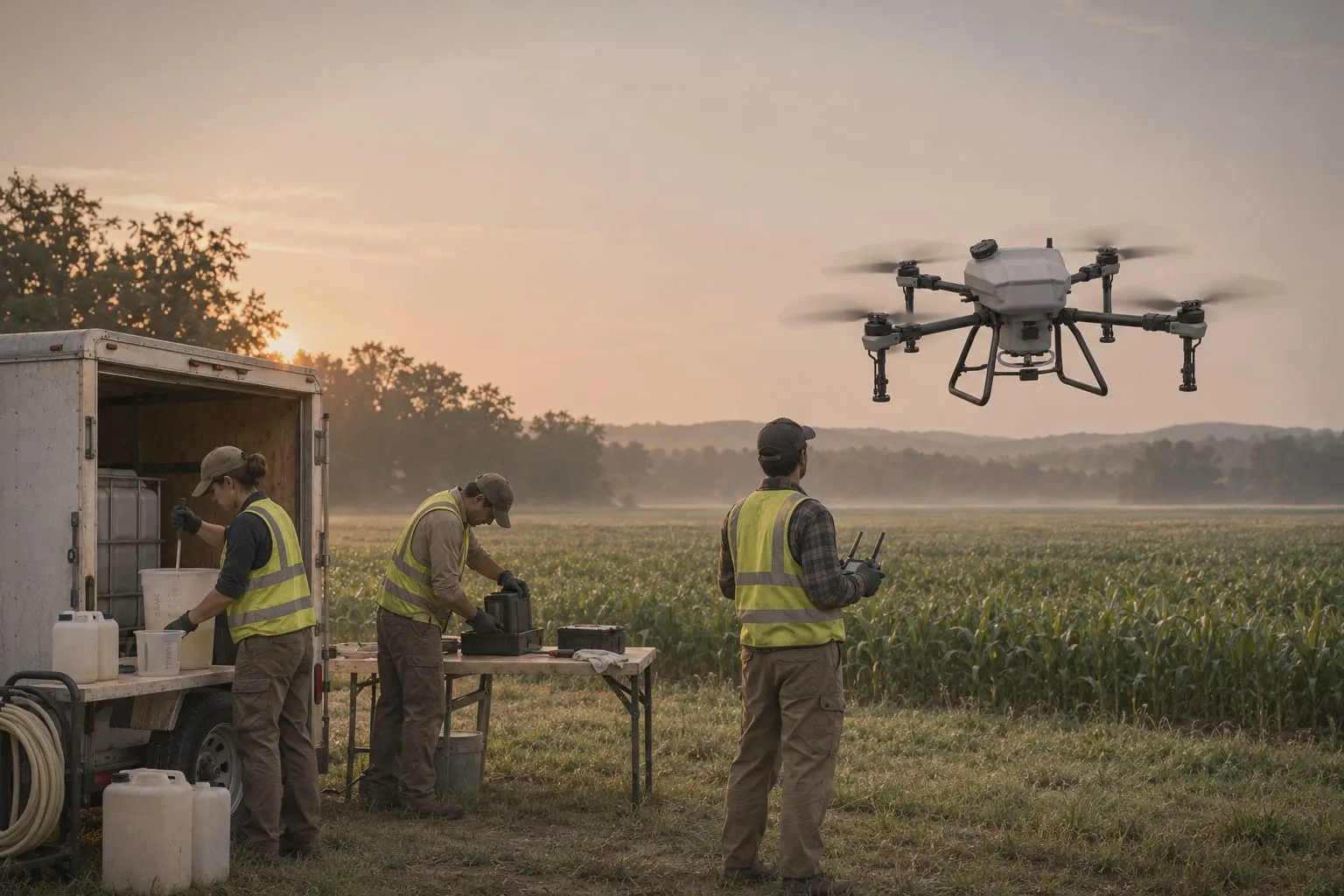
- Pilot: plans the mission, flies and watches the spray pattern and wind.
- Observer or helper: keeps the drone and field in view; stands where the spray and rotor wash do not reach.
- Mixer-loader: prepares and loads the product; Purdue advises pre-mixing in a large tank, a closed mixing system if you can and gloves at least.
- Driver or tender: moves the generator, water and trailer between fields.
- Technician: batteries, charging, cleaning, daily checks and small repairs.
- Leader: takes orders, plans routes and weather, keeps the work record and talks to the client.
How long is a working day for a spray drone crew?
| Time item (hours) | Contractor model | Farm model |
|---|---|---|
| Spraying | 6.5 | 6 |
| Driving | 2 | 1 |
| Cleaning | 1 | 0.5 |
| Other, non-spraying | 1.72 | 0.83 |
| Paid day | about 11.2 | about 8.3 |
| People | 2 | 1 |
Kentucky Extension adds a unit of work: 4 minutes for take-off, landing and moving, and 2 minutes between flights. The Missouri contractor model flies 52 sorties a day; the farm model 24. A short battery life (5–15 minutes with a full tank, says Ohio State) makes spare packs and fast charging part of crew planning: see how many batteries.
What shifts and weather rules should the crew follow?
The task force whose guidance UC Agriculture and Natural Resources summarises advises winds of 3–10 mph (about 1.3–4.5 m/s), subject to the label, and no spraying in a temperature inversion. Plan each day’s shifts around the forecast, and use the hours when conditions are wrong for charging, cleaning and moving between fields. Purdue also notes the need to cool generators and batteries in heat, generator noise, and that down time is lost money.
How much do drone spray pilots earn?
The Bureau of Labor Statistics shows US$ 21.38 an hour on average for pesticide sprayers (vegetation, May 2023); Missouri’s contractor model uses US$ 30. Example: 3 people × 11 h × US$ 30 = US$ 990 a day; over 39 spraying days that is US$ 38,610, the wage line in the business plan. Replace it with your local wage.
What safety jobs belong on site?
Brazil’s rule is a good checklist: a warning sign at the site, a fire extinguisher, soap and water, a first-aid kit, hospital and poison-centre numbers, protective equipment and reflective vests for everyone. The UC guidance adds briefing the crew on communication and emergencies, stopping if people enter the field, waiting for the rotors to stop, and keeping gloved hands off phones and controller screens because batteries and landing gear carry residue.
How does training fit?
Each pilot needs the regulator’s certificate, and in Brazil even the remote applicator who helps needs the CAAR. See pilot training. Dealers who sell a full set can add a crew plan and hand-over training: see the dealer programme, the Agri 100 and the Agri 50.
Questions dealers ask
- How many people does a drone spraying crew need?
- Two per drone is the safe minimum: pilot and helper. Two large drones can work with three people if mixing and driving are shared; four small ones with about five. Where an observer is required per drone, as in the US without a waiver, count two people per machine.
- What does each crew member do?
- The pilot flies and watches the spray. The helper or observer watches the drone and field. The mixer-loader prepares and loads the product. The driver or tender moves equipment and water. A technician handles batteries and repairs. The leader plans jobs and keeps records.
- How long is a working day for a spray drone crew?
- About 11 hours in Missouri's contractor model: 6.5 spraying, 2 driving, 1 cleaning and 1.72 other time. The farm model is 6 + 1 + 0.5 + 0.83 hours. Our business plan uses 11 paid hours.
- How much do drone spray pilots earn?
- There is no drone-specific figure in the sources we checked. The nearest US series is pesticide sprayers, about US$ 21 an hour in May 2023, and Missouri's contractor budget uses US$ 30. Use your local wage.
- Does a spotter have to be certified?
- In the US the second person is a visual observer required by the rules unless a waiver says otherwise; check the FAA for the current requirement. Brazil asks the remote applicator who assists the pilot to hold the CAAR certificate.
References
- [1]The Evolution of Spray Drones: current challenges (PPP-154). Purdue Pesticide Programs.
- [2]The Evolution of Spray Drones: operational setup in the field (PPP-154). Purdue Pesticide Programs.
- [3]G1274 Economics of Drone Ownership for Agricultural Spray Applications. University of Missouri Extension.
- [4]AEN-174 Drone Sprayer Sizing for Agricultural Applications. University of Kentucky Cooperative Extension.
- [5]Best practices for safe and effective drone spraying. UC Agriculture and Natural Resources.
- [6]Portaria MAPA nº 298, de 22 de setembro de 2021. Ministério da Agricultura e Pecuária (Brazil).
- [7]Occupational Employment and Wages, May 2023: 37-3012. U.S. Bureau of Labor Statistics.
- [8]Drones for Spraying Pesticides: Opportunities and Challenges. The Ohio State University CFAES.