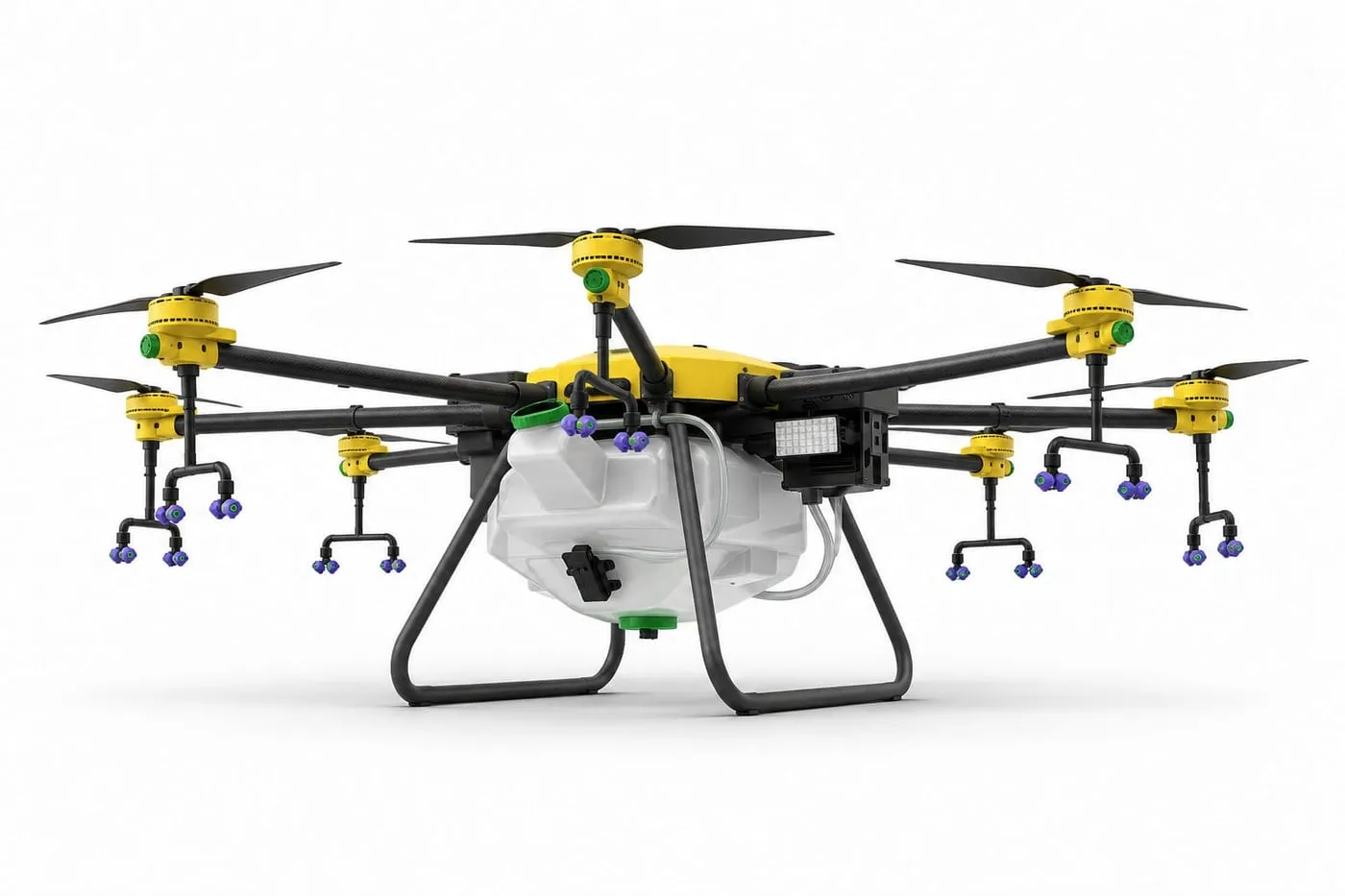
Short answer: Distributing agricultural drones in Mexico in 2026 is a port-to-field route with six stops: customs clearance through a customs broker, a radio approval enquiry at the CRT, AFAC online registration of each RPAS under NOM-107-SCT3-2019, customers using pesticides that carry a COFEPRIS registro sanitario, and your own parts and training. The first page of Google for this search is all Spanish-language dealers, so foreign makers and would-be distributors find no English guide that explains the route.
From port to field
| Step | Who | What to do | Note |
|---|---|---|---|
| 1 | Port | Land at Manzanillo or Lázaro Cárdenas | Two Pacific ports |
| 2 | Customs broker (agente aduanal) and ANAM | Customs entry, tariff code, duties and VAT | We quote none; your broker confirms |
| 3 | CRT, formerly IFT | Ask whether the radio link needs approval (homologación) | The IFT site is now a historical archive |
| 4 | AFAC | The operator registers each RPAS online (Appendix K of the standard) before operating | Entered in the Mexican Aeronautical Registry |
| 5 | COFEPRIS | The customer’s pesticides need a registro sanitario | Ask SENASICA about plant-health rules |
| 6 | You | Training, spare parts, a service desk | Several dealer pages in the results stress service and training |
What does NOM-107-SCT3-2019 require, in plain English?
It sets the requirements for flying remotely piloted aircraft in Mexican airspace. The Ministry of Economy’s PLATIICA system shows it as in force, published on 14 November 2019, effective 13 January 2020 and reviewed in 2024 with a conclusion of confirmation. AFAC is the competent authority, and its drone page says the online registration, through Appendix K, must happen before the first flight. For a dealer that means the buyer’s first task after payment is the AFAC registration, so put it first in your handover pack.
Which pesticides can customers spray?
Only products with a COFEPRIS registro sanitario. COFEPRIS says pesticides and plant nutrients need that registration, that the sites which make or formulate them need a sanitary licence, and that it also authorises the establishments that apply them where relevant. We could not confirm SENASICA’s exact role for pesticides, so ask it about plant-health requirements for your first crop.
Who handles radio approval now?
The CRT. The Federal Telecommunications Institute’s website now describes itself as a historical archive and sends visitors to the Comisión Reguladora de Telecomunicaciones for current procedures. The old site listed requirements for approving telecommunications equipment; whether a drone’s radio link needs them is a question for the CRT. Raise it before you ship, not at the port.
How does a local retail price compare with a dealer’s cost?
Example: one authorised dealer’s public prices for a leading brand (August 2026, VAT included) set beside our reference FOB ranges. They are different brands and kit contents, so the table shows scale, not a like-for-like offer.
| Class | Local dealer price | In US$ (25 Nov 2026 rates, for reference) | DEWKITE reference FOB |
|---|---|---|---|
| 100 L | MXN 556,000 | about US$ 28,700 | Agri 100: US$ 22,700–29,100 |
| 70 L | MXN 438,000 | about US$ 22,600 | Agri 72: US$ 15,400–16,400 |
| 50 L | MXN 289,000 | about US$ 14,900 | Agri 50: US$ 8,900–21,100 |
An importer’s gap has to pay for freight, duties, VAT, approvals, spares, training and its own margin, so read our profit margin example before you promise a retail price.
Which states come first?
Pick two using official data. SADER reported in March 2026 an initial purchase agreement of 1.1 million tonnes of Sinaloa maize, with buying from 13 March. FAO says the north-west, irrigated from reservoirs, is the key area for main-season wheat and secondary-season maize, that Tamaulipas is the key sorghum state and that main-season maize planting starts in April. The agricultural statistics service, SIAP, publishes planting and harvest progress by state.
In our November 2026 Google check, distributors appeared in several states, including Chiapas, and were mostly built around one leading brand. A second brand, large tanks and a parts shelf would be a way in. Our landed cost guide shows how to price it, and the dealer program describes the first order.