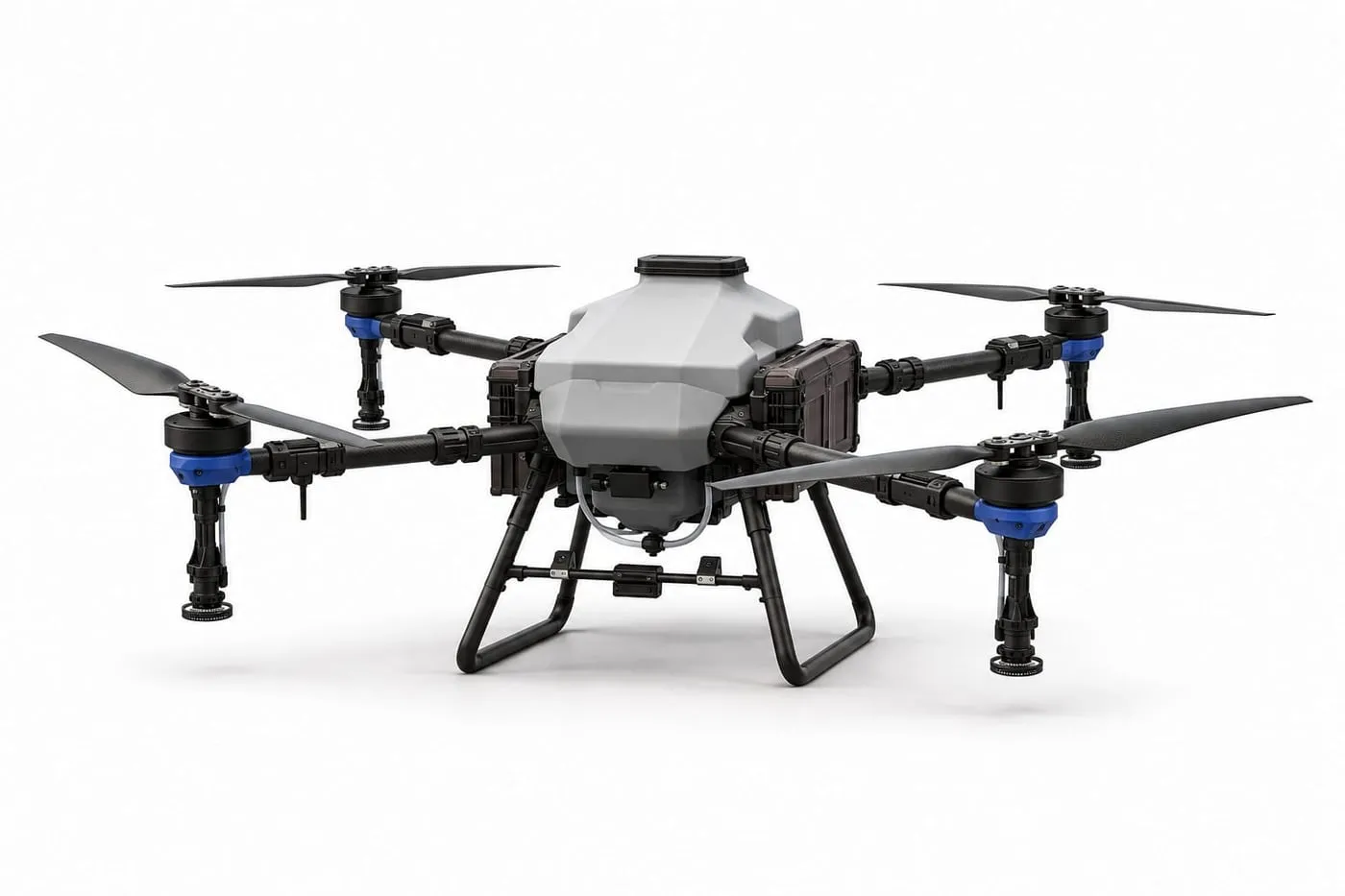
Short answer: Bolivia is a large-field soy market where the best entry is a service company or dealer in Santa Cruz with 60–100 L drones, importing through Pacific ports. Check the DGAC drone rules and SENASAG pesticide rules first, then plan a first year of one demo unit, contract spraying and a first order of two to four drones.
What does the first year look like?
The year below is example planning, not a forecast. Season dates are set by the crop calendar, so confirm them with local growers.
| Step | Example timing | What happens |
|---|---|---|
| 1 | Months 1–2 | Check DGAC rules, register the company, agree a clearing agent |
| 2 | Months 2–4 | Order one demo drone plus batteries and nozzle spares; ship to a Pacific port |
| 3 | Months 4–5 | Pilot training, field demonstrations on two or three farms |
| 4 | Next soy season | Paid contract spraying; learn the real hectares per day |
| 5 | After the season | Review results, order two to four more drones and a parts kit |
Parts matter more than tank size. A farm that waits three weeks for a nozzle will not recommend you, so stock a parts kit from day one; see spare parts.
Who is buying agricultural drones in Bolivia?
The buyers are large soy and grain farms and the contractors who serve them. The soy sector had about 1.55 million hectares in 2024, grew roughly 3% a year over the previous decade and produced about 5 million tonnes a year, according to the Anapo figures reported by Los Tiempos. The same report gives a yield of 1.30 t/ha against about 3 t/ha in Brazil and Argentina, and a goal of 12 million tonnes by 2033. A yield gap that large is the argument for timely, accurate spraying.
Soy brought in about US$978 million in 2024, which is 12% of total exports, and employs about 120,000 people directly and indirectly. These figures show a sector large enough to support specialist service companies.
What fuel and cost pressure do farmers face?
A 2026 report on a diesel shortage says Santa Cruz needs about 3 million litres of diesel a day to harvest soy from 950,000 hectares and plant another 400,000. For a drone dealer the point is simple: an electric aircraft that sprays a field in a morning is easier to schedule than a ground sprayer waiting for fuel. Do not promise it as a cure, though; farms still need charging power, so quote a generator and battery plan.
What do DGAC and SENASAG require?
The aviation authority is the DGAC. It published bulletin BR 108/2026 on the use and operation of unmanned aircraft systems on its website. In 2019 the same authority described an earlier draft with registration, a 122 m (400 ft) altitude cap and 150 m separation from buildings; that was a draft and not today’s text, so read the 2026 bulletin and ask the DGAC about aerial work with a spraying drone.
Pesticides are controlled by SENASAG, whose Resolution 03/2022 approves the regulation for the registration and control of chemical pesticides for agricultural use. Use only registered products and follow the product label and local rules. Whether a drone operation needs further SENASAG approval, confirm with SENASAG.
How do drones reach a landlocked country?
Bolivia has no coast, so cargo moves through neighbours. In the University of Navarra summary of port statistics, Chilean ports handled 74.4% of Bolivian export tonnage in 2018 and about 63% in 2020, while Peruvian ports grew from 7.4% to 13.3% and the Paraguay–Paraná river route carried about 1.37 million tonnes of exports in 2019. Shipping line MSC lists 21 free days for cargo in transit to Bolivia from 5 November 2025, counted Monday to Saturday. Duties and documents: confirm with your clearing agent.
How should a dealer start in Bolivia?
Best for a first Bolivian partner:
- Agri 100: a 100 L tank and 35 ha/h work rate for big soy blocks; US$22,700–29,100 FOB.
- Agri 60 / 60H: about 60 L at about 25 ha/h; the hybrid H version suits places where field charging is scarce.
- Agri 50: 50 L and 22 ha/h, easy to move between farms; US$8,900–21,100 FOB.
The dealer program explains samples, training and parts. Neighbouring Paraguay has a similar soy economy; see Paraguay.