Guides
Vineyard Spraying by Drone in 2026: Slopes, Canopy and Service Pricing
Does drone spraying fit terraced vineyards? 2026 guide to slope work, trellis and canopy limits, droplet size, an example price per ha and first customers.
- Prepared by
- DEWKITE Sales Team
- Published
- Reading time
- 4 min
- Sources
- 4
Key takeaways
- 1Drone spraying suits terraced and sloped vineyards best where tractors are slow or cannot go, especially soon after rain.
- 2A 2025 study of terraced vineyards found drone spraying not very suitable for vertical-shoot-positioned (VSP) trellises but a good alternative on Y-shaped trellises.
- 3Droplet size and flight height decide canopy coverage, so test on the grower’s own rows before you promise anything.
- 4As a planning example, a vineyard service at US$ 45 per hectare, eight sprays a season on 60 ha, brings in about US$ 21,600.
- 5First customers are growers with slopes, small estates that cannot afford a tractor sprayer, and estates that need a fast response after rain.
Contents
Short answer: Vineyard spraying by drone works best on terraced or sloped blocks and soon after rain, and it works better on Y-shaped trellises than on VSP trellises. As a planning example, a service at US$ 45 per hectare with eight sprays a season on 60 ha earns about US$ 21,600 a season. Test coverage on the grower’s own rows before you promise results.
What does a vineyard spraying service earn?
Here is how a small contract service might add it up. Every figure is an example, so swap in your own quotes.
| Item | Example value | Note |
|---|---|---|
| Area under contract | 60 ha | Several small growers |
| Sprays per season | 8 | Depends on disease pressure and region |
| Service price | US$ 45 per hectare | Chemical supplied by the grower |
| Revenue per season | 60 × 8 × 45 = US$ 21,600 | |
| Effective work rate on terraces | 3 ha per hour | Far below the table rate because of slopes, turns and refills |
| Flying hours | 480 ÷ 3 = 160 h | |
| Revenue per flying hour | about US$ 135 |
The 3 ha/h is our assumption. The spec tables list 8–12 ha/h for the Agri 30 and 22 ha/h for the Agri 50 in open fields, and terraces will come in well below those.
A sanity check on the price: Missouri Extension costs one owned drone at roughly US$ 12.27 an acre when it treats 1,000 acres in a year (University of Missouri Extension). Converted, that is near US$ 30 a hectare for open-field work, so treat it as a floor and not as a vineyard quote.
Do drones fit sloped vineyards?
They often do. DJI’s Romanian case study describes a slope where tractors struggle after rain and where water sources are far away; it reports that a tractor covers 4–5 ha a day against much more for a drone, and that a drone can start two to three hours after rain while a tractor must wait at least two days (DJI Agriculture). These are the manufacturer’s own figures, so treat them as a guide and not a guarantee.
The practical advantages are speed on slopes, no wheel damage on wet soil and low water use per hectare. The limits are battery and refill logistics on steep, narrow terraces, and the need for a clear flight route around poles, wires and trees.
Is canopy penetration good enough?
This is the main question growers ask. A 2025 study in Plants compared drone spraying with manual knapsack spraying in high-slope terrace vineyards with two trellis systems (Plants, MDPI). Its findings:
- On VSP trellises manual spraying gave the largest droplet area, and the authors call drone spraying not very suitable there.
- On Y-shaped trellises the drone gave smaller droplets, higher droplet density and better uniformity and penetration than manual spraying.
- Two drone passes gave droplet area statistically similar to manual spraying.
So the answer depends on the trellis. A dealer should ask the grower what system they use before quoting.
Which droplet size and drone fit a vineyard?
Droplet size, flight height and speed all change deposition. Our machines list adjustable atomising: 110–400 μm on the Agri 30 and 30–500 μm on the Agri 50 (two centrifugal nozzles). Smaller droplets cover more leaf surface but drift more, so keep to the product label, local wind limits and buffer rules.
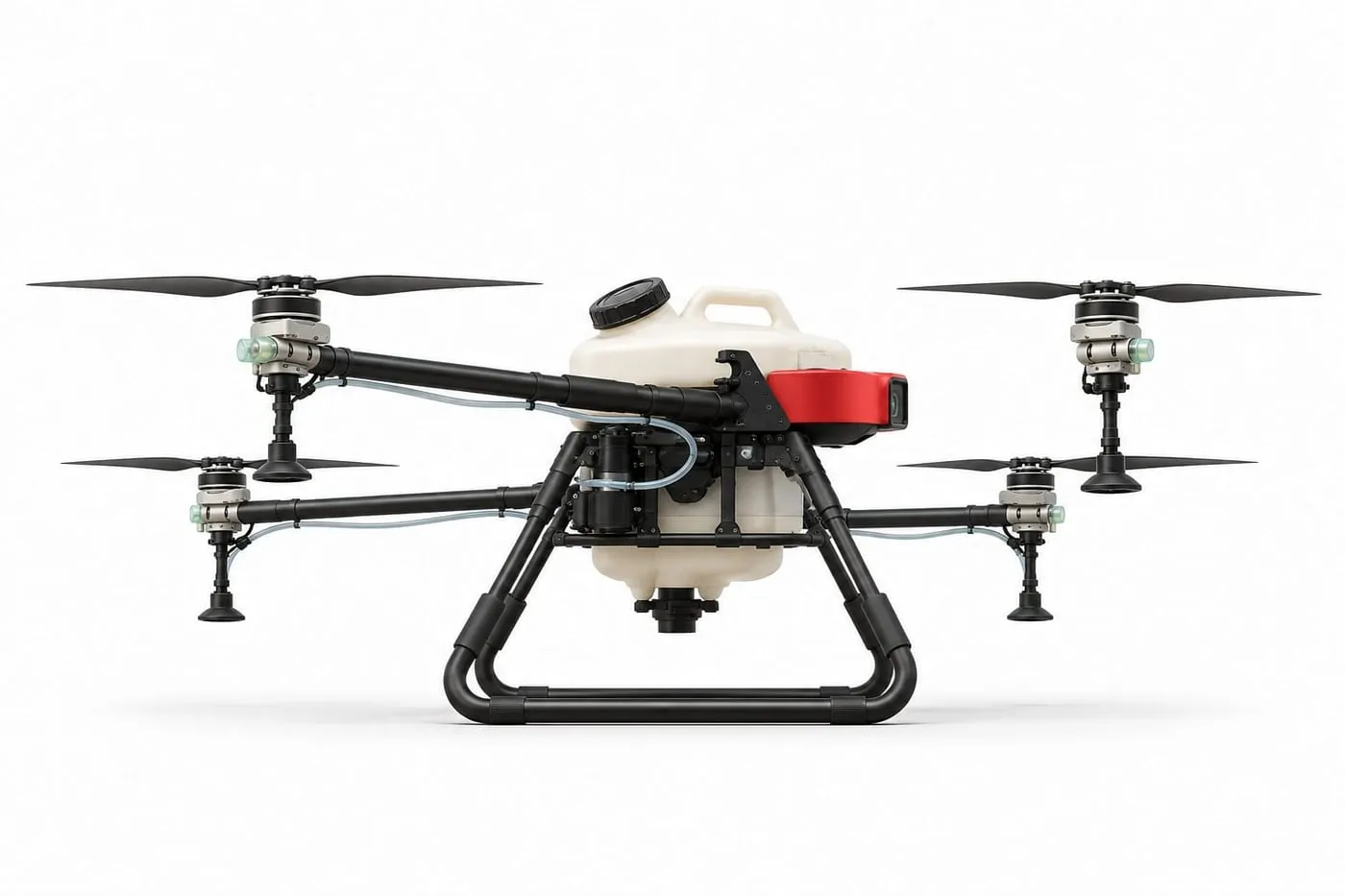
Best for narrow terraces and small plots: Agri 30, a 30 L machine that folds small enough to lift out of a pickup by hand.
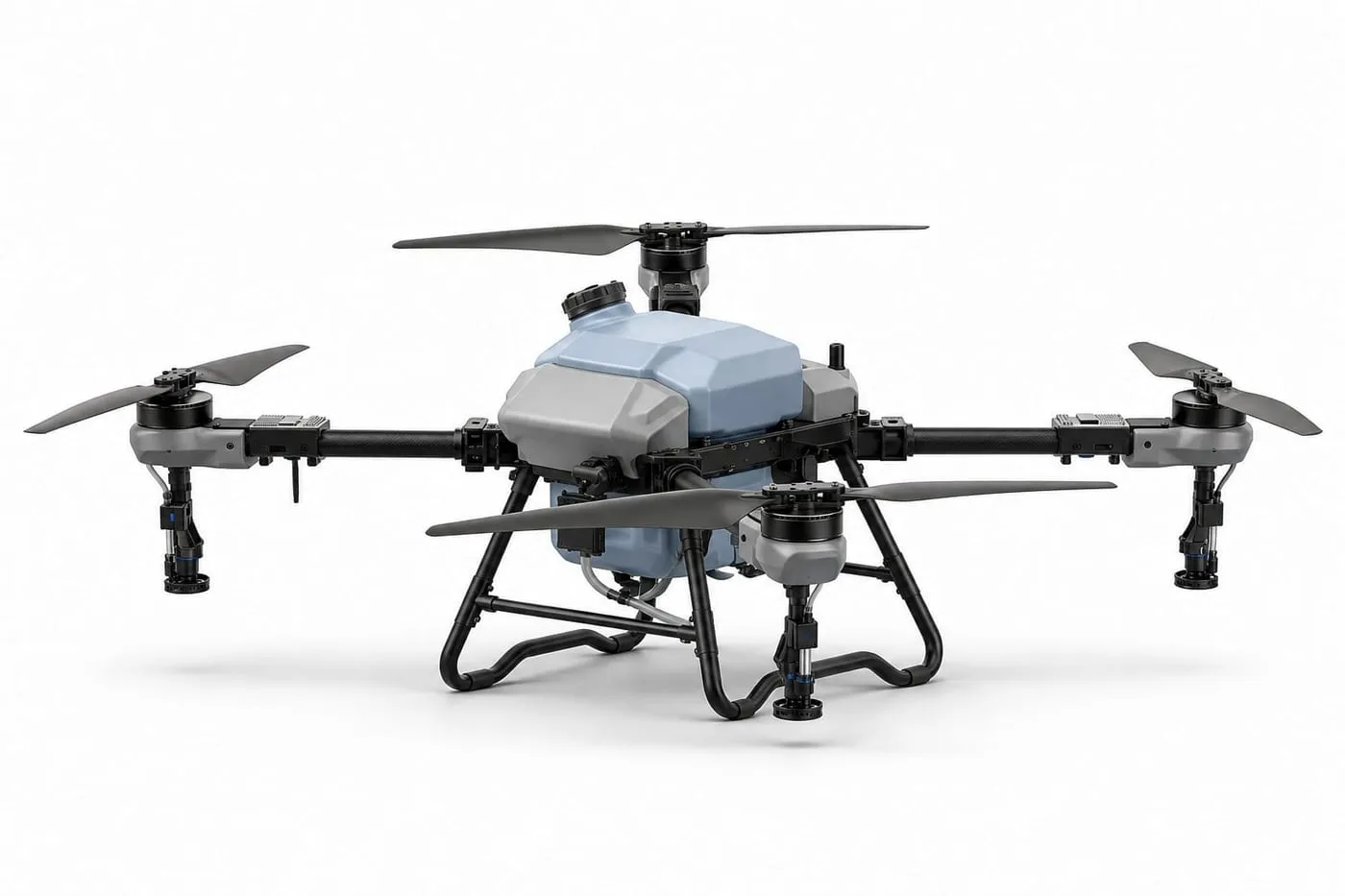
Best for estates with longer rows and several blocks: Agri 50, whose 50 L tank means fewer refills per hectare.
Read wind limits for drone spraying and nozzle selection before you set up a trial.
Where does a dealer find the first vineyard customers?
- Growers on slopes where tractor spraying is slow or unsafe.
- Small estates with no tractor sprayer of their own.
- Co-operatives that can book a contract service for many members.
- Winery agronomists who run trial blocks and write the spray programme.
Offer a free trial pass on one block, measure coverage with water-sensitive paper, and give the grower the result. That single document sells more than a brochure. See also best drones for orchard spraying, spraying cost per hectare and our dealer programme.
What about rules?
Pesticide use, flight approvals and operator licences vary by country, and in the wine regions of many countries they are strict. Follow the product label and local rules, and check the civil aviation authority before you sell a service.
Questions dealers ask
- Can a drone spray a vineyard?
- Yes, with limits. A drone covers sloped or wet ground quickly, but canopy penetration depends on the trellis, droplet size and flight setting. Run a trial pass on the grower’s block and check coverage on both sides of the leaves.
- How much does vineyard drone spraying cost?
- There is no single price. Large-field studies give a useful floor: a University of Missouri model puts the cost of owning and operating one drone at about US$ 12.27 per acre (about US$ 30 per hectare) at 1,000 acres a year. Vineyards need slower, more careful work, so service prices are higher. Our planning example uses US$ 45 per hectare.
- Is drone spraying suitable for VSP trellises?
- A 2025 study of terraced vineyards found it not very suitable for VSP trellises, while Y-shaped trellises did better. Check the trellis before you sell the service.
- What size of drone is best for a vineyard?
- Many terrace owners start with a 30–50 L machine because it folds small and moves easily between plots. A larger drone suits flat estates with long rows. Match the machine to field size and road access.
- Can I spray right after rain?
- Often yes. DJI’s Romanian case study says a drone can start two to three hours after rain, while a tractor needs at least two days on slopes. Always follow the product label and local rules on weather and re-entry.
References
- [1]Spraying Effects of UAV Application on Droplet Effectiveness in Two Vine Trellis Systems of High-Slope Terrace Vineyards. Plants (MDPI), 2025.
- [2]Grape Vineyard Farming with DJI Agriculture Drone Solutions. DJI Agriculture.
- [3]Transforming Vineyard Spraying in Romania with Drone Technology. DJI Agriculture.
- [4]Economics of Drone Ownership for Agricultural Spray Applications (G1274). University of Missouri Extension.