Guides
Wind and Weather Limits for Drone Spraying in 2026: Rules of Thumb and Lost Days
How much wind is too much for drone spraying: label limits, university guidance, temperature and humidity, and how many workable days to plan per month.
- Prepared by
- DEWKITE Sales Team
- Published
- Reading time
- 3 min
- Sources
- 5
Key takeaways
- 1A drone that can fly in strong wind is not allowed to spray in it: the pesticide label and local rules set the spraying limit, and extension services often advise stopping above 10 mph (about 16 km/h).
- 2University of Georgia Extension says XR-type nozzles are for calm conditions, wind below 4–5 mph (about 6–8 km/h).
- 3Drift rises in four conditions: strong wind, gusts, hot and dry air, and calm inversion air.
- 4For a business plan, assume lost days and write them down: 4 to 12 per month in the example table, as planning assumptions, not statistics.
- 5Fly the manufacturer's wind rating for safety and the label for spraying; the lower of the two wins.
Contents
Short answer: The wind limit for spraying is not the wind rating of the drone. It comes from the pesticide label, local rules and drift risk. Extension guidance advises stopping above about 10 mph (16 km/h) and keeping XR-type nozzles to winds under 4–5 mph (6–8 km/h). For planning, assume lost days every month.
The lost-days account first
A drone business sells hectares, so weather turns into money. The example below assumes 6 flying hours a day at 20 ha/h. All lost-day numbers are planning assumptions, not statistics.
| Climate (example) | Lost days per month | Workable days | Hectares per month |
|---|---|---|---|
| Dry, steady climate in the main season | 4 | 26 | 3,120 |
| Mixed climate with showers | 8 | 22 | 2,640 |
| Wet season with frequent rain and gusts | 12 | 18 | 2,160 |
Hectares = workable days × 6 h × 20 ha/h. Moving from 26 to 18 days costs 960 ha a month; at US$ 14/ha that is about US$ 13,400 a month of revenue (example). Put the lost-day line in the business plan, not just the drone price.
How windy is too windy for spraying?
Start with the label. Purdue Extension notes that labels rarely carry drone-specific volumes, heights or droplet sizes, and that a label saying “Do not apply this product using aerial equipment” rules out drone application. Where labels are silent, University of Georgia Extension gives practical guidance: avoid spraying when wind exceeds 10 mph, watch direction, and avoid inversions or sensitive crops downwind. It adds that XR nozzles belong in calm conditions, below 4–5 mph.
Penn State Extension notes that early research found more drift from drone applications than from ground sprayers. The Crop Protection Network says drone fungicide spraying may drift even at low wind speeds. So the safe limit is often lower than the number you remember.
Can you fly a drone in 25 mph wind, and should you spray?
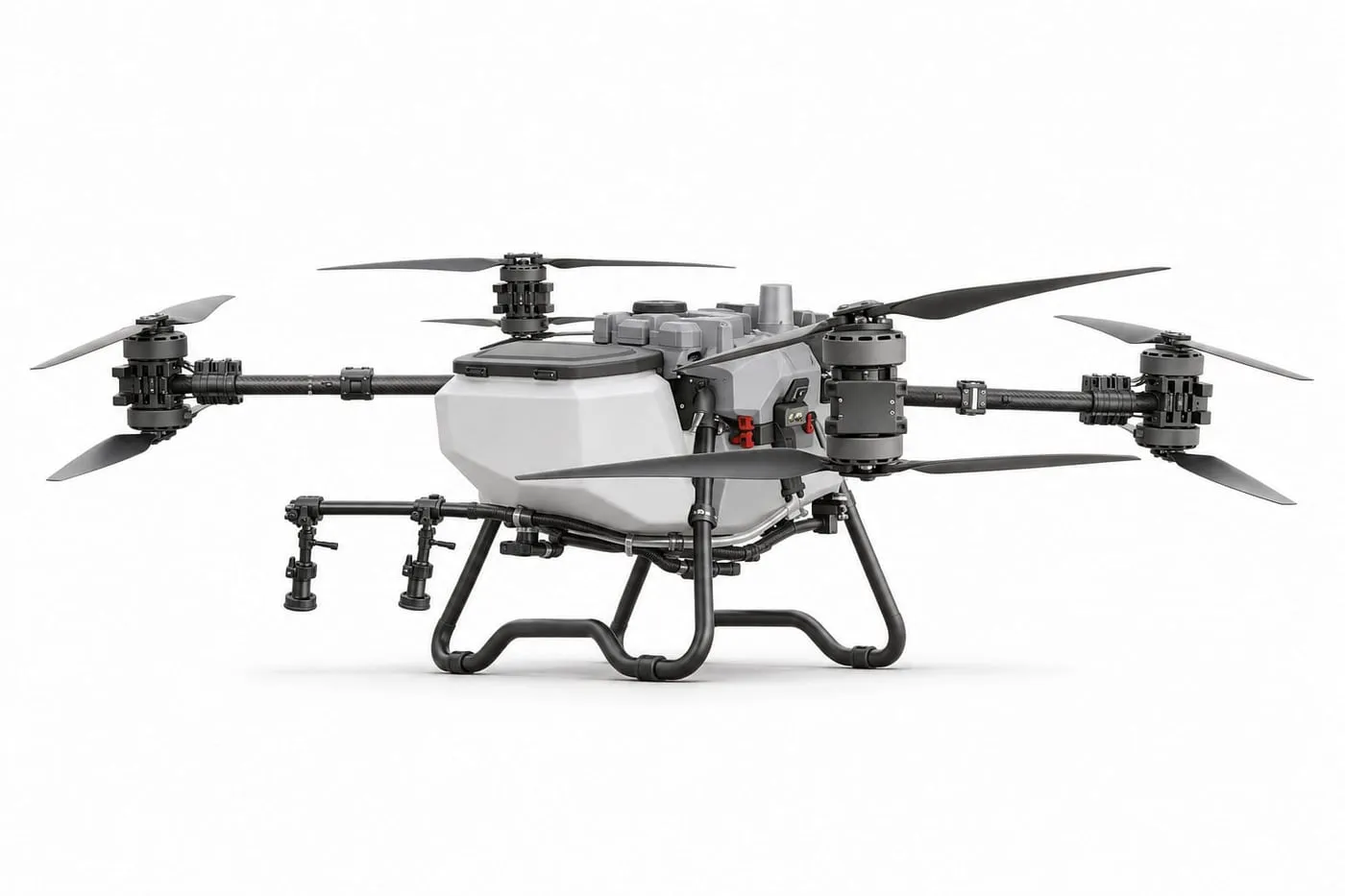
You may be able to fly. Agri 150 lists a wind-resistance rating of 25 knots (46.3 km/h); Agri 50 is rated for safe take-off and landing up to Beaufort level 6; the Clean 65 up to level 7. These are flight ratings. They tell you the drone will not fall out of the sky, not that the spray will land on the crop. Alabama Extension notes seed drift also rises sharply in wind, even with modern drones.
What else raises drift?
Sprayers101 lists the conditions where drift potential increases:
- Calm air with an inversion, where droplets hang and move later
- Wind that is too strong
- Gusty or changing wind
- Hot, low-humidity air, which makes droplets evaporate
Its practical fixes: slow the flight, use coarser droplets (UGA mentions 250–320 µm as a common range for rotary atomisers), raise volume, lower the altitude and stop when wind blows toward sensitive areas. Always follow the label and local rules.
What should a dealer tell customers?
Best for a safe spraying routine:
- Carry a hand-held anemometer. Check wind at spraying height before every load.
- Write the stop rule on the job sheet, such as “stop above 10 mph or when gusts change the swath”.
- Spray early or late, but check for inversion.
- Keep a weather log; after one season it becomes your own lost-day figure.
Match the machine to the days you have: a big drone such as Agri 100 covers more in each workable window. See the business plan guide, the cost per hectare and the dealer program.
Questions dealers ask
- How windy is too windy for spraying with a drone?
- No one number applies everywhere. Read the label and your local rules first. University of Georgia Extension suggests not spraying above 10 mph (about 16 km/h), and running XR-type nozzles only in winds under 4–5 mph.
- Can you fly a drone in 25 mph wind?
- Some drones are rated for it: the Agri 150 lists a wind-resistance rating of 25 knots (46.3 km/h). That is a flight-safety figure. Spraying in 25 mph would break most labels and cause drift.
- Is calm air best for spraying?
- No. Calm air can mean a temperature inversion, when fine droplets hang in the air and move away later. Light, steady wind blowing away from sensitive crops is usually better than dead calm.
- Does heat matter?
- Yes. Sprayers101 lists hot, low-humidity air as a drift risk because droplets evaporate. Spray early or late, use coarser droplets and raise volume.
- How many days a month can a drone sprayer work?
- It depends on climate and season. Plan with an explicit lost-day assumption (see the table) and test it against your first season's logbook.
References
- [1]Pesticide application considerations with spray drones. University of Georgia Extension.
- [2]Best Management Practices for Safe and Effective Pesticide Application using Drones. Sprayers101.
- [3]Herbicide Applications with Drones: Stay On-Label and On-Target. Penn State Extension.
- [4]Pesticide Labels: A Quandary for Clear Guidance (PPP-154). Purdue Extension.
- [5]Best Practices for Foliar Fungicide Applications with Spray Drones. Crop Protection Network.