Guides
Agricultural Drones for Cooperatives: Ownership and Service Models (2026)
Should a cooperative own a spray drone, hire a contractor or use a dealer-run service? 2026 comparison with a 500-member example, financing routes and sizing.
- Prepared by
- DEWKITE Sales Team
- Published
- Reading time
- 4 min
- Sources
- 7
Key takeaways
- 1A cooperative has three routes: own the drone and fly it with its own pilot, hire a spraying contractor and pay by the hectare, or let a dealer run a service point for members.
- 2Start with the arithmetic: members' hectares × spray rounds per season decides how many machines and flying hours you need.
- 3Example: 500 members with 1.5 ha each and three spray rounds need about 2,250 ha of spraying a season, which two drones in the 50 L class can fly if windows are not tight.
- 4Shared machines fail mostly through poor maintenance, so name a responsible person, a repair fund and a booking rule before you buy.
- 5Financing comes from member capital, loans or leases, government schemes (India's SMAM and Namo Drone Didi are examples) and aid projects; check your own country.
Contents
Short answer: A cooperative has three routes in 2026: own the drone and fly it with its own pilot, hire a spraying contractor and pay by the hectare, or let a dealer run a service point for members. Decide with arithmetic first: members’ hectares times spray rounds per season gives the flying hours you must buy or hire. In our example, 500 members need about 2,250 ha of spraying a season, which two 50 L-class drones can fly.
How many drones does a cooperative of 500 smallholders need?
Example numbers only: replace them with your members’ records. Output uses our planning rule of effective swath × 1.08 ha an hour (see the output guide).
| Step | Calculation | Result |
|---|---|---|
| Members and area | 500 members × 1.5 ha | 750 ha |
| Spray rounds in a season | 3 rounds | 2,250 ha of spraying |
| Output of one 50 L-class drone | 8 m swath × 1.08 × 6 hours a day | about 52 ha a day |
| Flying days needed | 2,250 ÷ 52 | about 43 days |
| Days available | Three 10-day windows | 30 days: 2 drones |
| Price to members | US$ 12 a ha × 2,250 ha | US$ 27,000 |
| Running cost (pilot, fuel, batteries, wear) | US$ 6 a ha | US$ 13,500 |
| Surplus | 27,000 − 13,500 | US$ 13,500 |
| Two sets at the US$ 14,030 landed example | 2 × 14,030 | US$ 28,060, repaid in about 2 years |
The range for 500 members with 1–2 ha each is 500–1,000 ha and 1,000–3,000 ha of spraying. A US cooperative’s published plan shows the other extreme: US$ 15 an acre (about US$ 37 a hectare) and a break-even of 8,156 acres (about 3,300 ha) a year to cover a US$ 122,344 budget with a salaried pilot. Your cost base will differ; do your own sums.
Should a cooperative buy a drone, hire a contractor or use a dealer service?
| Cooperative owns | Hires a contractor | Dealer-run service point | |
|---|---|---|---|
| Who pays | Members, loan or subsidy | Members, per hectare | Members, per hectare or yearly fee |
| Who flies | A trained member or salaried pilot | The contractor | The dealer’s pilots |
| Who maintains | Co-op technician or dealer contract | The contractor | The dealer |
| Member price | Set by the board; members pay less than outsiders | Contract price per ha | Agreed with the dealer |
| Main risk | Idle machine, poor maintenance, one pilot | Late service when everyone sprays at once | Dependence on one dealer; ask for a backup machine |
| Fits | Large membership, one crop calendar | First season, small area | A middle route |
In Iowa State’s 2025 farm poll, 37 % of farmers who used drones got the service through a retailer or cooperative, so cooperatives are already a main channel.
What rules keep a shared drone working?
FAO’s booklet on farmer-to-farmer hire services notes that groups gain buying power but that poor maintenance and repair are the usual dangers of shared machinery. Write these down before purchase:
- Booking order and priority in the spray window
- A named maintenance person and a repair fund, for example a fixed fee per hectare
- Who holds the pilot and operator authorisation
- Pesticide label checks and spray records for every job
- What non-members pay
How can a cooperative finance a spray drone?
| Route | How it works | Note |
|---|---|---|
| Member capital or a per-hectare levy | Members fund the purchase | Slow, but no interest |
| Loan or lease | Bank or dealer finance | Missouri found a drop in interest from 9 % to 7 % cut a farmer’s cost by US$ 0.97 an acre |
| Government scheme | Subsidy on purchase or hiring | India’s SMAM: 40 % up to 4 lakh rupees for custom hiring centres run by cooperatives, and up to 75 % for farmer-group demonstrations. Namo Drone Didi: 15,000 women’s groups, 80 % central grant, the rest through a loan with 3 % interest support |
| Aid or donor project | Tender for equipment and training | See our tender guide |
Schemes differ by country and change over time; ask your agriculture ministry.
Which size should a cooperative choose?
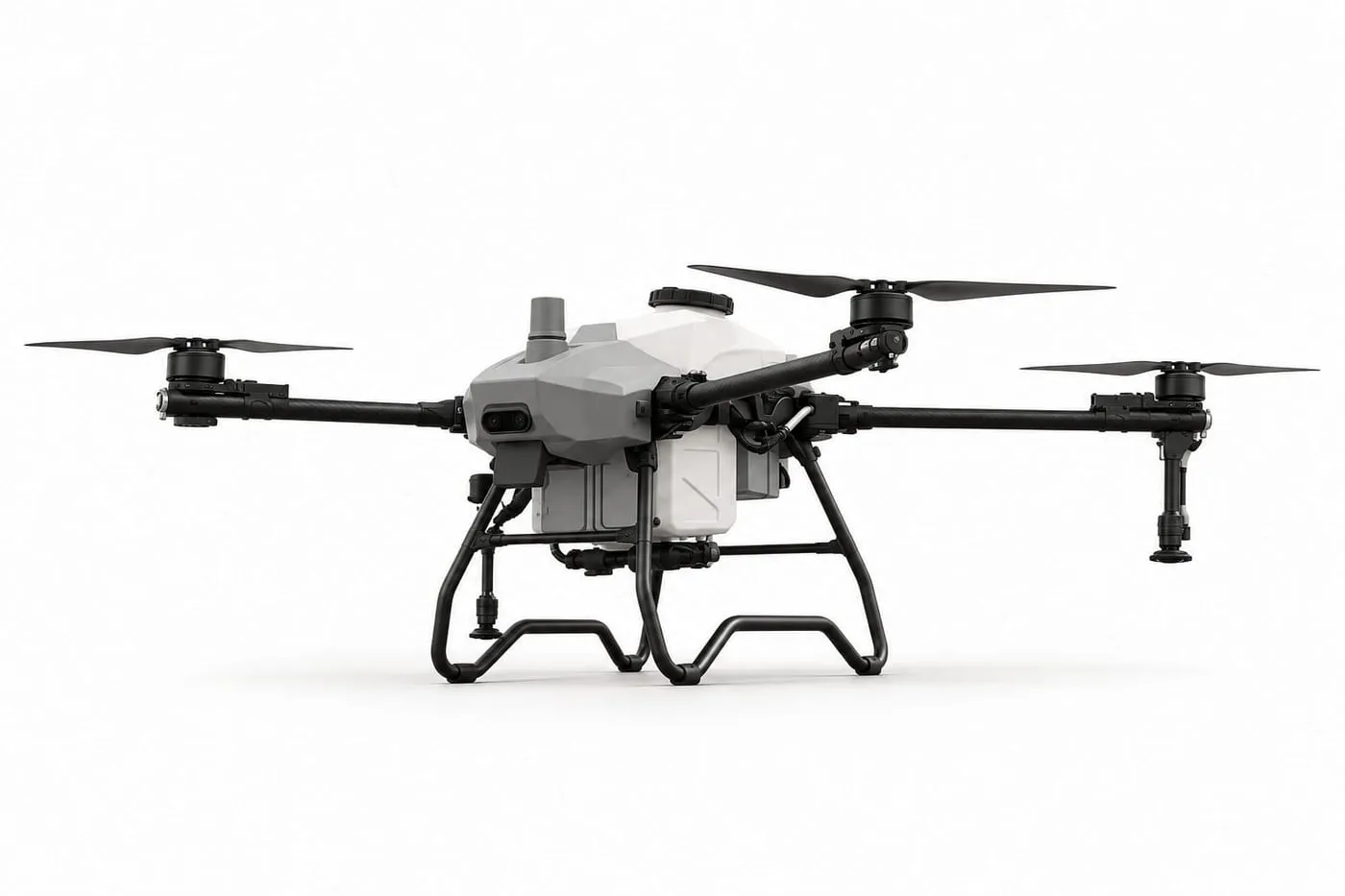
Match the plots, not the brochure. Small terraces and orchards: Agri 30 (30 L, 6–9 m swath) or Agri 10 / 20. Flat, joined-up land: Agri 50 (50 L, 8–20 m). Large merged farms: Agri 100. Spec-sheet rates of 8–12 ha an hour (Agri 30) and 22 ha an hour (Agri 50) are upper bounds; plan with the swath rule above. If a dealer will run the service, ask about our dealer program.
Questions dealers ask
- What is a good agricultural drone for a cooperative of small farmers?
- Usually a 30–50 L machine. Small terraces and orchards suit the Agri 30 or Agri 10 / 20; flat, joined-up land suits the Agri 50 or Agri 65. Choose by the plots your members actually farm, not by tank size alone.
- Should a cooperative buy a drone or hire a spraying service?
- Hire first if members' land is small or the first season is a test. Buy once the spraying work covers the machine, a pilot and a repair fund, and someone can look after it every day of the season.
- How much do people charge for drone services?
- It varies by country, crop and volume. Missouri Extension cites about US$ 16 an acre (about US$ 39.5 a hectare) for custom drone application in the US; use your local rate in the example.
- How can a cooperative finance a spray drone?
- Member capital or a per-hectare levy, a loan or lease, a government scheme or an aid project. In India, SMAM paid 40 % (up to 4 lakh rupees) for custom hiring centres run by cooperatives, and Namo Drone Didi covers 80 % of cost for selected women's groups.
- Who flies and maintains a cooperative-owned drone?
- A trained pilot, ideally two, plus a named person for maintenance with a dealer service contract behind them. Put the licence holder, the booking rules and the repair fund in writing.
- What is the price of a 50 litre agricultural spraying drone?
- The Agri 50 is listed at US$ 8,900–21,100 FOB per set (public reference range, 2026). Batteries and configuration move the figure, and the quotation fixes it.
References
- [1]Country Partners Cooperative Drone Business Plan (published plan, PDF). Nebraska Public Service Commission (hosting).
- [2]Hire services by farmers for farmers (Diversification booklet 19). FAO.
- [3]Despite growth, Iowa farmers remain uncertain about drones. Farm Progress (reprinting Iowa State University Extension).
- [4]Agriculture Ministry to provide grant up to Rs. 10 lakhs for purchase of drones. Press Information Bureau, Government of India.
- [5]PIB press release, 13 December 2022. Press Information Bureau, Government of India.
- [6]Namo Drone Didi (PIB document, November 2024). Press Information Bureau, Government of India.
- [7]G1274 Economics of Drone Ownership for Agricultural Spray Applications. University of Missouri Extension.