Guides
Rubber Plantation Drone Spraying in 2026: Tall Trees, Disease and the Business Case
Drone spraying in rubber plantations in 2026: what drones do on 20 m trees, disease timing, an estate contract example and cases from Thailand and Indonesia.
- Prepared by
- DEWKITE Sales Team
- Published
- Reading time
- 4 min
- Sources
- 5
Key takeaways
- 1Drones can spray the top of rubber trees that ground crews cannot reach, which is why Thailand and Vietnam have run field tests on rubber leaf diseases.
- 2A DJI case in Kon Tum, Vietnam, reports 8 ha of powdery mildew spraying in 8 hours by two pilots, about twice as fast as manual spraying, on trees around 20 m high.
- 3The spray window is short: powdery mildew attacks young leaves, so control starts when new leaves are breaking, with repeat rounds.
- 4In our example, one 150 L aircraft working 1,500 hectare-passes pays back in about 1 season at US$ 40/ha but takes nearly 5 seasons at US$ 20/ha, so the fee decides the case.
- 5Ask any supplier what the "maximum flight altitude" on the sheet means before you promise a job over 20 m trees.
Contents
Short answer: Drone spraying in rubber plantations in 2026 is a foliar-spray service for tall trees, timed to new-leaf disease windows, and it pays when the fee per hectare is high enough. A Vietnamese case reports 8 ha in 8 hours on trees about 20 m high, and in our example a 150 L aircraft pays back in about 1 season at US$ 40/ha but nearly 5 seasons at US$ 20/ha. Figures are examples to test, not promises.
The business account first: one estate contract
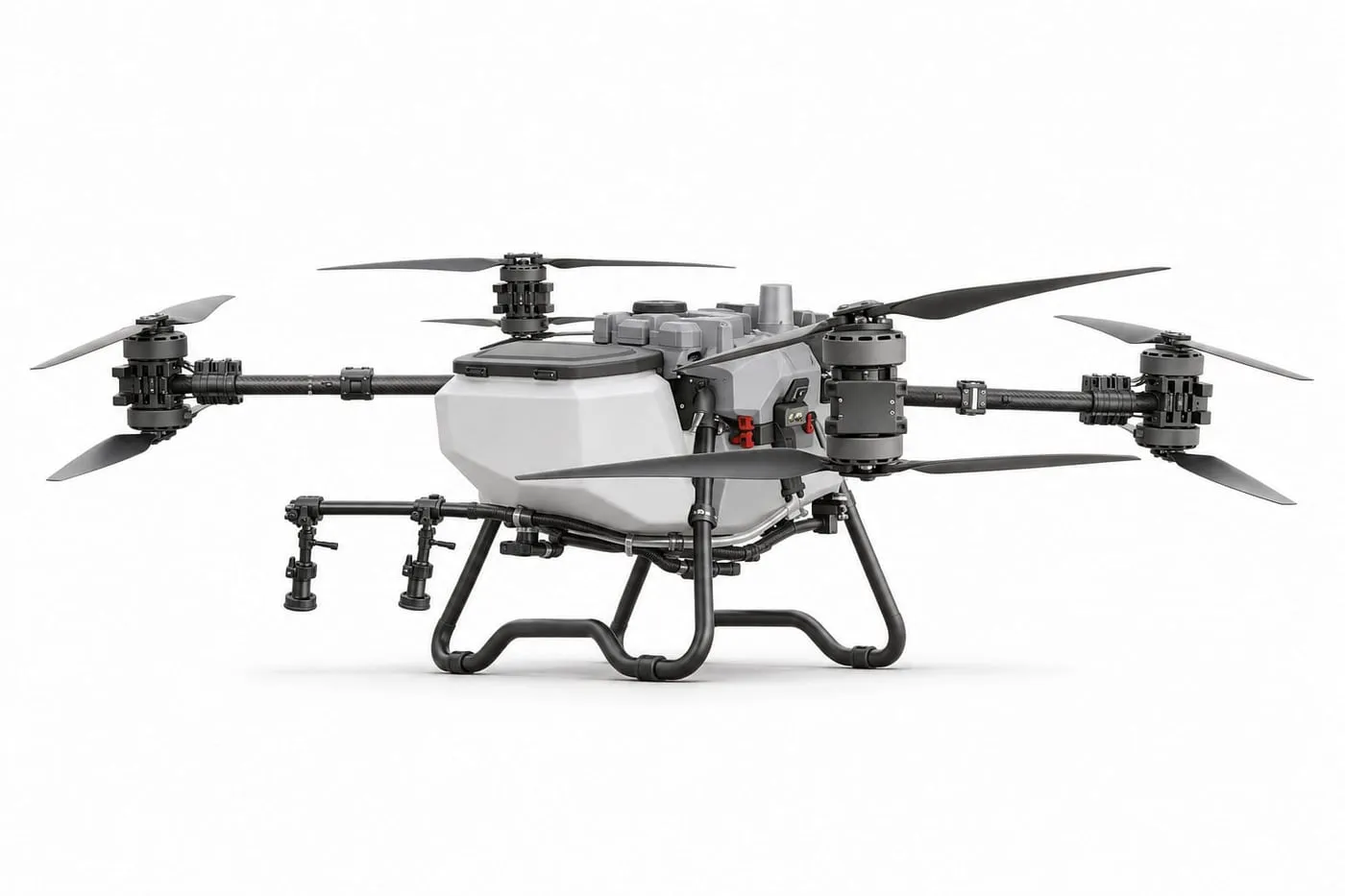
Example assumptions: an estate of 500 ha, 3 spray rounds in the new-leaf period, so 1,500 hectare-passes. One Agri 150 (listed US$ 28,900–34,800 FOB) plus batteries, generator, freight and training: US$ 40,000. Work rate: 3 ha an hour, 7 hours a day = 21 ha a day, three times the 1 ha an hour in the Vietnamese case, because a 150 L load is far bigger than that case’s machine. Working days = 1,500 ÷ 21 ≈ 72. Crew, power and travel: US$ 300 a day, so US$ 21,600.
| Fee per hectare | Revenue | Margin after day costs | Payback |
|---|---|---|---|
| US$ 20 | US$ 30,000 | US$ 8,400 | about 4.8 seasons |
| US$ 30 | US$ 45,000 | US$ 23,400 | about 1.7 seasons |
| US$ 40 | US$ 60,000 | US$ 38,400 | about 1.0 season |
Payback in seasons = start-up cost ÷ margin. The fee is an assumption: find local quotes first. At a low fee, one estate is not enough, so plan a customer list across several estates.
Can you spray rubber trees with a drone?
Yes for foliar work, and public cases exist. In 2019 the Rubber Authority of Thailand ran a one-week trial against a leaf blight, with two drones each carrying 10 litres and covering 32 hectares; the deputy governor called it a better and cost-effective way. In Kon Tum, Vietnam, a DJI case describes two pilots and one Agras T30 spraying 8 ha at 120 L/ha against powdery mildew. This is a vendor case study, not an independent trial, and the tree height was about 20 m.
Drones do not tap trees or collect latex. They carry out spraying and leaf-care jobs, plus mapping with a camera drone. Check that the product is registered for aerial application and follow the product label and local rules.
What is the maximum tree height a spray drone can work over?
Do not guess. The Agri 150 and Agri 100 sheets list a maximum flight altitude of 20 m or less. Ask the supplier whether this is height above the ground or above the take-off point, whether terrain-following radar works over a canopy, and what spray height above the leaves gives a good droplet pattern. Run a test on your own trees before you quote an estate, and record the coverage on water-sensitive paper or a dye test.
When should rubber be sprayed against disease?
Powdery mildew attacks young leaves, so the window opens when new leaves break. Kerala Agricultural University advises sulphur dusting on mature trees in 3–5 rounds at weekly to fortnightly intervals, starting at bud break when about 10 % of trees are refoliating, at 11–13 kg/ha of a 70:30 sulphur-talc mix per round. Those are Indian extension figures for dusting, not a drone recipe. In the Vietnamese case the spraying happened at the young-leaf stage, after tapping had stopped. Ask your national rubber research institute for the schedule for your clones.
Which countries look promising?
| Country | What a source says (example) | What to check next |
|---|---|---|
| Thailand | 2019 trial of two 10 L drones over 32 ha against leaf blight; the report says the blight could cut production by up to 50 % on affected trees | Current regulator rules, who pays for spraying |
| Indonesia | The agriculture ministry said at least 382,000 ha were affected by leaf disease in 2019, and smallholders hold 85 % of the area | Cooperative or group contracts for smallholders |
| Cote d’Ivoire | ANRPC expects it to become the third-largest producer and the country plans 500,000 more hectares by 2036 | Estate and farmer-group customers, local registration of products |
| Vietnam | Kon Tum case on powdery mildew, 8 ha in 8 hours | Tree height, slope and local operator rules |
How does a dealer build this business?
Sell one demonstration, then a contract. A dealer who trains a local spray team to a stated work rate has a better offer than a dealer who sells a box. Compare crop cases in palm oil plantation drone spraying, tea plantation drone spraying and banana plantation drone spraying, and read the dealer programme for what we offer from the first unit.
Questions dealers ask
- Can you spray rubber trees with a drone?
- Yes, for foliar jobs such as fungicide or leaf fertiliser, as shown by a 2019 Thai rubber authority trial and a Vietnamese case on powdery mildew. Follow the product label and local rules for any aerial application, and test spray coverage on your own trees.
- What is powdery mildew of rubber trees?
- It is a fungal disease of young rubber leaves and other immature tissue. Kerala Agricultural University describes it as a disease of young leaves that is controlled with sulphur or fungicide, and the timing follows the refoliation of the trees.
- When should rubber trees be sprayed for powdery mildew?
- A Kerala Agricultural University guide advises starting at bud break, when about 10 % of trees are refoliating, and repeating 3–5 times at weekly to fortnightly intervals. Your local rubber research institute gives the schedule that applies to your clones and climate.
- How do you price a drone contract for an estate?
- Multiply hectares by rounds to get hectare-passes, divide by hectares per day to get working days, then add crew and travel cost per day. Set the fee per hectare so that the margin covers the aircraft, batteries and a lost day in the rain.
- Which countries look promising for rubber drone services?
- Thailand, Indonesia and Cote d'Ivoire are large rubber markets with leaf disease and growth stories we found sources for. Treat each as an example to research, not as a ready market.
References
- [1]Drones enlisted to fight fungus blight in rubber heartland. Bangkok Post.
- [2]Two Times Faster Than Manual Spraying Method: Rubber Tree Powdery Mildew Solution With DJI AGRAS T30. DJI (vendor case study).
- [3]Plant disease threatens thousands of hectares of rubber plantations. The Jakarta Post.
- [4]Rubber (Hevea brasiliensis): powdery mildew. Kerala Agricultural University.
- [5]Beyond Cocoa, Rubber Drives Growth in Cote d'Ivoire's Agricultural Exports. Ecofin Agency.