Guides
Agricultural Drone Spare Parts List for Dealers (2026)
Which spare parts an agricultural drone dealer should stock in 2026: wear, repair and rare parts, with starter quantities for fleets of 5, 20 and 50 drones.
- Prepared by
- DEWKITE Sales Team
- Published
- Reading time
- 4 min
- Sources
- 3
Key takeaways
- 1Sort parts into three groups: wear parts (always used), common-repair parts (used after hard landings) and rare parts (flight controller, radar, GNSS).
- 2Most of a first-season parts budget should go to wear parts: propellers, nozzles, pump parts, filters and seals.
- 3Starter example: a dealer supporting 20 drones keeps about 40 propellers, 30 nozzle sets, 8 pumps and 4 arm sets on the shelf.
- 4Batteries are cycle-limited consumables; plan replacements from the rated cycle count of each model.
- 5Order parts with the drones; parts shipped alone later cost more per piece.
Contents
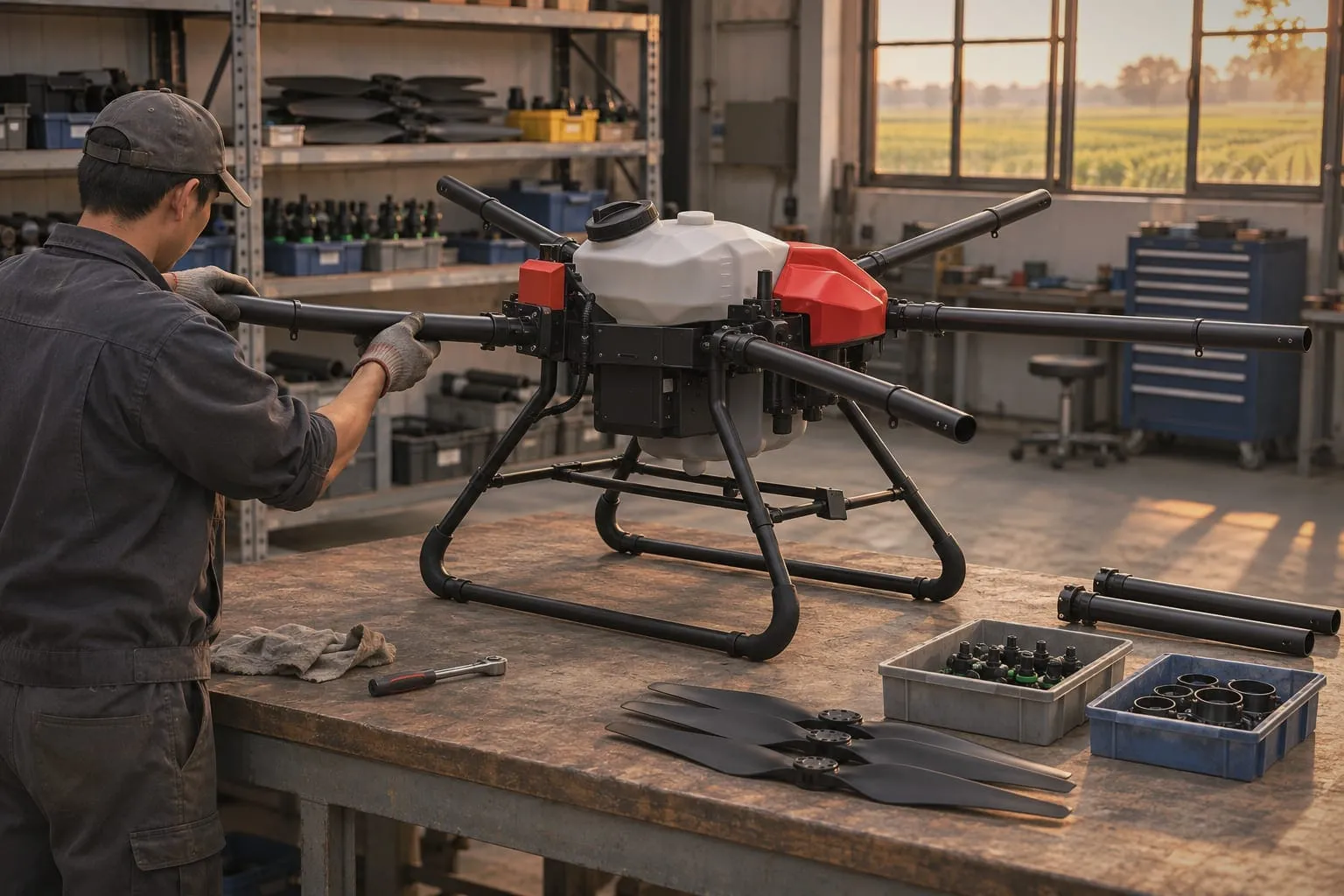
Short answer: An agricultural drone dealer’s spare parts list has three tiers: wear parts that every drone uses every season (propellers, nozzles, pump parts, filters, seals), common-repair parts for hard landings (arms, landing gear, motors, tank fittings) and rare parts (flight controller, radar, GNSS module). Put most of the first-season budget into the first tier and order it together with the drones.
Starter quantities by fleet size
The table shows a 2026 starting example for dealers supporting mixed fleets of 30–100 L drones. Adjust after the first season using your repair records.
| Part | Tier | 5 drones | 20 drones | 50 drones |
|---|---|---|---|---|
| Propellers (pairs, CW + CCW) | Wear | 12 | 40 | 90 |
| Nozzle sets or centrifugal discs | Wear | 8 | 30 | 70 |
| Pump or pump repair kit | Wear | 2 | 8 | 18 |
| Filters, seals, hoses (kits) | Wear | 5 | 20 | 45 |
| Arm assemblies | Common repair | 1 set | 4 sets | 8 sets |
| Motors | Common repair | 2 | 6 | 14 |
| Landing gear | Common repair | 1 | 4 | 8 |
| Tank and quick-connect fittings | Common repair | 2 | 6 | 12 |
| Complete bare frame | Rare | — | 1 | 2 |
| Flight controller, radar, GNSS module | Rare | — | 1 each | 2 each |
| Battery sets | Consumable | per model, see below |
Group the list by model you sell; parts rarely fit across drone sizes.
Why wear parts come first
Wear parts fail on every drone, every season, whether or not the pilot is careful. Propellers chip on dust and branches, nozzles clog or wear, and pump seals age in contact with chemicals. When a dealer runs out, a customer’s drone stands still in the spray window, the moment the customer can least afford it. These parts are also the cheapest, so a full shelf costs little.
Batteries: plan by cycles
Smart batteries are rated for a number of charge cycles. A drone flying 6 hours a day with full-load flights of 7–10 minutes runs through many cycles a week. Example: a drone doing 30 cycles a day for 60 spray days uses 1,800 cycles a season, spread across its battery sets. Divide by the rated cycle count of the model and you know how many sets to budget for replacement. Our Agri 10 / 20 batteries list 500 cycles; ask for the rating of each model you sell.
Batteries are dangerous goods in transport (Class 9), so order replacement sets with a drone shipment where you can.
Frames for the big repairs
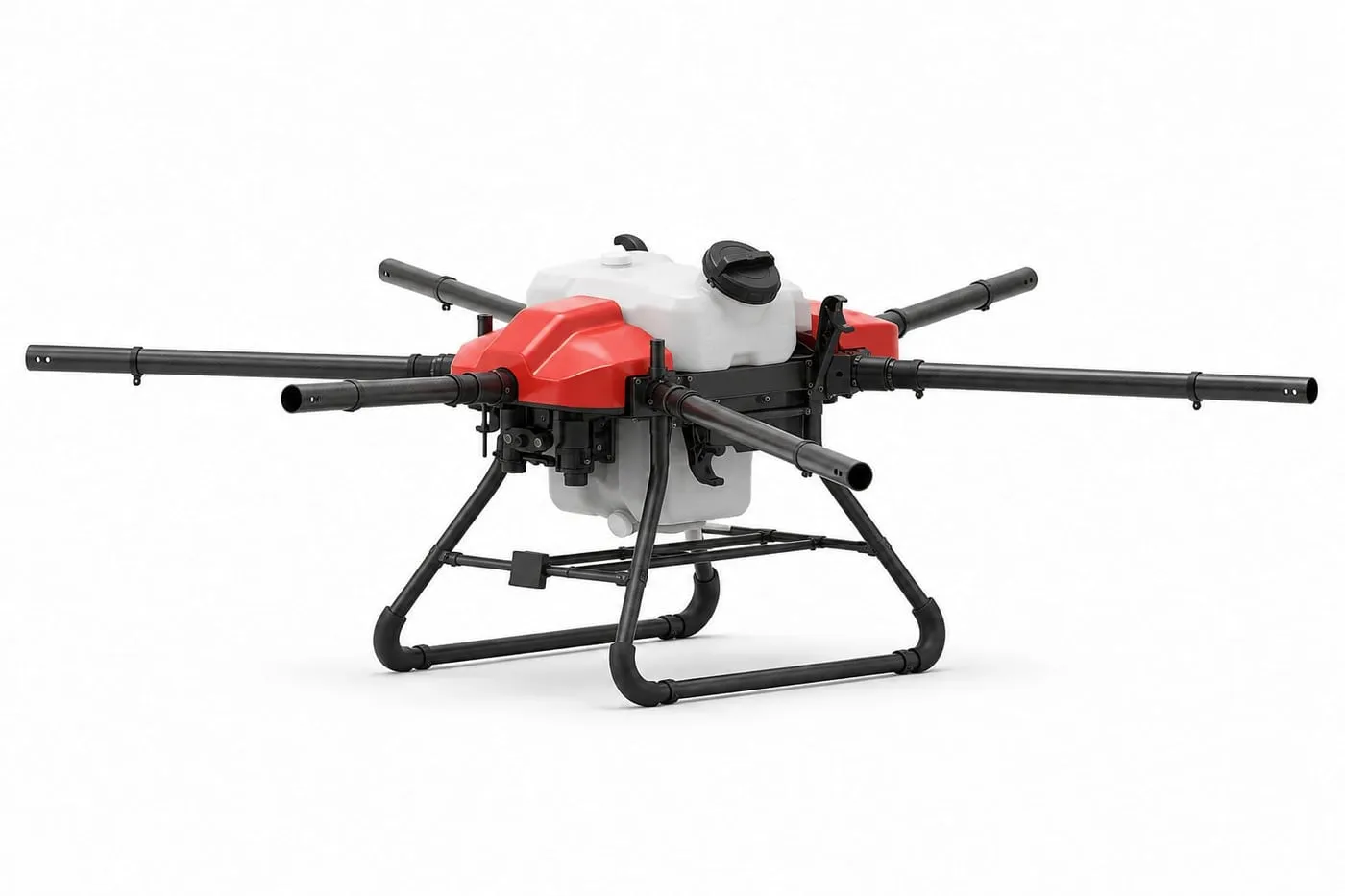
After a crash that bends the centre frame, rebuilding with a new frame is faster than straightening and replacing plates. DEWKITE supplies bare Frame 10, 20 and 30 for 10, 20 and 30 L class drones, for repairs and for dealers who build their own models.
The parts budget in the dealer account
| Fleet you support | Example first-year parts shelf (US$) | Share of drone value sold |
|---|---|---|
| 5 drones, 30–50 L | 4,000–6,000 | about 8–10 % |
| 20 drones, mixed | 14,000–20,000 | about 8–10 % |
| 50 drones, mixed | 30,000–45,000 | about 7–9 % |
These shares are planning examples. Parts sold to customers come back as margin; see our dealer profit margin example.
How to run the parts counter
- Label by model and tier. One shelf or bin per model, wear parts at hand height, rare parts locked away.
- Count after every repair. A simple spreadsheet with part, model, quantity and reorder point is enough for a small dealer.
- Set reorder points before the season. Sea freight takes weeks, so reorder wear parts when the shelf drops to about half, not when it is empty.
- Keep the broken parts for a week. Photos and the old part help the supplier confirm warranty cases and the right replacement.
- Sell parts kits, not single pieces. A “season kit” per drone (propellers, nozzles, filters, seals) is easier for customers to budget and keeps them coming back to you.
Ordering parts from DEWKITE
Tell us the model and, for older machines, send a photo of the part; we confirm it before shipping. With each first order we send a recommended list based on the models and fleet size, and the spare parts page lists batteries, chargers and accessories. New dealers start with our dealer program.
Questions dealers ask
- What spare parts wear out fastest on an agricultural drone?
- Propellers, nozzles and the parts of the pump and filters that touch chemicals. They are cheap individually, so keep plenty.
- How many batteries should a drone have?
- Most operators run two or three battery sets per drone so one flies while the others charge. Replace them according to the rated cycle count; our Agri 10 / 20 batteries, for example, list 500 cycles.
- Should a dealer keep complete frames in stock?
- For larger fleets, yes. After a bad crash a complete frame is faster than replacing arms and plates one by one, and the customer is flying again in days.
- Can I get a parts list for each model?
- Yes. DEWKITE sends a recommended parts list with each first order and adjusts it after the first season.
References
- [1]Drones for Spraying Pesticides – Opportunities and Challenges. The Ohio State University CFAES.
- [2]Lithium batteries. IATA.
- [3]G1274 Economics of Drone Ownership for Agricultural Spray Applications. University of Missouri Extension.