Guides
Spray Drone Battery Life in 2026: When to Replace Packs, and How Dealers Earn From Them
How many cycles does an agricultural drone battery last? 2026 guide to cycle life claims, replacement tests, storage and battery sales for dealers.
- Prepared by
- DEWKITE Sales Team
- Published
- Reading time
- 3 min
- Sources
- 5
Key takeaways
- 1Published cycle numbers disagree: 300–500 cycles to 80 % capacity from a battery maker (200–300 in field use), 1,000 cycles in a university cost example.
- 2The difference comes from chemistry, discharge rate, temperature and charging habits, so decide by a capacity test, not by a count alone.
- 3Replace or downgrade a pack when capacity falls below about 80 %, resistance rises or cells differ by more than 0.05 V (one dealer's rule of thumb).
- 4Example cost per hectare at US$ 1,000 per pack and 2.6 ha per cycle: US$ 1.92 at 200 cycles, 0.77 at 500, 0.38 at 1,000.
- 5For dealers, batteries are repeat income through replacement, capacity tests and fleet plans; follow the battery maker's storage rules.
Contents
Short answer: There is no single cycle-life number. A battery maker says 300–500 cycles to 80 % capacity, with 200–300 more typical in field use; a University of Missouri cost example budgets 1,000 cycles or five years. Decide by a capacity test, replace packs at about 80 % or lower, and treat batteries as a repeat income line for the dealership. Batteries are priced in our battery price guide; this page covers life, testing and storage.
What do the sources say about cycle life?
| Source | Figure | Note |
|---|---|---|
| Battery maker (CNS Battery) | 300–500 cycles to 80 % capacity; 200–300 in typical field use | Maker’s own claim |
| Battery maker, three stages | 0–100 cycles at peak; 100–300 lose 5–15 %; beyond 300 below 80 % with rising safety risk | Same source |
| University of Missouri example | Battery life 1,000 cycles or 5 years, whichever first | US cost model, 40 L class |
| Manufacturer’s price guide | Budget replacement at about 1,000 cycles | Manufacturer’s view |
The numbers differ because chemistry, discharge rate, heat and charging habits differ. Count cycles, but test the pack.
How do I decide a pack is finished?
| Test | Rule of thumb |
|---|---|
| Capacity | Around 80 % or below: downgrade to training use or replace |
| Cell gap | Gap above 0.05 V between cells after balancing: check or retire (one dealer’s rule) |
| Heat | Pack runs hot or swells: remove from use |
| Voltage sag | Drops early under load: capacity is gone |
| Contacts | Burn marks or loose pins: repair or replace |
The same dealer advises rotating three sets, landing at about 30 % and never running to the 20 % floor. Follow the maker’s manual first; our battery count guide shows how many packs a machine needs.
What is the battery cost per hectare?
Formula: pack price ÷ cycles ÷ hectares per cycle. Example: US$ 1,000 pack (see the battery price guide for real prices), and 2.6 ha per cycle, which converts the University of Missouri figure of 6.5 acres per charge for a US 40 L class machine. Use your own flight log instead.
| Cycles to replacement | Cost per cycle (US$) | Cost per hectare (US$) |
|---|---|---|
| 200 | 5.00 | 1.92 |
| 300 | 3.33 | 1.28 |
| 500 | 2.00 | 0.77 |
| 1,000 | 1.00 | 0.38 |
The Missouri model puts battery cost at US$ 0.72–1.72 per acre, about US$ 1.78–4.25 per hectare. Compare it with your fleet.
How should batteries be stored?
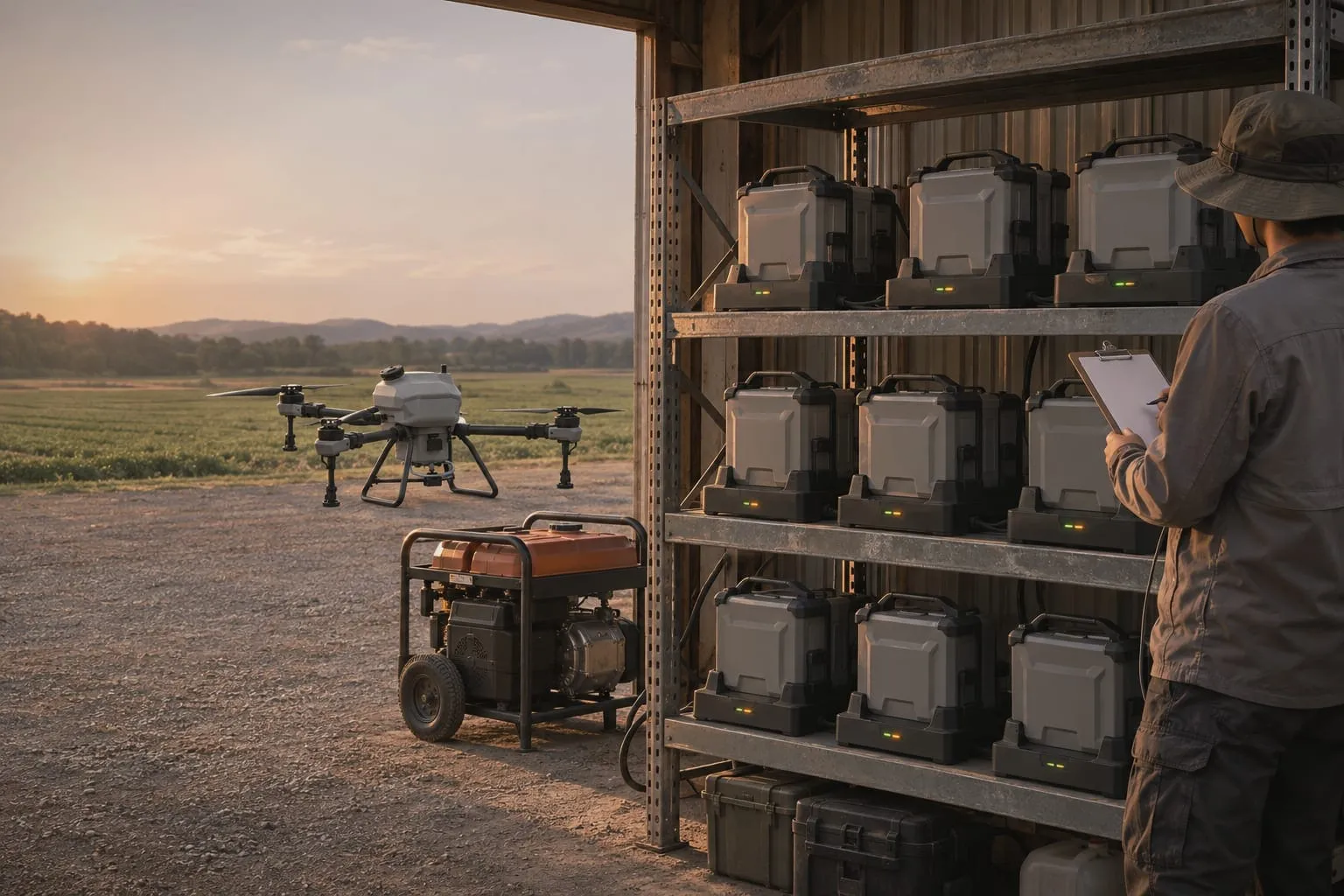
Do not keep packs hot or in the sun. Battery University says high temperatures speed permanent capacity loss; many manufacturers advise partial charge for long storage. Check your pack’s manual for the exact range. A DJI battery page notes that above 35 °C a pack may not allow two charge cycles in a row, so shade and plan rotation. Keep a fire-resistant storage cabinet in your workshop; see the service centre guide.
How do dealers earn from batteries?
Example: a customer base of 20 machines with 3 packs each holds 60 packs. At 100 cycles per pack per season and a 300-cycle life, about 20 packs are replaced each year. At US$ 1,000 and a 20 % margin that is about US$ 4,000 a year, plus capacity tests at an example US$ 10 each for 60 packs (US$ 600). Add a fleet plan, a bulk offer and return handling; see the battery transport guide for old packs.
For part lifespans see drone lifespan. The Agri 50 and Agri 100 battery supply is part of the dealer programme conversation.
Questions dealers ask
- How many cycles does an agricultural drone battery last?
- A battery maker says 300–500 cycles to 80 % capacity, with 200–300 more common in field conditions; a university example budgets 1,000 cycles or 5 years, whichever first. Use these as a range, and test your own packs.
- When should I replace a spray drone battery?
- When a capacity test shows around 80 % or less, when voltage sags under load, or when cells show a gap of more than 0.05 V after balancing. Swelling or damage means immediate removal.
- How should batteries be stored over winter?
- Follow the manual. General guidance from Battery University says heat accelerates permanent capacity loss, so keep packs cool and dry, away from sunlight, and stored at a partial charge. DEWKITE batteries follow the instructions supplied with them.
- Does heat affect charging?
- Yes. A DJI battery page notes that at ambient temperatures above 35 °C the pack may not allow two charge and discharge cycles in a row. Shade and rotate batteries in hot weather.
- Can a dealer make money selling batteries?
- Yes. Packs age, so customers replace them in cycles; dealers earn on replacement packs, capacity tests, fleet plans and returns handling. See battery transport rules for old packs.
References
- [1]Drone Battery Safety: Essential Battery Life Cycles for Plant Protection. CNS Battery (battery maker).
- [2]The Power of the Pack. Raptor Dynamic.
- [3]Agras T50 and T25 Battery Systems. DJI Agriculture.
- [4]G1274 Economics of Drone Ownership for Agricultural Spray Applications. University of Missouri Extension.
- [5]BU-702: How to Store Batteries. Battery University.