Guides
Heavy-Lift Agricultural Drones (50–150 kg Payload): A Buyer's Guide (2026)
What a heavy-lift agricultural drone is in 2026: payload classes from 50 to 150 kg, take-off weights, power and crew needs, rules by weight and where it pays.
- Prepared by
- DEWKITE Sales Team
- Published
- Reading time
- 4 min
- Sources
- 6
Key takeaways
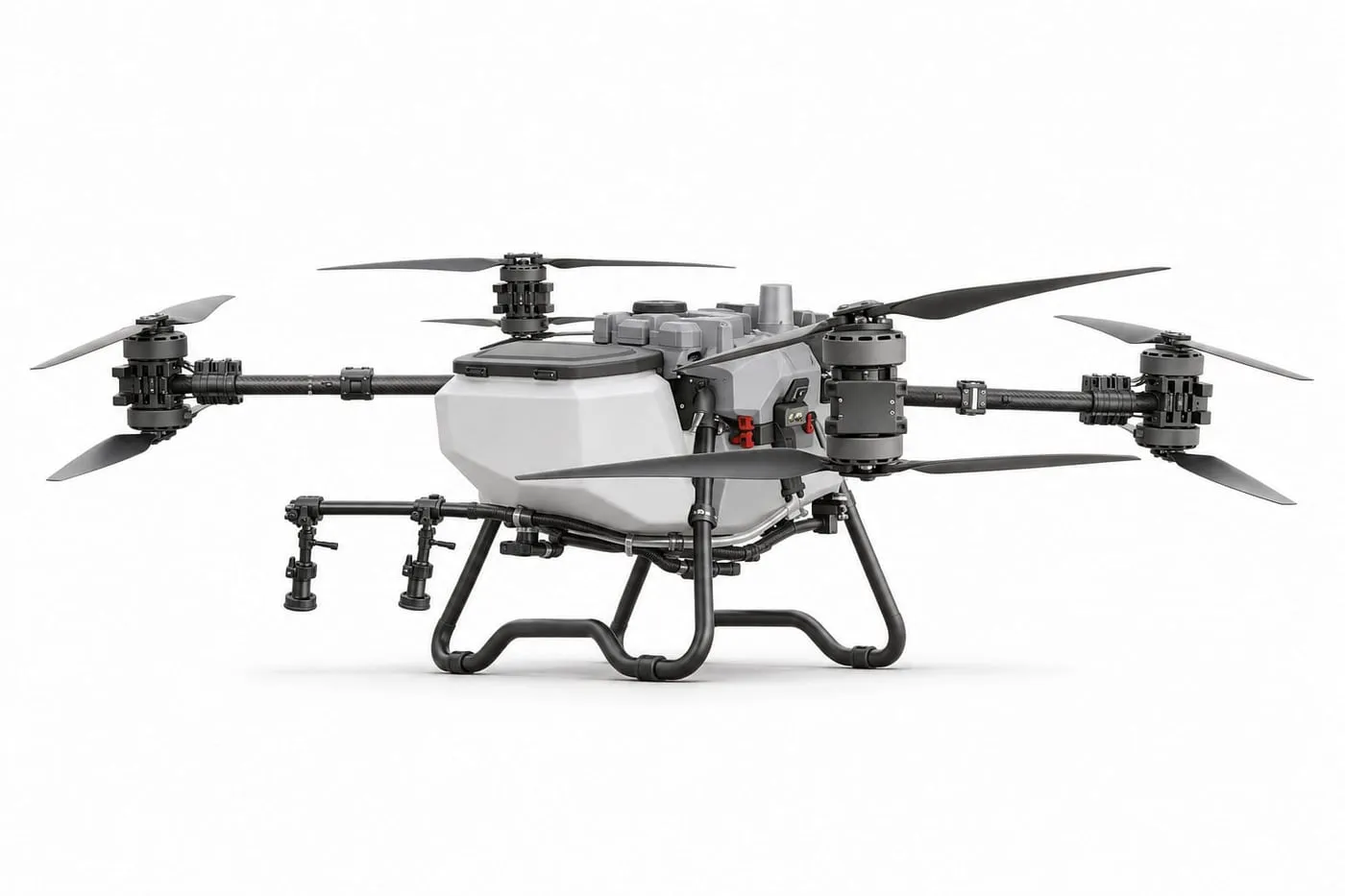
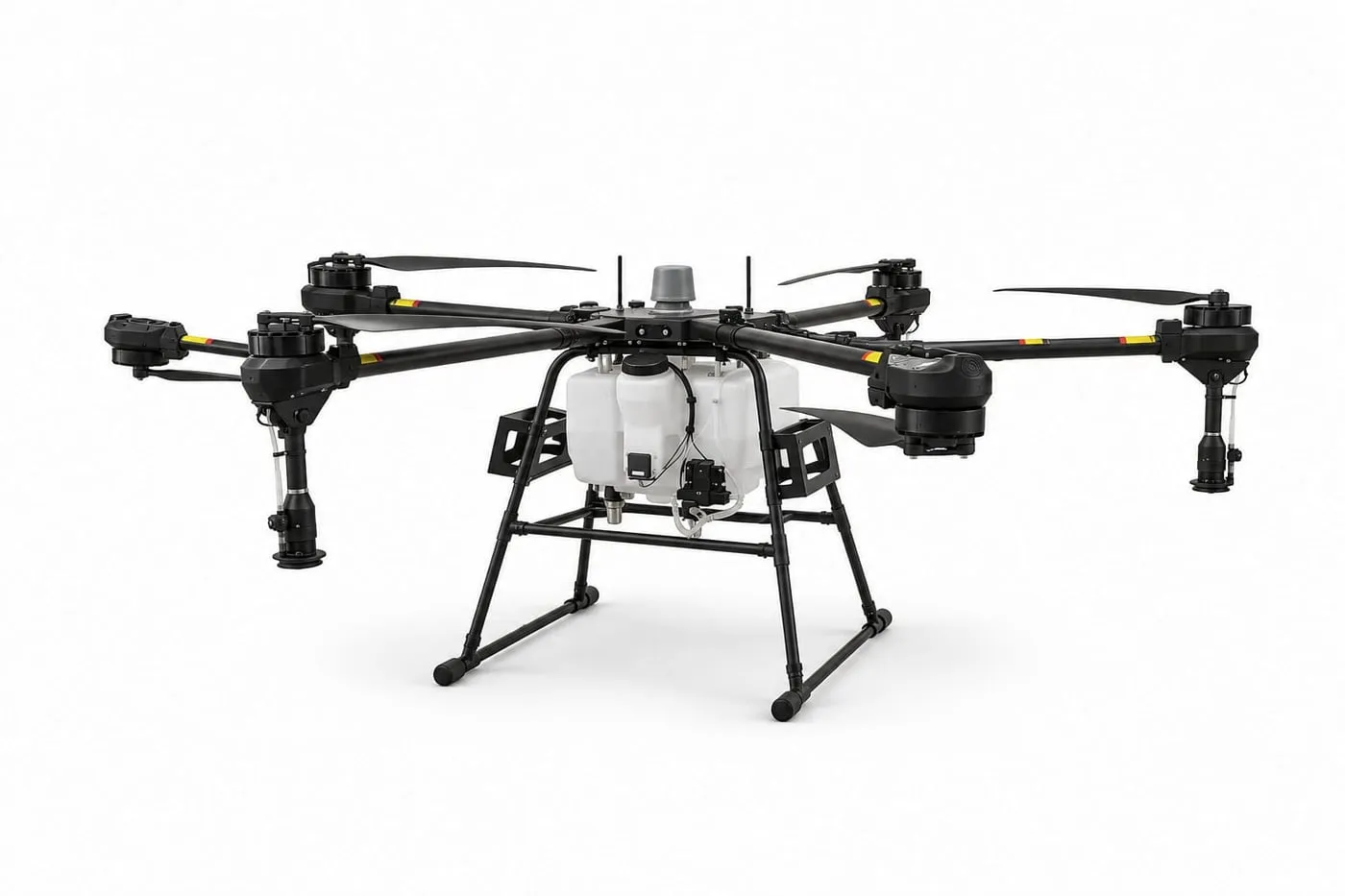
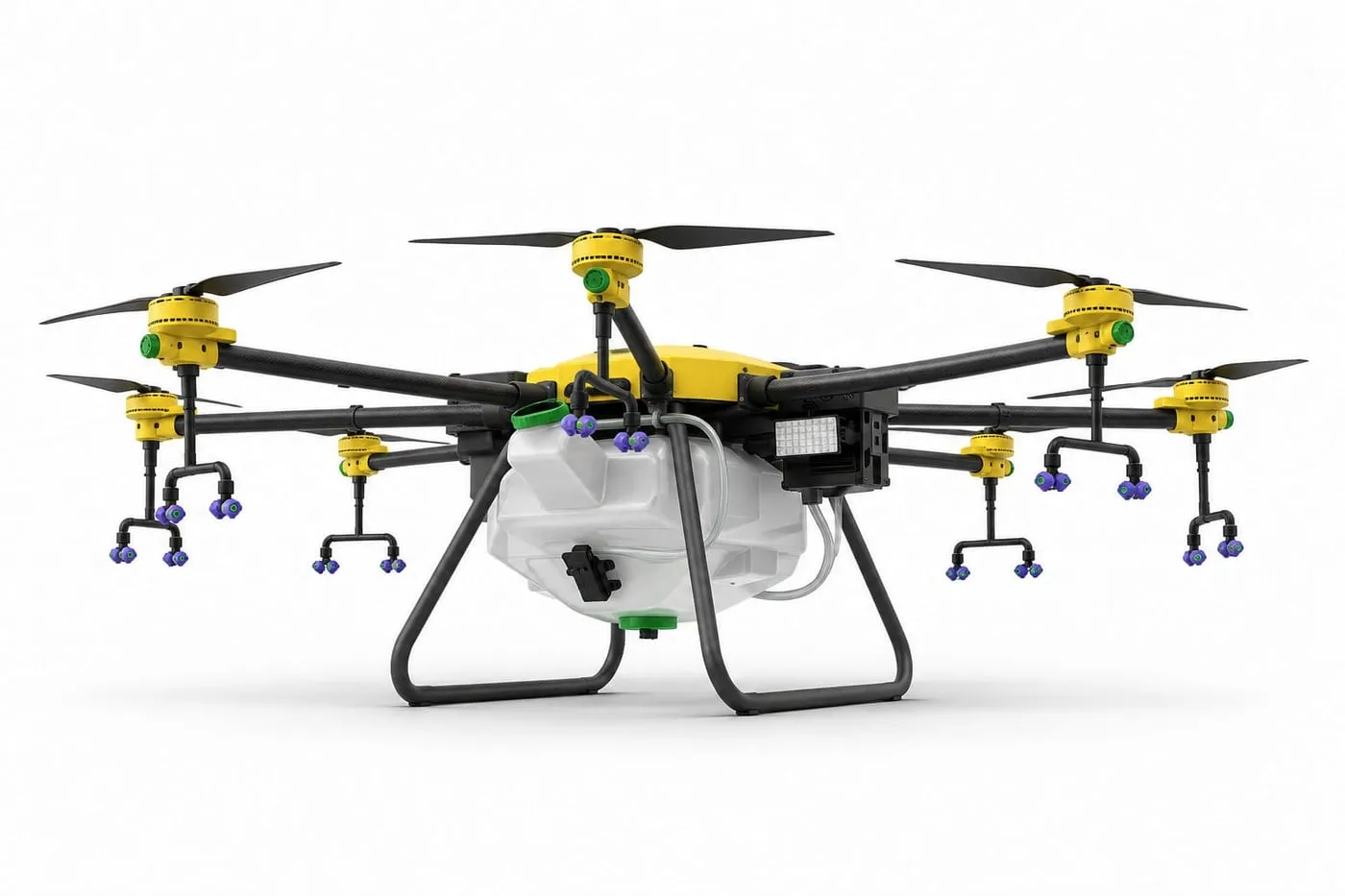
- 1In this guide a heavy-lift agricultural drone carries roughly 50–150 kg of liquid, which means a 50–150 L tank; in our range that runs from the Agri 50 to the Agri 150.
- 2Kentucky's service-provider model gives the 72 L class about US$61,000 net in a three-week window against about US$24,000 for a 30 L drone (model values).
- 3Listed maximum take-off weights run from 99 kg (Agri 50) to 311 kg (Agri 150), so weight-based rules and a loading ramp matter for the large classes.
- 4Heavier loads shorten flight time: full-load hover is 8 minutes for the Agri 100 and 4 minutes for the Agri 150, and fast charging needs a 10 kW-class generator.
- 5Skip heavy-lift if you spray under about 750 ha a year, work small broken fields or cannot move a 150 kg machine safely.
Contents
- 01What does the extra payload earn?
- 02What counts as a heavy-lift agricultural drone?
- 03Is payload in kilograms the same as tank size in litres?
- 04How much do altitude and heat cut the payload?
- 05What power and crew does a heavy drone need?
- 06Do heavy drones need extra approval?
- 07When does a heavy-lift drone pay, and when should you skip it?
Short answer: In 2026, a heavy-lift agricultural drone is one that carries roughly 50–150 kg of liquid (a 50–150 L tank), from the Agri 50 up to the Agri 150 in our range. It pays on large open fields, spreading work, estates and contract spraying. The price of the extra payload is weight (99–311 kg at take-off), a generator in the 10 kW class and a bigger ground crew.
What does the extra payload earn?
More net income per window: in Kentucky’s service-provider model a 72 L drone nets about US$61,000 in three weeks against about US$24,000 for a 30 L one. The assumptions are the same for every row: 2 gal/acre, US$15 an acre, a three-week window at 40 hours a week. Figures are model values before tax and travel.
| Tank class | Three-week area | Net income |
|---|---|---|
| 30 L | 2,561 acres (about 1,036 ha) | US$ 23,920 |
| 40 L | 3,872 acres (about 1,567 ha) | US$ 40,733 |
| 72 L | 5,974 acres (about 2,418 ha) | US$ 61,054 |
The guide’s own advice is that service providers should generally follow a “bigger is better” approach. It adds that a 72 L drone needs more than 1,870 acres (about 757 ha) a year to bring the cost under US$15 an acre. That is the hurdle for any heavy-lift purchase.
What counts as a heavy-lift agricultural drone?
There is no legal definition, so this guide uses the liquid payload. The weights below are the maximum take-off weights listed on our product pages.
| Class | Liquid tank | Payload | Listed max take-off weight | Where it pays | DEWKITE models |
|---|---|---|---|---|---|
| Light heavy-lift | 40–50 L | about 40–50 kg | 99 kg (Agri 50) | Mixed farms, first contractors | Agri 40, Agri 50 |
| Mid heavy-lift | 60–80 L | about 60–80 kg | 111 kg (Agri 65), 166 kg (Agri 72) | Contractors, high-volume crops | Agri 65, Agri 72, Agri 60, Agri 80R |
| Full heavy-lift | 90–150 L | about 90–150 kg | 254 kg (Agri 100), 311 kg (Agri 150) | Large fields, estates, spreading | Agri 92, Agri 100, Agri 150 |
Is payload in kilograms the same as tank size in litres?
Not always. Liquid weighs about 1 kg per litre, so a 100 L tank is roughly a 100 kg load. A spreading box is rated in litres, kilograms or both, and granules differ in density. One maker lists a 100 L spray tank with 100 kg of operating payload next to a 150 L spreading box that holds at most 100 kg. Our Agri 100 lists a 100 L tank and a 120 kg spreading load, and the Agri 150 lists a 150 kg rated load with 210 L of spreading capacity. Example: 150 kg ÷ 210 L = 0.71 kg/L, so any granule denser than that reaches the weight limit before the box is full.
How much do altitude and heat cut the payload?
One maker’s 40 L-class data sheet takes 10 kg off the payload for every 1,000 m of altitude and warns that temperature matters too. At 1,500 m that is a 15 kg loss before heat. Ask for the altitude and temperature derating of each model before you quote a farm in the hills.
What power and crew does a heavy drone need?
A generator above about 9.5 kW running (Purdue’s figure for fast charging; one maker pairs its 100 L machine with an 11.5 kW set), two people and a vehicle that can carry the weight. Batteries are heavier and drain faster: Purdue notes that the extra weight from bigger tanks shortens battery life, and our data sheets show it, with full-load hover of 7 minutes for the Agri 50, 8 minutes for the Agri 100 and 4 minutes for the Agri 150. Weight also matters on the road: the Agri 150 weighs 161 kg with its battery and folds to about 1.45 × 1.15 m, so plan a ramp or a tailgate lift. The battery guide shows the charging maths.
Do heavy drones need extra approval?
Often, and the rule changes with weight, so treat this table as a starting point and not as advice for your country.
| Country | What the rule looks at |
|---|---|
| United States | Registered spray drones, below or above 55 lb, go through a Section 44807 exemption and then Part 137 certification |
| Australia | The medium category (25–150 kg) needs a pilot licence for the exact drone type and model |
| Anywhere else, or above 150 kg | Ask the local aviation authority which category applies |
When does a heavy-lift drone pay, and when should you skip it?
It pays when you spray or spread large open blocks every day of the season: contractors, estates and big farms. It also pays on spreading jobs, where a 120–210 L box saves many landings; read the fertiliser spreading guide. For lifting loads over hills and plantations, see the Cargo 150 and the heavy-lift services guide.
Skip it when you spray fewer than about 750 ha a year, when fields are small, broken or full of obstacles, or when you have no vehicle, generator or second person for a machine of this weight. Start with a 50 L or 100 L machine, then step up. Dealers can begin with one unit on the dealer program.
Questions dealers ask
- How much can a large drone lift?
- It depends on the type. Our spraying drones carry up to 150 L of liquid (Agri 150), and our lifting drones list a maximum load of 150 kg (Cargo 150) or 200 kg (Cargo 200). Look at the rated load as well as the maximum, because the rated load is the one you can use every day.
- What is the largest agricultural drone?
- In our range it is the Agri 150 with a 150 L tank and a 311 kg maximum take-off weight. Other makers list different figures, so compare the tank, the spreading box and the rated load rather than one headline number.
- What can drones be used for in farming?
- Spraying, spreading granules and seed, mapping and scouting, and moving loads in estates and plantations. Heavy-lift spraying drones cover the first two, and a spreading kit turns the same airframe into a fertiliser machine.
- What drone can lift 200 kg?
- The Cargo 200 and Cargo 200S list a 200 kg maximum load with a 150 kg rated load and about 30 minutes of flight time. These are lifting drones for construction, power-line and forestry sites, not spraying machines.
- Is a heavy-lift drone better than a mid-size one for spreading?
- On large paddies and estates, yes: a 120 kg load covers 2.4 ha at 50 kg/ha, against 1.0 ha for a 50 kg load, so there are far fewer reloads. On small plots the extra weight does not pay. Our spreading guide has the full table.
- Do I need a special licence for a drone this heavy?
- Often yes, and the rules change with weight. See the table above and ask your civil aviation authority which category a take-off weight of 250–310 kg falls into before you order.
References
- [1]AEN-174 Drone Sprayer Sizing for Agricultural Applications. University of Kentucky Cooperative Extension.
- [2]The Evolution of Spray Drones: operational set-up in the field (PPP-154). Purdue Pesticide Programs.
- [3]DJI AGRAS T100 specifications. DJI (manufacturer data).
- [4]DJI AGRAS T50 specifications. DJI (manufacturer data).
- [5]Drone weight categories and requirements. Civil Aviation Safety Authority (Australia).
- [6]Dispensing Chemicals and Agricultural Products (Part 137) with UAS. Federal Aviation Administration.