Guides
Best Agricultural Spraying Drone in 2026 (By Farm Type)
The best agricultural spraying drone depends on the farm. Six picks for 2026 by use, with two numbers to check each, reference prices and a planning table.
- Prepared by
- DEWKITE Sales Team
- Published
- Reading time
- 4 min
- Sources
- 6
Key takeaways
- 1There is no single best spraying drone in 2026: the right class depends on the farm type, the field size and who will fly it.
- 2Large row crops suit the 100–150 L class, orchards and terraces 30–40 L, contractors 50–72 L and smallholders 10–30 L.
- 3A brochure swath is not a planning swath: Purdue reports that the effective swath is about 65–75 % of the advertised one.
- 4Owning only pays above a certain area: about 400 ha of spraying a year in the Missouri model, and a similar figure in Kentucky's.
- 5A dealer should stock three classes (small, mid, large) and quote a full set with batteries, charger and training.
Contents
Short answer: There is no single best agricultural spraying drone in 2026; the best one is the class that fits your farm. Pick the 100–150 L class for large row crops, 30–40 L for orchards and terraces, 50–72 L for contractors, 10–30 L for smallholders and a hybrid where charging in the field is hard. Judge every machine on its effective swath and its hectares per battery cycle, not on the brochure rate.
The shortlist in one table
| Best for | Class to pick | DEWKITE model | Reference price, FOB |
|---|---|---|---|
| Large row crops (400 ha a year or more) | 100–150 L | Agri 100, Agri 150 | US$ 22,700–29,100; US$ 12,000–34,800 |
| Orchards, slopes, terraces | 30–40 L | Agri 30, Agri 40 | US$ 3,000–7,100; US$ 3,000–11,000 |
| Spray contractors | 50–72 L | Agri 50, Agri 65, Agri 72 | US$ 8,900–21,100; 10,400–16,400; 15,400–16,400 |
| Smallholders and co-ops | 10–30 L | Agri 10 / 20 | US$ 3,100–9,800 |
| No charging power in the field | Hybrid, about 60 L | Agri 60H | US$ 10,400–31,500 (Agri 60 and 60H) |
| Spraying and spreading in one season | 30–50 L, one tank | Agri 30R / 50R | US$ 5,800–14,000 |
Treat these as public FOB listing ranges for a single unit. Freight, duty and extra batteries come on top, and only a quotation fixes the price.
Which drone is best for each type of farm?
Match the class to the farm. Each pick below gives one reason and two numbers to read on the data sheet.
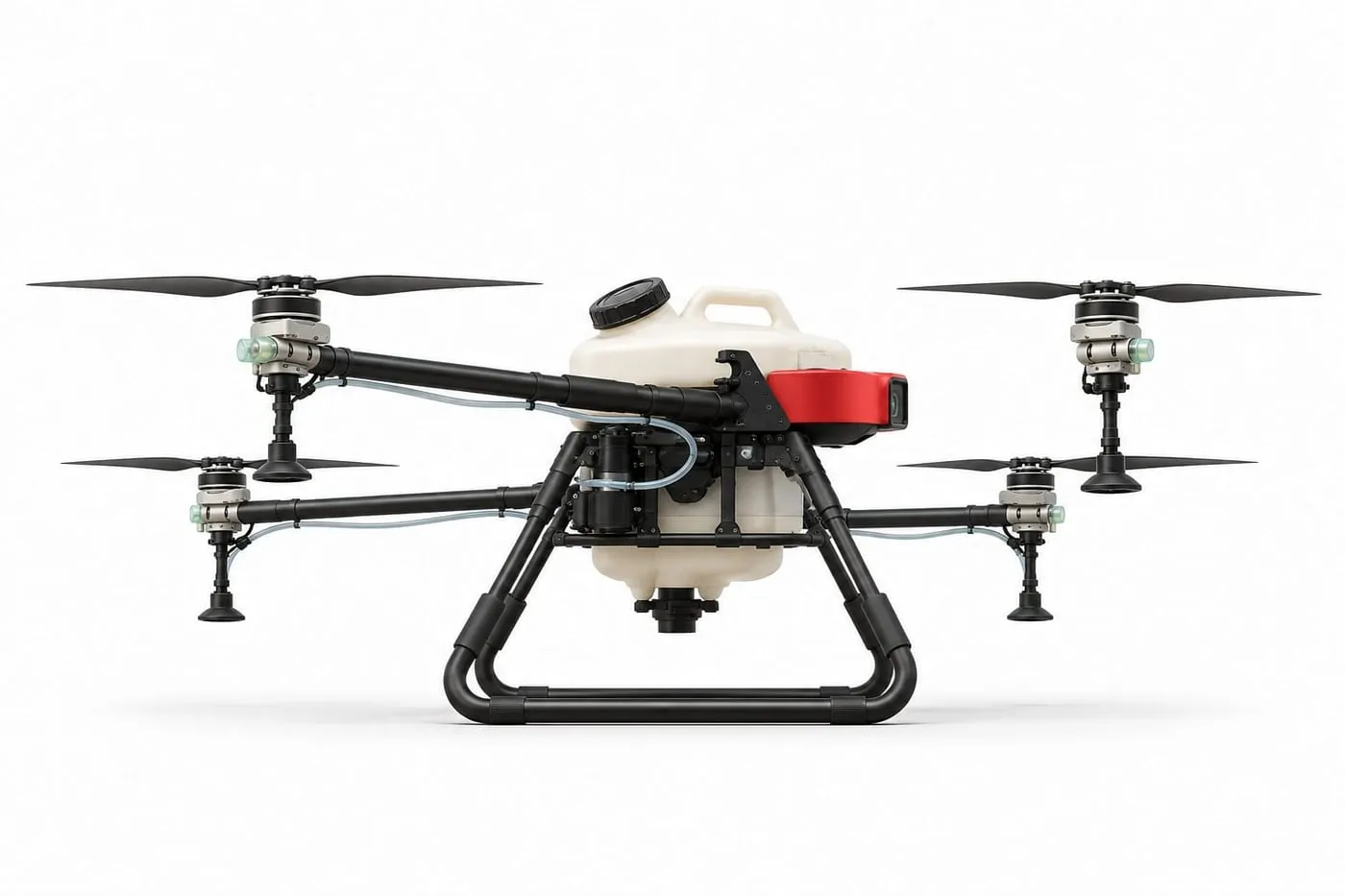
Best for large row crops: the Agri 100 and Agri 150, because a 100–150 L tank lands at most half as often as a 50 L one. Check the 8–15 m listed spray width and the 120 kg spreading load (Agri 100).
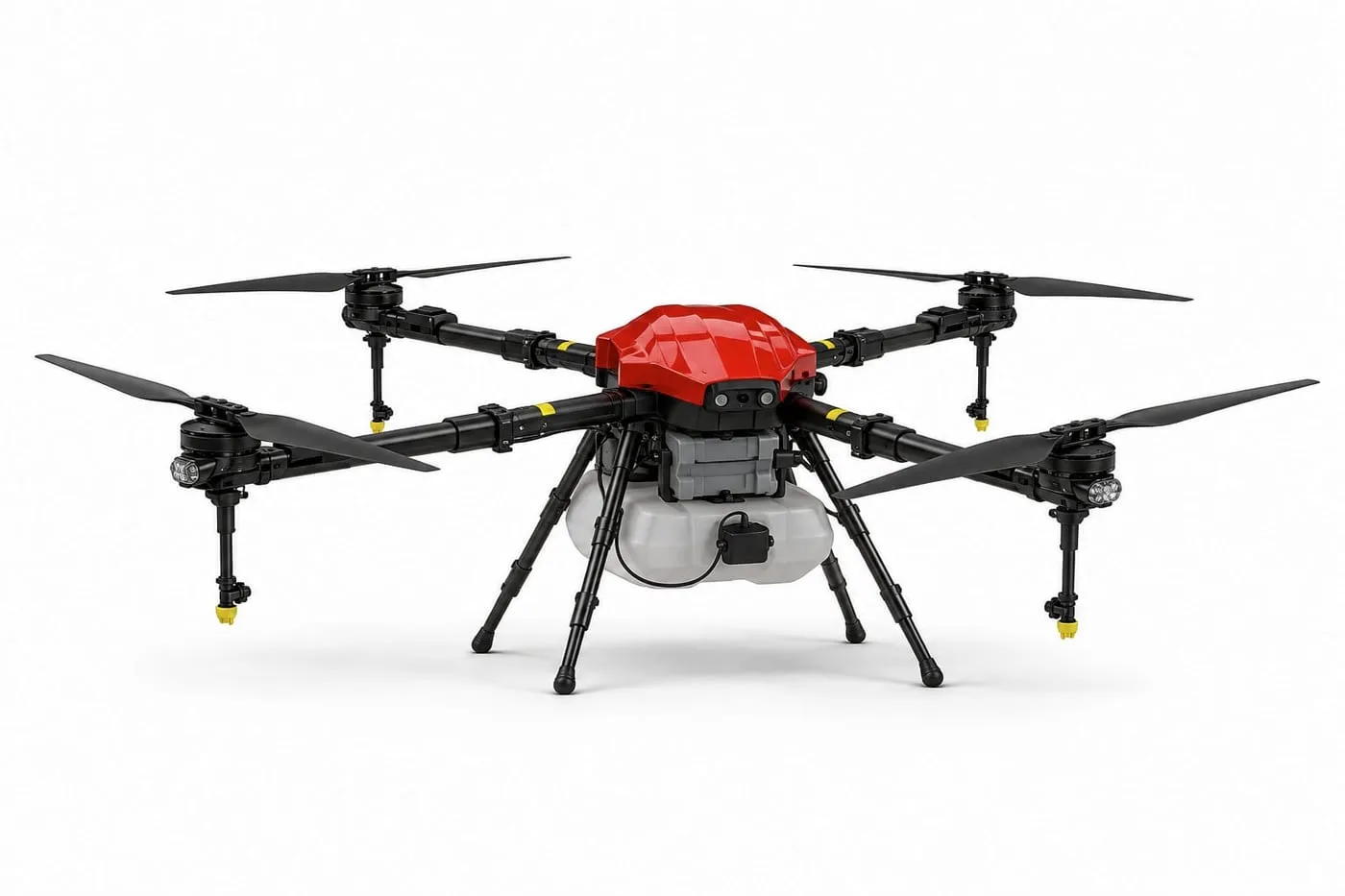
Best for orchards, slopes and terraces: a 30 L machine such as the Agri 30, compact enough for small, steep blocks and fitted with front and rear radar. Check the 8 L/min system flow and the 27 kg airframe weight without battery.
Best for spray contractors: the 50–72 L class, where one truck carries several drones to many fields. Check the 20 L/min flow (Agri 50, Agri 65) or the 16 high-pressure nozzles of the Agri 72, and how fast parts reach you.
Best for smallholders and co-ops: the Agri 10 / 20, light enough for one person (10 kg and 20 kg airframes) and quick to learn. Check the all-in price with batteries and charger and the about 30 minute charging time.
Best where field charging is hard: a petrol-electric hybrid such as the Agri 60H, which carries its own generator. Check the about 60 L tank (typical value) and the engine’s service schedule in the data sheet.
Best for mixed spray-and-spread seasons: the Agri 30R / 50R, because one tank does both jobs. Check the 8–12 m spread width and the 0.5–6 mm granule range, and move up to the Agri 100 for bigger loads.
How do you turn a brochure swath into a planning number?
Take the effective swath, not the brochure swath, and multiply it by 1.08 to get hectares per hour (6 m/s flying speed, half of the time actually spraying). Purdue’s spray-drone guide reports the effective swath at about 65–75 % of the advertised figure; the hectares-per-hour guide explains the rule.
| Nominal swath | Effective swath (65–75 %) | Planning output |
|---|---|---|
| 8 m | 5.2–6.0 m | 5.6–6.5 ha/h |
| 15 m | 9.8–11.3 m | 10.5–12.2 ha/h |
| 20 m | 13.0–15.0 m | 14.0–16.2 ha/h |
Example (estimate): a 15 m listed swath on a 100 L machine gives about 11 ha/h, so a six-hour spray day is about 65 ha per drone. A brochure rate of 35 ha/h would suggest 210 ha.
How many hectares a year before buying makes sense?
About 400 ha of spraying a year. Missouri Extension puts the threshold at 980 acres (about 397 ha), the point where a farmer’s own drone becomes cheaper than a US$16 per acre custom rate. Kentucky’s guide lands close by: roughly 1,000 acres (about 405 ha) at 2 gal/acre, dropping to about 500 acres (about 200 ha) for heavier spray volumes. Under that, a service provider costs less; our small-farm guide covers the options.
Does the weight of the drone change the licence?
Usually. Weight sorts drones into categories, and each category carries its own paperwork. The FAA, for one, regulates agricultural spraying through Part 137; Australia’s CASA gives 25–150 kg drones a medium category with a type-specific pilot licence. Ask your own aviation authority about every weight class you plan to import, before the first order.
What should a dealer stock?
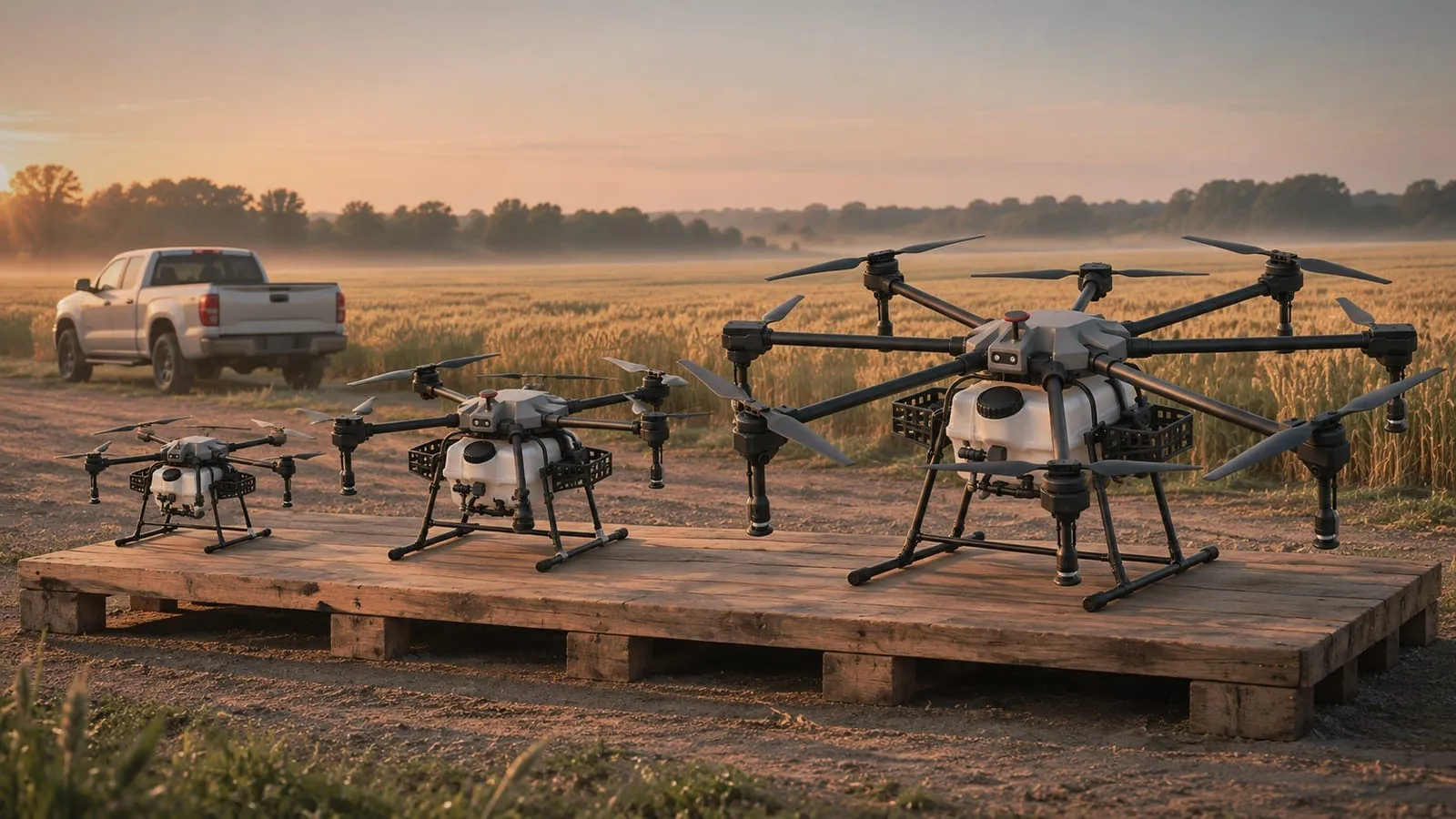
Stock three classes, not one flagship. A workable mix (example): one machine from each of three classes, a 10–30 L drone for small farms, a 50–72 L drone for contractors and a 100 L-plus drone for large fields. The dealer program starts at one unit, so a mixed first order is possible. For the 100 L class in detail, see the 100 L guide; for prices by size, the price guide.
Questions dealers ask
- Which spraying drone is best for a first-time buyer?
- A 30–50 L machine such as the Agri 30 or Agri 50. It is large enough to earn on 100 ha or more, small enough to move in a pickup, and the batteries and charging set stay manageable. Add a second, larger drone only after a full season of bookings.
- How many hectares can an agricultural drone spray per hour?
- The 50–150 L models on our pages list 22–40 ha/h in the brochure. For planning, use the effective swath: about 5.6–6.5 ha/h for an 8 m nominal swath and 14–16 ha/h for a 20 m one (table above).
- What is the best agricultural drone for large farms over 1,000 hectares?
- A 100–150 L machine such as the Agri 100 or Agri 150. On paper one drone covers 1,000 ha in a three-week window, but most buyers plan two so that a breakdown does not cost the window; see the fleet-size guide.
- Which agricultural drone is best for orchards on hillsides?
- A 30–40 L machine with terrain-following and obstacle radar, because small tanks are easier to move between blocks and fly closer to the canopy. Ask for the maximum system flow too: orchards often need a high volume per hectare.
- How much does an agricultural spray drone cost?
- Public FOB reference ranges run from about US$ 3,000 for compact machines to over US$ 30,000 at the top of the 60 L and 150 L ranges. Batteries, charger, generator, freight and duty change the landed price, and the final figure is always on a quotation.
- Is a bigger spray drone always better?
- No. A big tank pays on large, open blocks where it saves landings. On small, broken or sloping fields the extra tank is rarely used and the machine is harder to move, so a 30–50 L drone earns more.
References
- [1]The Evolution of Spray Drones, Their Capabilities and Challenges: calibrating spray drones (PPP-154). Purdue Pesticide Programs.
- [2]G1274 Economics of Drone Ownership for Agricultural Spray Applications. University of Missouri Extension.
- [3]AEN-174 Drone Sprayer Sizing for Agricultural Applications. University of Kentucky Cooperative Extension.
- [4]Ohio Farm Custom Rates 2026. The Ohio State University Extension.
- [5]Drone weight categories and requirements. Civil Aviation Safety Authority (Australia).
- [6]Dispensing Chemicals and Agricultural Products (Part 137) with UAS. Federal Aviation Administration.