Guides
Agricultural Drones for Small Farms: Own, Share or Hire? (2026)
Should a small farm own, share or hire a spray drone in 2026? Worked examples for 5 ha and 50 ha, the hectare break-even, co-operative models and tank sizes.
- Prepared by
- DEWKITE Sales Team
- Published
- Reading time
- 4 min
- Sources
- 6
Key takeaways
- 1Most small farms in 2026 should hire a spray service or share a drone with neighbours, not buy one for themselves.
- 2From roughly 400 ha of spraying a year, owning starts to beat hiring in two US models; heavy spray volumes bring the line down to about 200 ha.
- 3At about US$37 per ha (Ohio's 2026 average), a 5 ha farm that sprays four times pays about US$740 a year, too little to justify its own drone.
- 4Co-operatives and service teams change the sum: India's Namo Drone Didi scheme expects each group to manage about 800–1,000 ha a year.
- 5For dealers the customer in small-farm markets is the service team, co-op or input shop, so sell a package of machine, batteries, training and parts.
Contents
Short answer: In 2026 most small farms, from a few hectares to a few dozen, should hire a spray service or share a drone, not buy one alone. The break-even for owning is roughly 400 ha of spraying a year in two US university models. A 10–30 L drone lowers the entry price, but the work still has to be there.
Own, share or hire: the three routes
| Route | Who it suits | What you pay | What you need | Main risk |
|---|---|---|---|---|
| Hire a service | Farms under about 50 ha | A rate per hectare, about US$37 in Ohio 2026 | A local provider and a booking | Provider is busy in your spray window |
| Share through a co-op or group | 50–400 ha across several farms | Shares of the machine, batteries and training | A trained pilot, an agreed diary | Disputes over turns and repairs |
| Own | 400 ha or more a year, or a spray-service business | Machine, batteries, charger, training, licence | Pilot, crew, a place to charge | The machine sits idle and loses value |
What do 5 ha and 50 ha look like in money?
About US$740 a year for 5 ha and US$7,400 for 50 ha at an Ohio-level rate. The rate comes from Ohio’s 2026 custom-rate survey: drone spraying at US$14.98 an acre (about US$37 a ha) and a self-propelled ground sprayer at US$10.63 (about US$26 a ha). Swap in your own market’s prices; the method matters more than the number.
Example (5 ha farm): four sprays a year = 20 ha of passes × US$37 = about US$740 a year. An Agri 10 starts at a US$ 3,100 FOB reference price before batteries, charger, freight and training. At that rate the hire bill takes more than four years to reach the machine’s price, and you must also fly it.
Example (50 ha farm): four sprays = 200 ha of passes × US$37 = about US$7,400 a year. If a small set cost US$9,000 landed (assumption), simple payback would be about 1.2 years. That holds only if you spray all four rounds yourself, the local rate is as high as Ohio’s and nothing breaks. Cut the rate to US$10 per ha and payback is more than four years. Payback in years = landed cost ÷ (hectares × local rate − running costs).
How many hectares do you need before buying a spray drone?
About 400 ha a year. Two US extension services give a threshold:
| Model | Spray volume | Area a year where owning starts to pay |
|---|---|---|
| Missouri Extension (vs US$16 per acre custom rate) | Not stated | 980 acres, about 397 ha |
| University of Kentucky | 2 gal/acre | About 1,000 acres, about 405 ha |
| University of Kentucky | 4–5 gal/acre | About 500 acres, about 200 ha |
Purdue adds a warning for light users: drones lose value like other electronics, so a machine that sits idle is hard to justify. Missouri’s model assumes a US$23,000 package, so a cheaper small machine moves the line only part of the way.
How do co-operatives and women’s groups share drones?
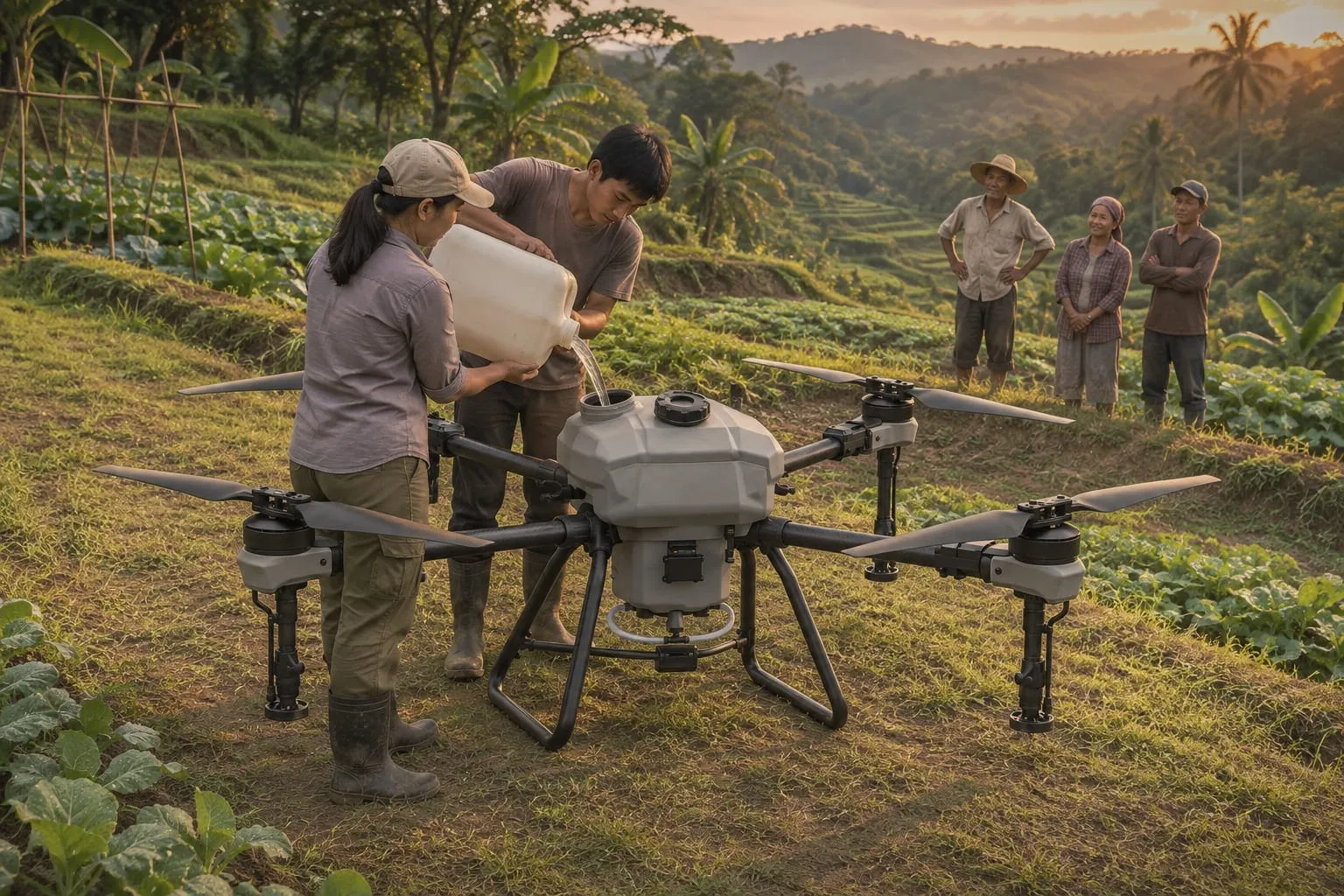
Sharing is how many small-farm markets reach the volume. India’s Namo Drone Didi scheme gives drones to 15,000 women’s self-help groups for renting out to farmers. The Government of India pays 80 % of the cost, up to Rs 8 lakh, and the package includes batteries, a fast charger, a one-year warranty, two years of maintenance and insurance. Training takes 15 days, 5 for flying and 10 for farm use, and each group is expected to manage about 2,000–2,500 acres a year (about 800–1,000 ha). FAO’s 2022 report on agriculture describes the same logic in Africa: platforms such as TROTRO Tractor link farmers with owners of equipment, including drone owners offering mapping and herbicide spraying. See our co-operatives guide and the rental business guide.
Which tank size suits a small farm?
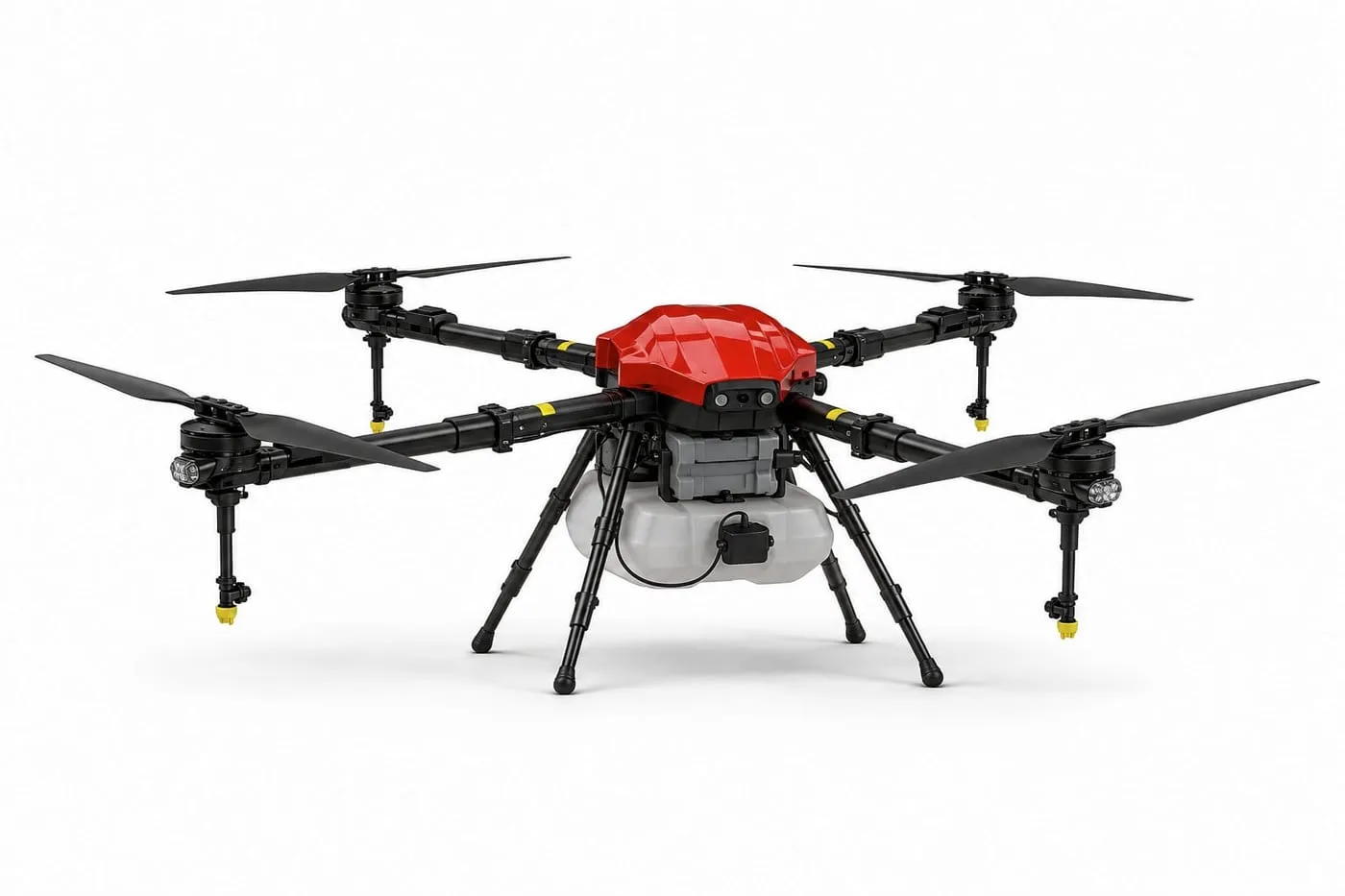
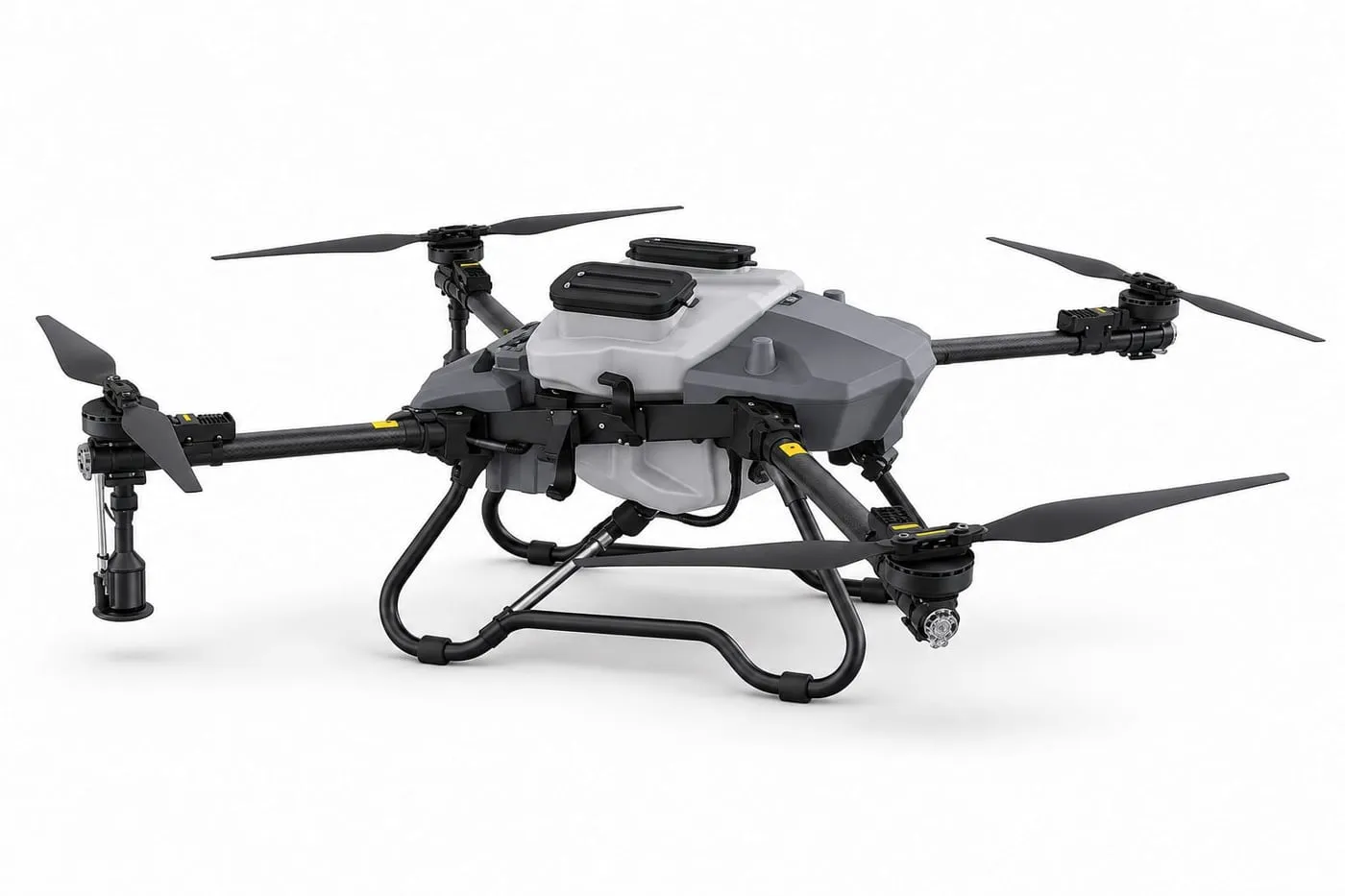
For small fields, handling matters more than tank size. The Agri 10 weighs 10 kg and the Agri 20 weighs 20 kg, so one person can carry either to the field edge. The Agri 30 adds 30 L and a 40 L spreading kit. Purdue notes that on small, odd-shaped fields or fields with obstacles, a spray drone may be the only method that works at all, so size the machine to the field and the people, not to the biggest tank. Read more in the Agri 10 / 20 page.
What does this mean for a dealer?
In small-farm markets the buyer is rarely one farmer. It is the service team, the co-op or the farm-input shop that sprays for dozens of farms. Sell them a package: machine, batteries, charger, training and a parts kit, and help them price the service per hectare. The dealer program starts at one unit, and the subsidy guide covers public schemes that can pay part of the cost.
Questions dealers ask
- How much does a farm drone cost?
- Public FOB reference prices start around US$ 3,000 for compact spray drones: the Agri 10 / 20 range is US$ 3,100–9,800 and the Agri 30 range US$ 3,000–7,100. Batteries, charger, freight, duty, training and a licence come on top, so ask for the landed figure.
- Are agricultural drones worth it for a small farm?
- Usually not as a single-farm purchase. They are worth it when someone sprays hundreds of hectares a year with the machine, which a co-operative, a service team or an input dealer can do and one small farm cannot.
- What is the price of a 50 liter agricultural spraying drone?
- The Agri 50 / Agri 52 reference range is US$ 8,900–21,100 FOB. That is more drone than most small farms need; a 20–30 L machine matches the field size better.
- How many acres can an ag drone spray per hour?
- A small 10–20 L drone with a 4–5 m effective swath does about 4–5 ha/h by our planning rule, or roughly 11–13 acres an hour. Brochure rates are higher; see the hectares-per-hour guide.
- What is a good agricultural drone for a co-operative of small farmers?
- A 20–30 L machine for terraces and plots, plus a 50 L machine for the larger blocks, with several battery sets and one trained pilot per drone. Start with one unit and add a second when the booking diary is full.
- Do I need a licence for a small spray drone?
- Often yes, and weight usually sets the category. The Agri 10 lists a 26 kg maximum take-off weight and the Agri 20 lists 43 kg, which sit on different sides of the 25 kg line between small and medium drones in Australia, for example. Check your aviation authority and the pesticide rules.
References
- [1]G1274 Economics of Drone Ownership for Agricultural Spray Applications. University of Missouri Extension.
- [2]AEN-174 Drone Sprayer Sizing for Agricultural Applications. University of Kentucky Cooperative Extension.
- [3]Ohio Farm Custom Rates 2026. The Ohio State University Extension.
- [4]Namo Drone Didi: empowering women self-help groups with advanced agricultural technology. Press Information Bureau, Government of India.
- [5]The State of Food and Agriculture 2022: the digital revolution in agricultural practices. FAO.
- [6]The Evolution of Spray Drones: considerations before purchasing (PPP-154). Purdue Pesticide Programs.