

Guides
How to Run an Agricultural Drone Field Day That Ends in Orders (2026 Checklist)
A 2026 checklist for an agricultural drone field demonstration: permissions, safety, what to show, an example budget and a 7-day follow-up plan.
- Prepared by
- DEWKITE Sales Team
- Published
- Reading time
- 3 min
- Sources
- 4
Key takeaways
- 1A good field day runs about 75 minutes and shows tank refill, spray pattern, spreading and a battery change, then leaves 15 minutes for questions.
- 2Start planning 30 days ahead: land owner, date, permissions, safety officer, shade and a weather back-up date.
- 3Use clean water for most of the demo and put cloth or paper on the ground to show spray deposit; confirm with your civil aviation authority what is allowed.
- 4Example budget for one field day: about US$ 1,000–1,500 including pilot time, transport, refreshments and insurance.
- 5The sale is made in the following week: send results on the day, a quote on day 3 and a trial offer on day 7.
Contents
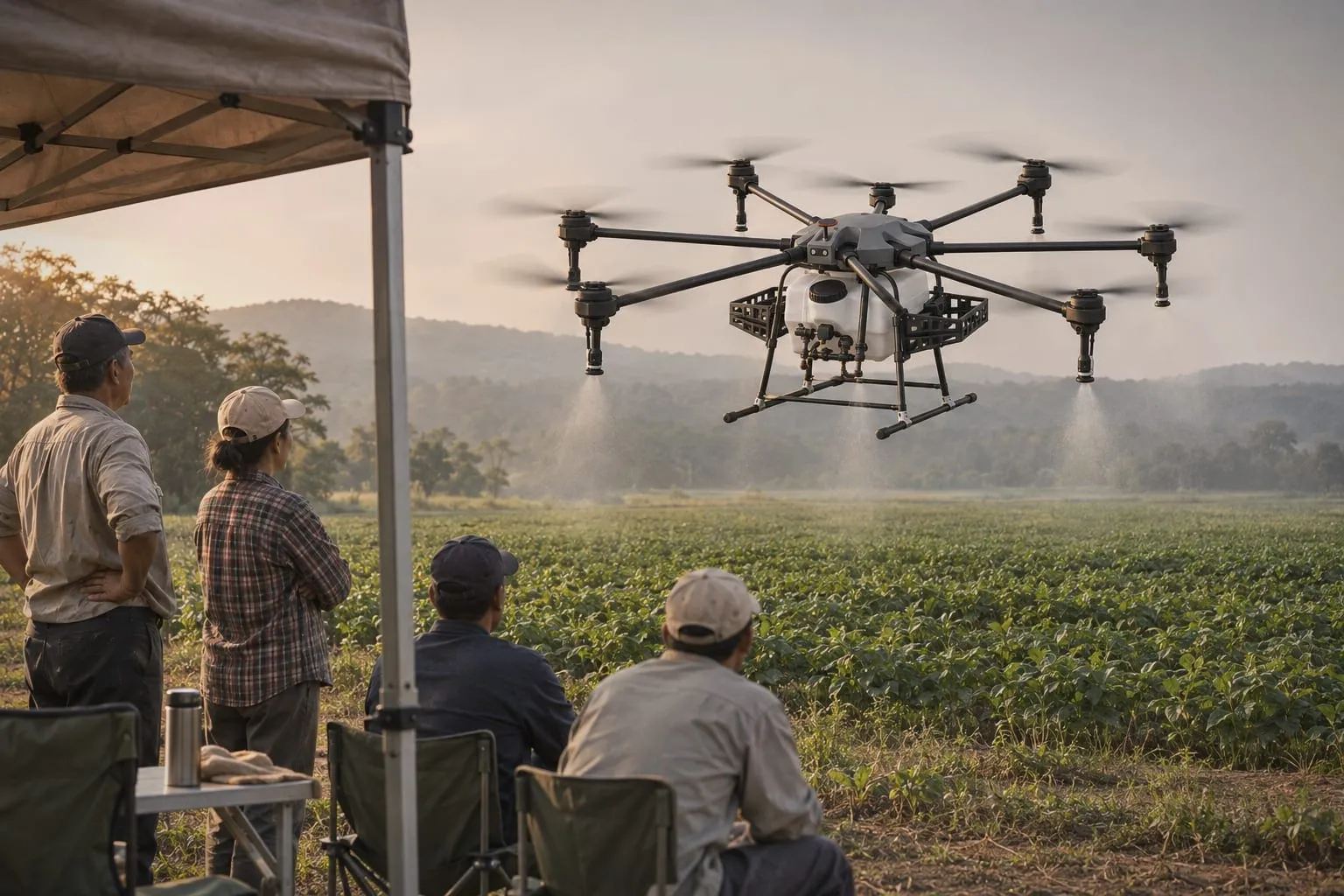
Short answer: A field demonstration that sells is short, measured and followed up. Plan it 30 days ahead, show five things in about 75 minutes (take-off and spraying, refill, battery change, spreading, questions), and send every visitor results within a day. An example budget is about US$ 1,000–1,500 a day; the orders come in the seven days afterwards, not on the field.
The preparation account first
Here is the example budget for one demo day with a 50–100 L machine. It is a planning example, not a quote.
| Item | Example (US$) |
|---|---|
| Field and owner’s thank-you | 150 |
| Refreshments and shade | 250 |
| Transport and fuel | 150 |
| Pilot and helper | 250 |
| Banner and printed sheets | 100 |
| Clean water, dye, filters | 50 |
| Insurance for the day | 100 |
| Follow-up calls and trial flights | 150 |
| Total | 1,200 |
If 25 farm decision-makers come, 6 ask for a quote and 1–2 order within a month, the day has paid for itself at a hardware margin near US$ 3,470 (see the margin guide). These are example numbers.
What is the checklist, week by week?
| When | What to do |
|---|---|
| 30 days before | Choose a field, get the owner’s written consent, set a date and a back-up date, open sign-up |
| 14 days before | Tell the civil aviation authority or local official if required, arrange insurance |
| 7 days before | Name a safety officer, order shade, water and chairs, test the sound and the weather outlook |
| 1 day before | Charge every battery, check nozzles and pump, load water and the mixing tank |
| Day of | Brief visitors, fly the plan, log hectares and times |
| Day 1 | Send photos, areas and times to everyone by message |
| Day 3 | Call every person who asked for a quote |
| Day 7 | Offer a trial on the buyer’s own field |
What should you show?
Show what a farmer cannot learn from a brochure. A 75-minute plan from a Canadian dealer runs through a short safety talk, a take-off and spray run, a battery change, spreading and a Q&A. Add measurements:
| Show | How to prove it |
|---|---|
| Refill speed | Time the tank fill with a stopwatch in front of everyone |
| Spray pattern | Place cloth or paper strips on the ground and read the wet marks |
| Spreading | Calibrate with a weighed sample and weigh what lands |
| Battery change | Time the swap and the charge plan |
| Area per cycle | Read the flight log aloud at the end |
A University of Missouri example counts 6.5 acres (about 2.6 ha) per charge cycle for a US 40 L class machine; your own log should replace it. A University of Illinois Extension demonstration used a first pass at height to scout a 160-acre field before a lower pass, a useful idea for crop scouting displays.
Is it safe and permitted?
Keep the show safe first: a marked flight zone, spectators to the side, no flights over people and a safety officer with the authority to stop. For rules, the FAA states that dispensing from a drone falls under Part 137, and New Mexico State University lists the pilot certificate, Part 137 certificate and state applicator licence. Outside the United States, confirm with your civil aviation authority and with the crop-protection regulator, and follow the product label and local rules for any chemical.
What happens after the field day?
The follow-up is where sales happen. Use the same steps every time: results on day 1, quote on day 3, trial offer on day 7. For the tracking sheet and the demo-unit cost per day, read the demo unit guide; for the channels that fill the field, see the marketing plan. The Agri 100 (100 L, 35 ha/h) makes a good headline machine for a day aimed at contractors; the dealer programme lists the demo support.
Questions dealers ask
- Should a demo use water or chemicals?
- Most dealers use clean water, with a dye if they want visible results. It avoids chemical handling around visitors and drift problems. Whether a water demo still needs permission is a question for your aviation authority; if you spray a product, follow the product label and local rules.
- How do you run a spray drone demo safely?
- Mark a flight zone, keep spectators behind a line upwind or to the side, give one person the safety role, stop for wind above the limit in the manual, and never fly over people. Brief every visitor before the first take-off.
- Do I need a permit for a drone demonstration?
- That depends on where you fly. Test flights over farmland may need notice to the aviation authority, and anything that releases product is treated more strictly. Put the question in writing to your civil aviation authority and your crop-protection office before you set a date.
- How many people should I invite?
- Twenty to forty farm decision-makers is enough. A smaller, well-chosen crowd of growers and contractors sells more than a large open day.
- What should I do within 7 days after a field day?
- Send the results the same day, call every quote request by day 3 and offer a trial on the buyer's own field by day 7. Record all of it in your lead sheet.
References
- [1]What to Expect at an Agricultural Drone Demonstration. Ag Drones.
- [2]Extension demonstration shows drone's usefulness on farms. AGDAILY, University of Illinois Extension.
- [3]Dispensing Chemicals and Agricultural Products (Part 137) with UAS. FAA.
- [4]Chemical Applicator Drones in Agriculture: Regulatory Requirements. New Mexico State University.


