Guides
How to Set Up an Agricultural Drone Service Center (2026)
How to set up an agricultural drone service center in 2026: four zones, battery storage, washdown, service flow and budgets for 5, 20 and 50 drones.
- Prepared by
- DEWKITE Sales Team
- Published
- Reading time
- 4 min
- Sources
- 6
Key takeaways
- 1A service centre that can carry a spray season has four zones: intake and washdown, a repair bench, a parts shelf, and a battery charging and storage area.
- 2Example budgets, not quotes: about US$ 9,000–19,000 for a centre supporting up to 5 drones, US$ 31,000–54,000 for about 20 drones and US$ 71,000–127,000 for about 50.
- 3The parts shelf is the biggest line in a small centre, and its size follows the fleet you support.
- 4Store lithium batteries dry and cool, limit how many sit in one place, and train staff to spot swollen, leaking or hot packs (OSHA guidance).
- 5Wash drones at the end of every spray day away from ditches and drains, and never pour leftover spray liquid on the ground.
Contents
- 01How much does an agricultural drone service centre cost?
- 02What should an agricultural drone service centre have?
- 03How do you store spray drone batteries safely?
- 04How do you clean a spray drone after use?
- 05What does a good service flow look like?
- 06What skills should the technician have?
- 07Which parts should the centre keep, and how do you ship batteries back?
Short answer: An agricultural drone service center needs four zones, a trained technician and a parts shelf sized to the fleet you support. In our 2026 example a small centre for up to 5 drones costs about US$ 9,000–19,000 to set up, one for 20 drones US$ 31,000–54,000 and one for 50 drones US$ 71,000–127,000. Start small and grow with the fleet. This guide is for dealers and importers who want to service the machines they sell, not for farmers looking for a repair shop.
How much does an agricultural drone service centre cost?
All amounts are US dollars. The parts-shelf figures come from our spare parts list; the other lines are planning examples with no published source, so get local quotes. Wages are excluded.
| Line | Small, up to 5 drones | Medium, about 20 | Large, about 50 |
|---|---|---|---|
| Space fit-out: bench, shelving, washdown tray | 2,000–5,000 | 6,000–12,000 | 15,000–30,000 |
| Tools and test equipment | 1,500–3,000 | 4,000–8,000 | 10,000–20,000 |
| First-year parts shelf | 4,000–6,000 | 14,000–20,000 | 30,000–45,000 |
| Battery charging and storage area | 1,500–3,000 | 4,000–8,000 | 10,000–20,000 |
| Technician training | 0–2,000 | 3,000–6,000 | 6,000–12,000 |
| Set-up total | 9,000–19,000 | 31,000–54,000 | 71,000–127,000 |
| Technicians, before wages | 1, part-time | 1–2 | 3–4 |
What should an agricultural drone service centre have?
Order the zones so a drone moves one way: from dirty, to clean, to flying.
| Zone | What happens there | Rule of thumb |
|---|---|---|
| 1. Intake and washdown | The drone is photographed, logged and washed | Outdoors or on a drained tray, away from ditches; no pressure washer on the airframe |
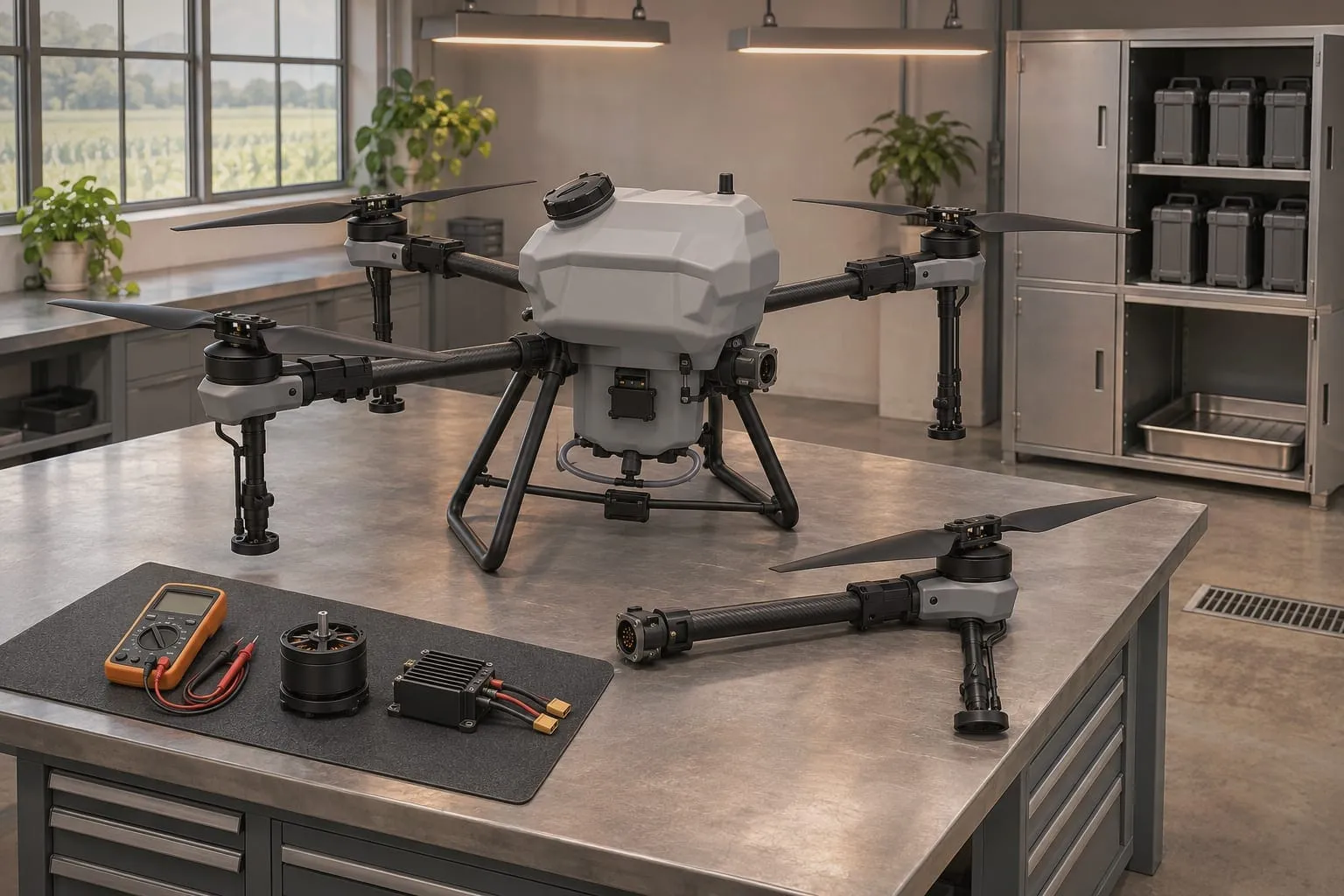
| 2. Repair bench | Arms, motors, speed controllers and pumps fitted; nozzles calibrated; radar and GNSS modules swapped; firmware updated; flight logs read | Clean, dry, well lit; label every removed part by drone |
| 3. Parts shelf | Wear parts at hand height, rare parts locked away | One bin per model and tier |
| 4. Battery room | Charging, storage, and a separate place for damaged packs | Apart from the bench; see below |
| 5. Test-flight area | Hover and spray test after every repair | Clear open space; test with water only |
How do you store spray drone batteries safely?
Follow the principles in OSHA’s lithium-ion battery guidance: keep batteries in a dry, cool place; store, charge and maintain them as the manufacturer says; limit the quantity stored in line with NFPA 800 and NFPA 855; train staff to recognise defective, damaged or failing batteries; and keep an emergency plan that covers thermal runaway fire and explosion. We give no fire-engineering figures here; ask your fire authority and insurer how the rules apply to your building.
Plan power for charging too. Purdue Extension reports 7–12 minutes of flight per battery on heavy spray drones and 10–30 minutes to recharge, depending on battery size, supply voltage and temperature. A busy centre tests several packs at once, so size the supply and the floor space for several chargers.
How do you clean a spray drone after use?
Purdue’s guidance is to flush the lines at the end of every spray day, even if the same product goes on tomorrow. When you change products or sensitive crops, use a tank cleaner and take the filters apart. Do not use a pressure washer on the airframe. Rinse away from ditches and grass waterways, catch the rinse water in a tray, and dilute leftover spray liquid and spray it back onto the treated field instead of pouring it on the ground. Follow the product label and local rules.
What does a good service flow look like?
| Step | Target time (example) | What to record |
|---|---|---|
| Intake | Same day | Photos, serial number, flight hours, the customer’s description |
| Diagnosis and quote | 1–2 working days | Fault, parts needed, warranty or paid job |
| Repair | 1–3 days if parts are in stock | Parts used, time, technician |
| Test flight and calibration | Same day as the repair | Flow, hover, spray pattern |
| Return with a short report | Same day | What was done and the next service date |
In the spray season keep a loan machine or a priority lane. Purdue tells buyers to ask what happens when a drone goes down; the centre should have the answer ready.
What skills should the technician have?
Motor and speed-controller replacement, pump and nozzle calibration, radar and GNSS module replacement, firmware updates, reading flight logs and test flying. Get them from the supplier’s training plus a first season of repairs with a supplier technician on call. DEWKITE’s dealer program trains your pilots and technicians before the first sale.
Which parts should the centre keep, and how do you ship batteries back?
Keep the three tiers from our parts guide, with wear parts first; bare frames and the spare parts page cover big repairs. For returned batteries, IATA’s 2025 battery guidance works alongside the 66th edition of the Dangerous Goods Regulations; damaged or defective packs are handled separately, so follow the carrier’s requirements before shipping.
Questions dealers ask
- What should an agricultural drone service center have?
- Four zones in one direction of travel: intake and washdown, a repair bench, a parts shelf and a battery area, plus a clear space for test flights. Add a trained technician, a parts list per model and a loan machine for the spray season.
- How do you store spray drone batteries safely?
- Follow OSHA's lithium-ion principles: dry, cool storage; storage, charging and maintenance as the manufacturer says; limited quantities in line with NFPA 800 and NFPA 855; trained staff; and an emergency plan. Ask your fire authority and insurer how they apply to your building.
- What spare parts should an agricultural drone dealer keep in stock?
- Wear parts first (propellers, nozzles, pump parts, filters, seals), then common-repair parts such as arms and motors, then rare parts such as flight controllers and radar. Our spare parts guide gives starter quantities for fleets of 5, 20 and 50 drones.
- How do you clean a spray drone after use?
- Flush the lines at the end of each spray day, use a tank cleaner when you change products or sensitive crops, avoid a pressure washer on the airframe, and rinse away from ditches over a tray that catches the water. Follow the product label and local rules.
- How much do farmers pay for drone spraying, and can a service center sell it?
- Rates vary by country and crop. Missouri Extension quotes about US$ 16 an acre (roughly US$ 39.5 a hectare) for US custom drone work. Many centres put a demo machine on paid jobs while the workshop fills up.
- Does a service center need manufacturer authorisation?
- Some manufacturers certify service centres. A US dealer, nuWay Ag, describes its authorised centre as using genuine parts and technicians trained on the platform. Ask your supplier about authorisation, training and genuine parts.
References
- [1]Service Center. nuWay Ag.
- [2]Lithium-ion Battery Safety: Control. U.S. Occupational Safety and Health Administration.
- [3]8. Common Questions Regarding Spray Drone Applications (PPP-154). Purdue Extension.
- [4]4. Current Challenges of Using Spray Drones (PPP-154). Purdue Extension.
- [5]Batteries (DGR guidance). IATA.
- [6]G1274 Economics of Drone Ownership for Agricultural Spray Applications. University of Missouri Extension.