Short answer: In Thailand in 2026, buyers ask first whether a farm drone can fly. After the 2025 border crisis, the civil aviation authority (CAAT) made agricultural drones the first group allowed back, from 11 August 2025, under strict conditions. Rules have been eased again since, so in 2026 a dealer sells compliance as well as hardware.
How did the rules change, month by month?
| Date | Change | What it means for farm drones |
|---|---|---|
| Early Aug 2025 | Drones restricted nationwide during the border situation | Farm sales stalled |
| 11 Aug 2025 | CAAT conditional exception for agricultural drones | Spraying and spreading allowed under conditions |
| Mid Aug 2025 | Reports say a wider lifting followed | Check CAAT notices, not news |
| 2026 | CAAT notice no. 16 (B.E. 2569), reported 26 June 2026 | Border limits eased; seven provinces stay controlled |
Treat this as a reading guide and use CAAT’s current announcements as the authority; they are posted on CAAT’s UAS portal, linked from the government page.
What were CAAT’s conditions for farm drones?
The Nation’s report of the August 2025 rules lists:
- Operator and drone registered with CAAT, and a CAAT agricultural authorisation.
- No violations on record.
- Flying only over your own farmland or land you have the owner’s consent for.
- Notice through the UAS portal 12 hours ahead, with an email to the police anti-drone centre and local police or village head.
- Maximum height 30 m, between 06:00 and 18:00.
- Spraying and spreading only; no photography or mapping.
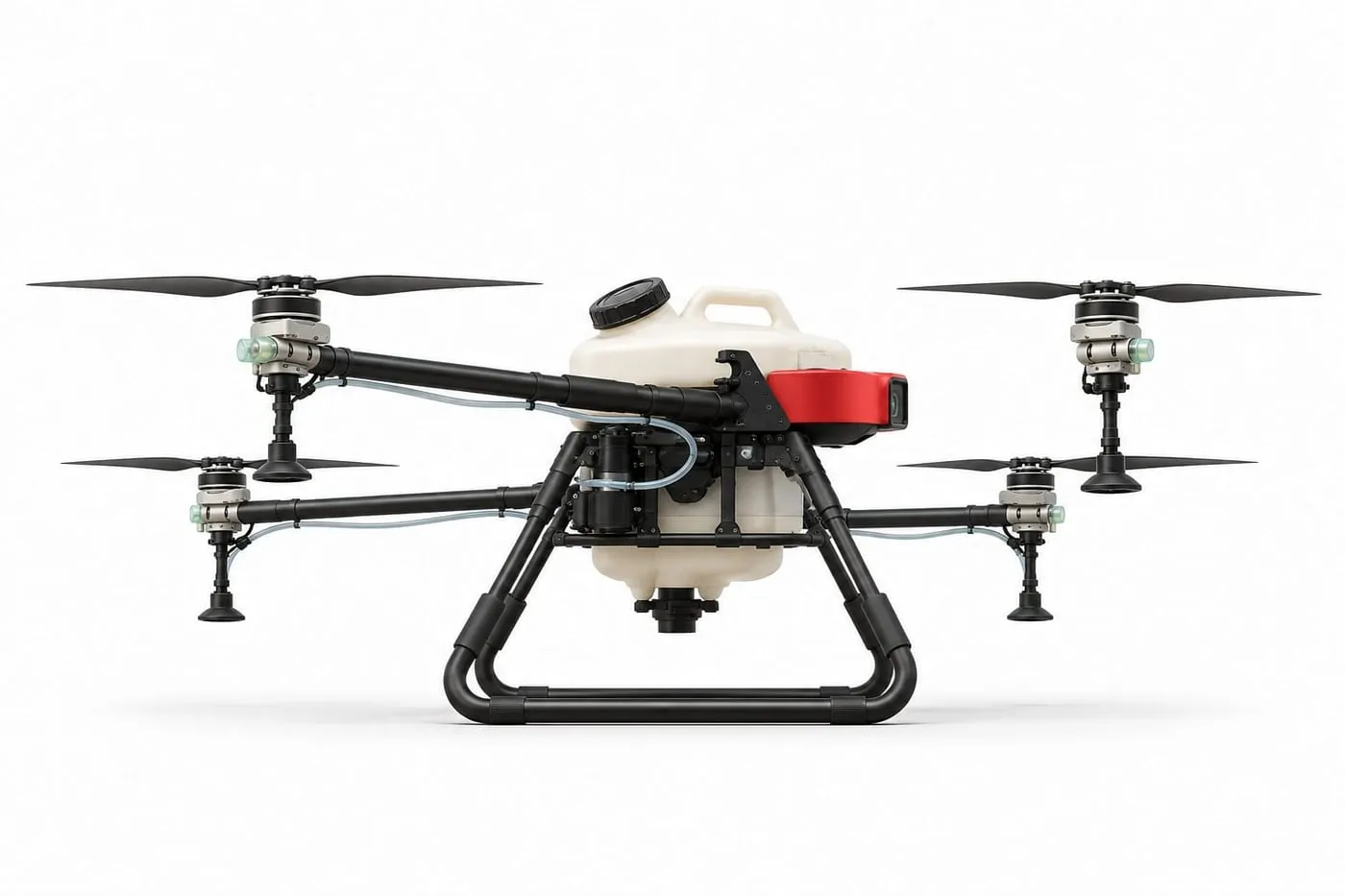
For a dealer this is a sales checklist: help the customer register, show the notice routine and supply the manuals. The Agri 50 is the usual first machine.
What does a drone save a rice farmer?
The government portal reports AEROTHAI’s “Nakhon Phanom model” on a 22 rai glutinous-rice field (1 rai = 1,600 m², so about 3.52 ha):
| Item | Result |
|---|---|
| Seed | 52% saved |
| Fertiliser | 25% saved |
| Labour | 41% saved |
| Yield | 1,100 kg per rai, 250 kg more than conventional |
| Net income | 5,254 baht per rai, 2,509 more |
Example: for 3.52 ha, an Agri 50 rated at 22 ha/h needs about 10 minutes of flying per pass, plus refills. A farm service that charges per rai can run several such fields in a day. These are government demonstration figures; your customer’s result may differ.
AEROTHAI also says farm drone use is growing more than 20% a year with over 200,000 units in use. Other reports give far smaller counts, so the figures are unreconciled; we quote it as “AEROTHAI says”.
Who buys, and where is the gap?
FAO forecasts 33.5 million tonnes of paddy for 2025/26, 1.9% below the previous year; the main crop harvest finished by late January and the second crop is under way. Rice-service teams and cooperatives are the buyers; read our guide for cooperatives. With so many drones, the room is in big-tank models, spare parts and training. See also the Agri 100 for large blocks.
First-year plan
- Months 1–2: confirm CAAT registration steps for dealer and customers.
- Months 2–4: one demo drone and a farm demonstration with the notice routine shown.
- Months 4–8: service-team pilot, parts counter.
- Then a first order of two to four machines through the dealer programme. Import duties: confirm with your clearing agent.