Short answer: Latin America is several markets, not one. In 2026 the clearest written rules are in Brazil (MAPA Portaria 298, with SIPEAGRO registration), Argentina (ANAC’s 2025 framework, no CETA for lower-risk operations) and Colombia (Aerocivil RAC 100). Dealers do best where rules are clear and the existing network is thin, which today looks more like Colombia, Argentina and Peru than Brazil.
How do the five markets compare?
| Country | Main authorities | What the rules say | Dealer picture |
|---|---|---|---|
| Brazil | MAPA, ANAC | Operator registered in SIPEAGRO, technical manager, 20 m buffers, two-year records | Big and active; competition is strong |
| Argentina | ANAC | Resolution 550/2025 and RAAC 100/101/102; three categories; lower-risk work without CETA | Open to new brands |
| Colombia | Aerocivil, ICA | RAC 100 for aircraft and pilot; ICA for pesticides | Mostly one big brand’s dealers |
| Mexico | AFAC, SENASICA | Confirm spraying rules with AFAC and SENASICA | Confirm locally |
| Peru | MTC and aviation authority | Confirm with the authorities | Confirm locally |
Registration numbers in Brazil are quoted at very different levels depending on the source, from a few thousand registered spraying drones to tens of thousands in use. We therefore do not quote one; just note that registered drones are far fewer than estimated ones.
What does Brazil require to operate a spray drone?
An ANAC registration is not enough in Brazil. Under Portaria MAPA 298/2021 the operator registers with MAPA in SIPEAGRO, names an agronomy or forestry engineer as technical manager, keeps maps, prescriptions and application records for at least two years, and keeps a 20 m distance from homes, water intake points and protected areas. A dealer who sells to Brazilian contractors should explain this on the first call.
What changed in Argentina?
ANAC’s 2025 framework (Resolution 550/2025 with RAAC 100, 101 and 102) replaced the old A–E classes with three categories. Lower-risk operations no longer need a CETA, the air-work operator certificate, and the medical certificate is optional. The declaration is online and free. That lowers the cost of starting a spraying service. Confirm which category agricultural spraying falls into before quoting a customer.
Which size should a Latin American buyer look at?
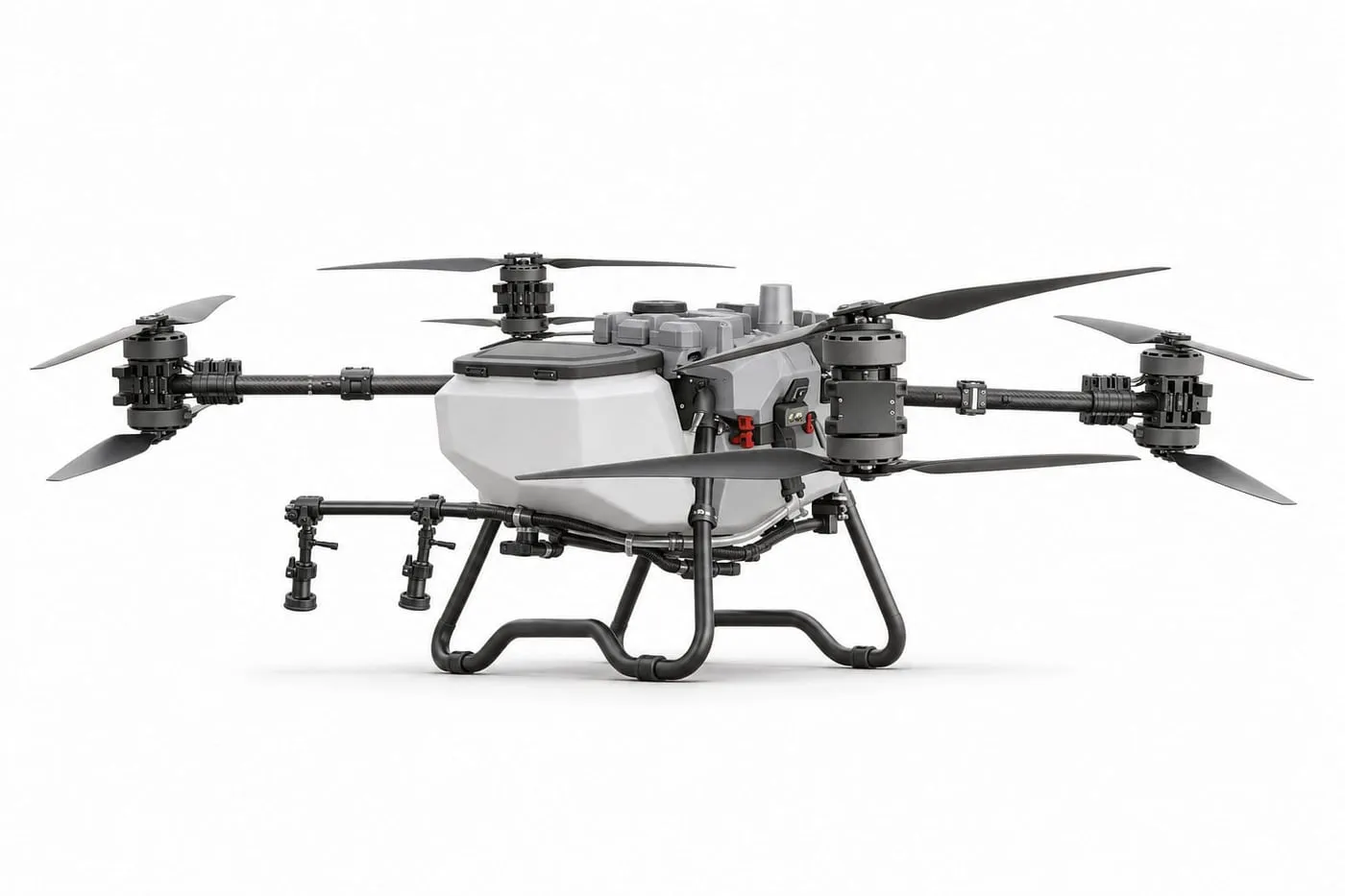
Tank size follows block size. The Agri 150 is the top of our line, with a 150 L tank and a listed 40 ha/h, and suits grain and sugar blocks. A 25 L class drone is a farm-level tool for orchards and small plots. For price bands, see our price guide and add landed costs.
How much does a big tank save? (example)
Example: a 100 ha soybean block with a 50 L drone and a 150 L drone. Assume each flight sprays 10 L per hectare. The 50 L drone covers 5 ha per flight and needs 20 flights; the 150 L machine covers 15 ha and needs about 7 flights. Fewer refills means less time on the ground, but only if the water truck, the battery supply and the generator keep up. These numbers are assumptions for the comparison, not guarantees.
Where is the dealer opportunity?
- Parts and service. A drone grounded for weeks loses the contractor’s season. See spare parts.
- Training. Pilots need to learn mixing, drift and record-keeping, especially in Brazil.
- Second brand for large blocks. Contractors who run big brands often want a heavy-lift alternative.
Read our dealer program and the Colombia guide for a worked first-year plan.