Guides
Agricultural Drone Frames: Building Your Own Brand on a Proven Frame (2026)
What it takes to build your own agricultural drone brand on a bought frame in 2026: six parts to source, tests, compliance, costs and the safer alternatives.
- Prepared by
- DEWKITE Sales Team
- Published
- Reading time
- 4 min
- Sources
- 3
Key takeaways
- 1A frame is one of six blocks in a spray drone: the rest are propulsion, flight controller and navigation, spray system, batteries and charging, and the remote or ground software.
- 2Most cost and risk sit in tuning the flight controller, calibrating the spray system and handling after-sales, not in the frame itself.
- 3DEWKITE's Frame 10, 20 and 30 have a public FOB reference range of US$900–2,400, which excludes motors, flight controller and spray parts.
- 4If you build and sell under your name, you are the maker in the eyes of regulators and customers, so the radio, aviation and warranty duties land on you.
- 5OEM supply and dealership are lower-risk routes to your own brand; build on a frame only with test capacity and a service desk.
Contents
- 01Three routes to your own name, compared
- 02What does a frame cost compared with a finished drone?
- 03What is included in a drone frame kit?
- 04The six blocks and the question for each supplier
- 05Which flight controller works with a sprayer?
- 06Eight tests before the first sale
- 07Who gives the warranty on a self-built drone?
- 08When a frame makes sense
Short answer: Building your own brand on a bought frame means sourcing six blocks: frame, propulsion, flight controller with navigation, spray system, batteries with charging, and ground software. The frame is the cheapest part to buy and the least of the risk. The real work is tuning, spray calibration, certification and after-sales. If you do not have a test field and a service desk, an OEM or dealership route usually gets you a brand faster.
Three routes to your own name, compared
| Route | What you do yourself | Who gives the warranty | Who handles radio and aviation papers | Start-up effort | Best for |
|---|---|---|---|---|---|
| A. Bare frame and own parts (Frame 10, 20, 30) | Design, build, tune, test, support | You | You | High | Engineering teams with a workshop |
| B. OEM or private label on a complete model | Choose model, brand, sell | Shared, per contract | Supplier prepares, you file | Medium | Dealers who want a brand quickly |
| C. Dealership | Demo, sell, service | Supplier, with your parts stock | Supplier prepares, you file | Low | Most new businesses |
See the OEM guide for route B and the dealer program for route C.
What does a frame cost compared with a finished drone?
Reference ranges, FOB, 1 unit minimum, final prices on quotation:
| Item | Reference range (US$) | What it includes |
|---|---|---|
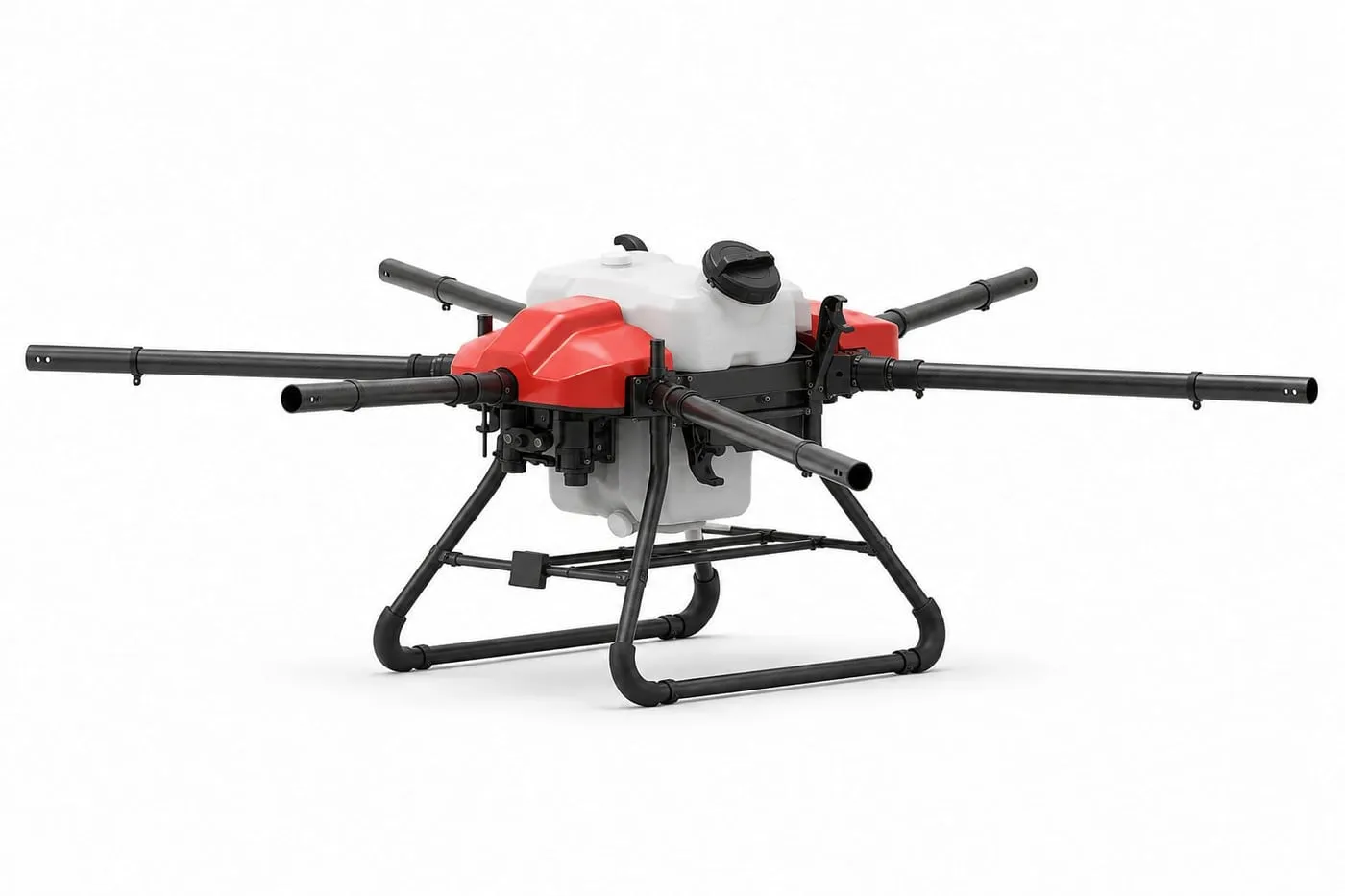
| Frame 10 / 20 / 30 | 900–2,400 | Bare folding frame only |
| Agri 30 complete | 3,000–7,100 | Finished 30 L class drone |
| Agri 50 complete | 8,900–21,100 | Finished 50 L class drone |
Example: you buy a Frame 30 at US$1,800 (example, inside the range). Motors, speed controllers, flight controller, RTK, pump, nozzles, tank and batteries each come from other suppliers, and the sum depends on their quotations. Then add your own labour, test flights, crashed parts, radio and aviation papers, and support. Quote the real figures from your suppliers; this guide does not give prices for parts it cannot source. The point is that a cheap frame does not make a cheap drone.
What is included in a drone frame kit?
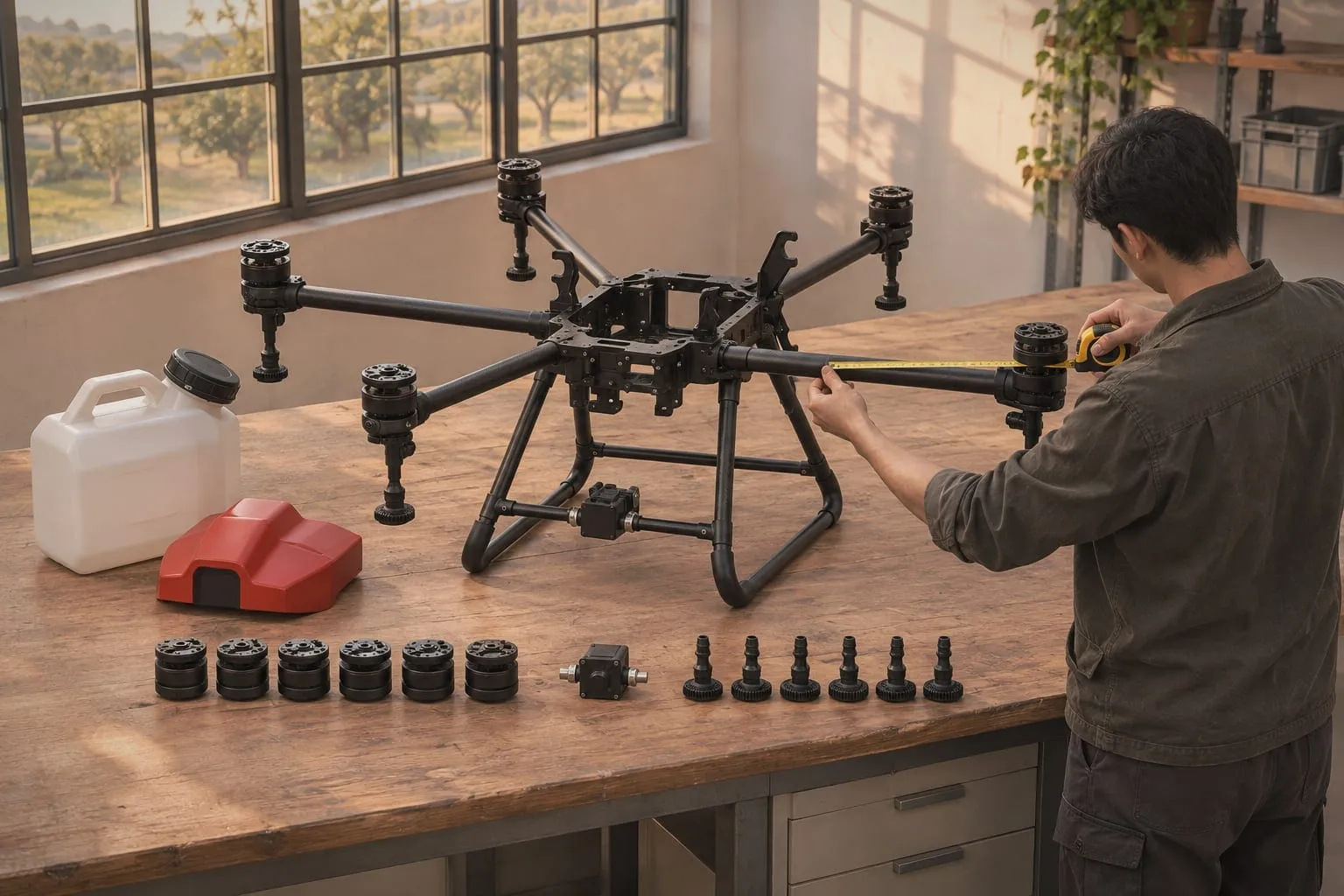
Always ask what is in the box. A bare frame is arms, plates and fittings; some sellers add a tank bracket or landing gear. DEWKITE’s frames fold, use carbon-fibre arms with aluminium fittings (typical), and come in 10, 20 and 30 L classes with 4, 6 and 4 arms (typical). Drawings and a parts list are available on request. For part names, see the parts names guide; for a list of suppliers see the frame manufacturers guide.
The six blocks and the question for each supplier
| Block | Question to ask |
|---|---|
| Frame | Which motors and tanks was it designed for, and what is the arm load? |
| Propulsion | Are motor, controller and propeller sold as a matched set? Hobbywing lists agricultural propulsion systems, centrifugal nozzles and pumps as standard modules |
| Flight controller and RTK | Does the firmware include sprayer control and failsafe return? |
| Spray system | Pump flow, nozzle type, tank sensor, flow meter, and how you calibrate |
| Batteries and charger | Cycle life, charging power, transport papers |
| Ground software | Language, field mapping, who updates it |
Which flight controller works with a sprayer?
Open-source firmware can drive a sprayer. ArduPilot’s documentation describes a PWM-controlled pump whose flow follows ground speed, with an optional spinner to set droplet size. It also warns that boards with 1 MB flash lack the feature. Open-source control is flexible, but it comes without a complete-machine warranty or approval papers; you must supply those.
Eight tests before the first sale
These are our suggestions, not a standard:
- Hover and slow turns with an empty tank.
- Hover with a full tank and look for shaking.
- Pump flow calibration against a measured volume.
- Lost-link and low-battery return.
- Spray width test on a tarp.
- Vibration check after a full battery.
- Battery temperature rise after repeated flights.
- A continuous working day without a fault.
Who gives the warranty on a self-built drone?
You do. Your name is on the machine, so the radio papers, the import and aviation rules and the customer’s repair all point to you. Read the certification guide before you commit. For operators in the United States, the FAA applies Part 137 to spraying from drones; other countries have their own rules.
When a frame makes sense
A frame suits a repair workshop that wants a spare airframe on the shelf, or an engineering team that already has propulsion and controller work done. Pick the Frame size by the tank class you service, tell DEWKITE the model you work on, and see the frames product page. If you only want a brand, start with route B or C.
Questions dealers ask
- What is included in an agricultural drone frame kit?
- It depends on the seller. A bare frame is the airframe with arms and plates. DEWKITE's frames are bare folding frames with carbon-fibre arms and aluminium fittings (typical), and a parts list and drawings are available on request.
- How much does a drone frame cost?
- DEWKITE lists Frame 10, 20 and 30 at a public FOB reference range of US$900–2,400, depending on size and quantity. That is the frame only: motors, flight controller, pumps and batteries are extra and priced by their makers.
- Can I build my own agricultural drone brand on a bought frame?
- Yes, technically, but you take on design, testing, radio and aviation papers and the warranty. Many dealers find OEM supply or a dealership gives the same brand with less risk.
- Which flight controller works with a sprayer?
- ArduPilot Copter documents a crop sprayer function: a PWM-controlled pump adjusts flow to speed, and an optional spinner sets droplet size. Some boards with only 1 MB flash do not include it, so check the board.
- Who gives the warranty on a self-built drone?
- You do. Each part maker may warrant its own part, but the complete machine has only one maker: you. Plan a service desk and spare-part stock before you sell the first unit.
References
- [1]Crop Sprayer. ArduPilot Dev Team.
- [2]Hobbywing. Hobbywing.
- [3]Dispensing Chemicals and Agricultural Products (Part 137) with UAS. Federal Aviation Administration.