Guides
How Tethered Cleaning Drones Get Water and Power (2026 Buyer Guide)
How a tethered cleaning drone gets water and power from the ground, why height is limited, and what a cleaning company has to buy. Worked examples, 2026.
- Prepared by
- DEWKITE Sales Team
- Published
- Reading time
- 4 min
- Sources
- 4
Key takeaways
- 1A tethered cleaning drone does not carry water: a ground pump sends it through a high-pressure hose to a spray bar on the aircraft.
- 2Some systems add a power tether from a ground unit so flight time is no longer limited by the battery.
- 3Height limits come from hose length, the weight of hose and water hanging in the air, and pressure lost along the pipe.
- 4In an example, 50 m of 8 mm hose holds about 2.5 kg of water before the hose itself is counted, and that comes off the payload.
- 5A service company needs a pump, hose and reel, spray bar, generator, water supply and a plan for fencing, insurance and permits.
Contents
- 01How much does the hanging hose weigh?
- 02How does a tethered facade cleaning drone get its water supply?
- 03How high can a tethered cleaning drone reach?
- 04Tethered or self-contained: which one for which job?
- 05What ground equipment does a drone cleaning crew need?
- 06Do I need purified water?
- 07What are the disadvantages of a tethered drone?
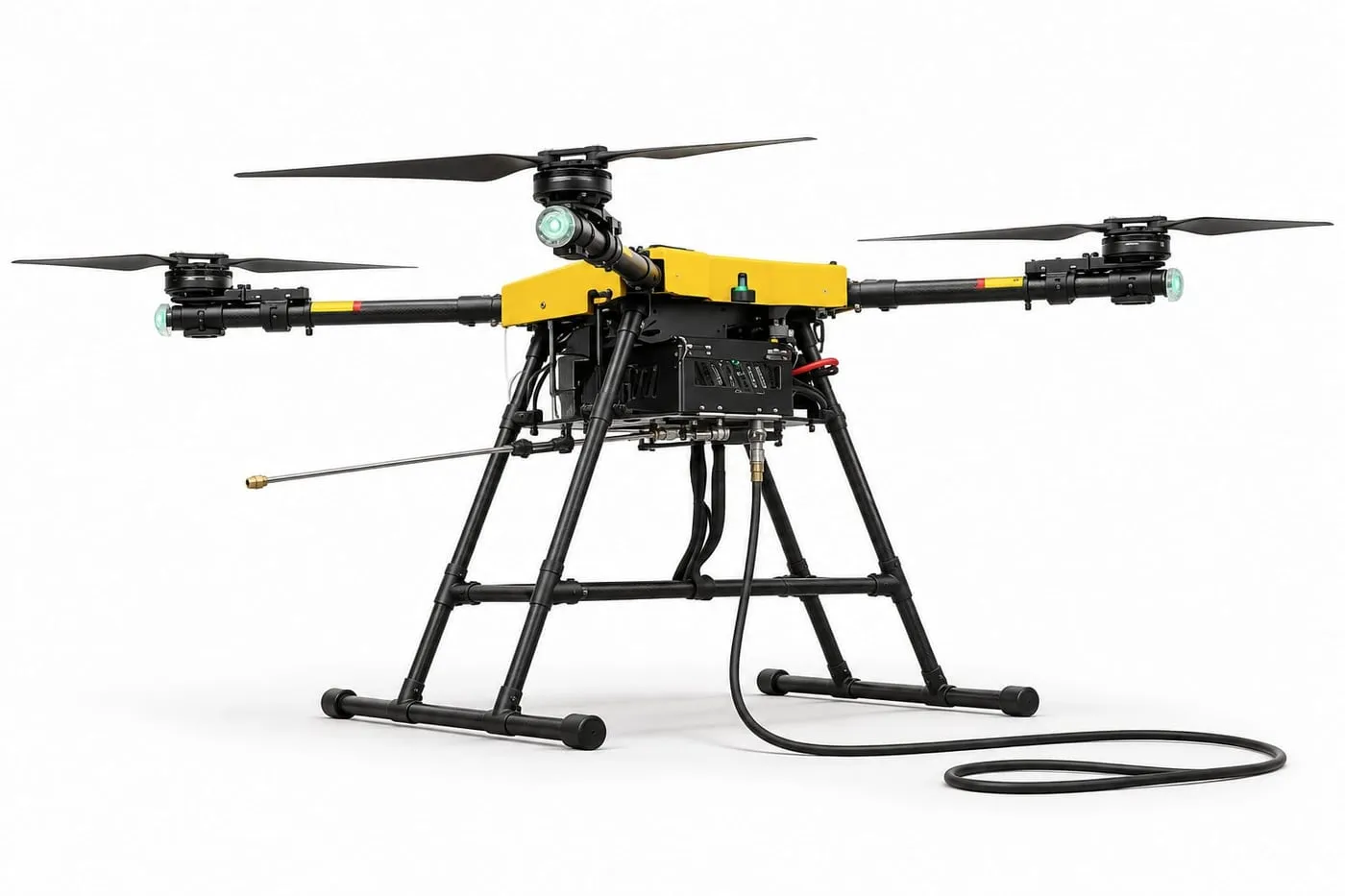
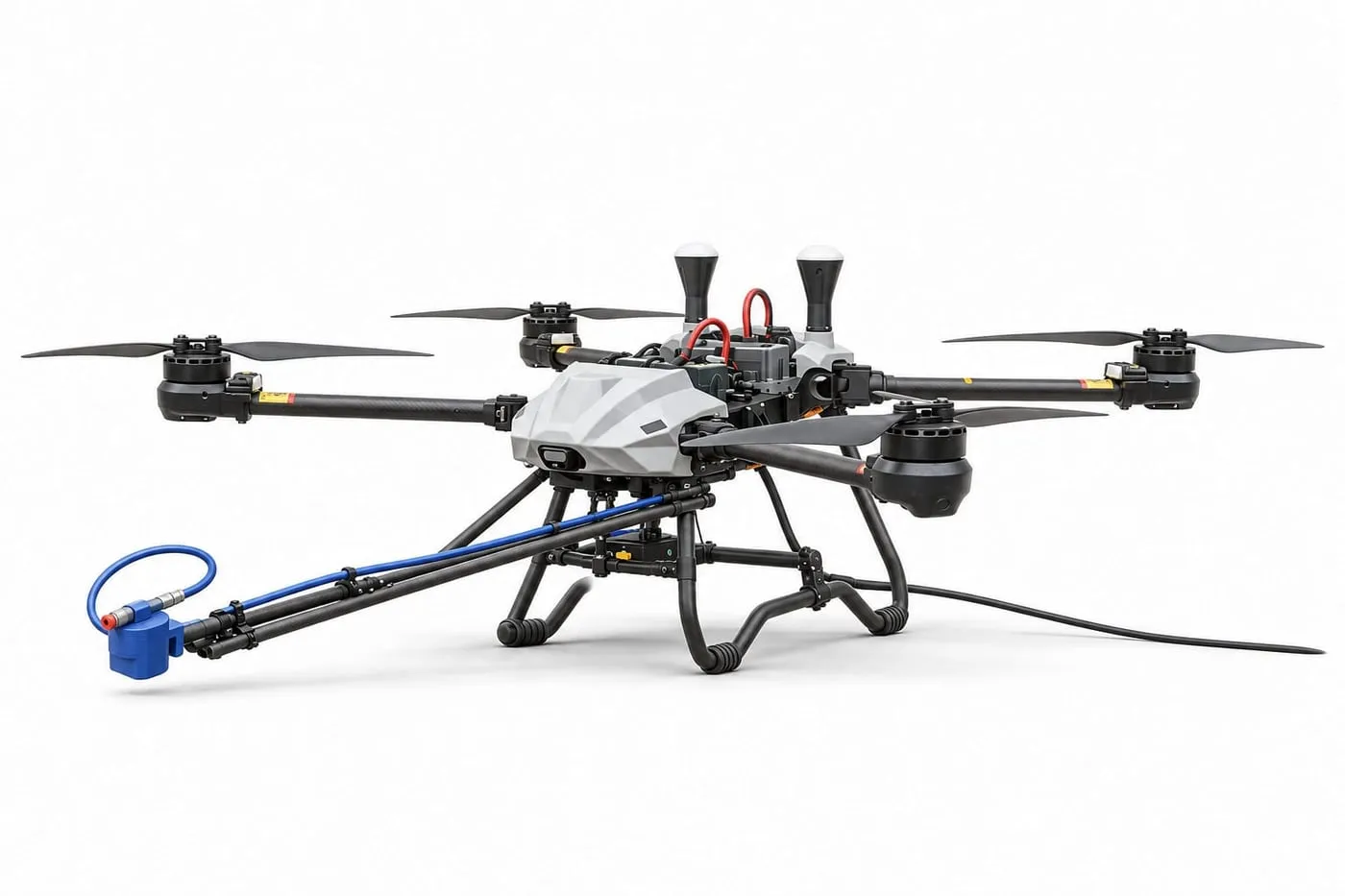
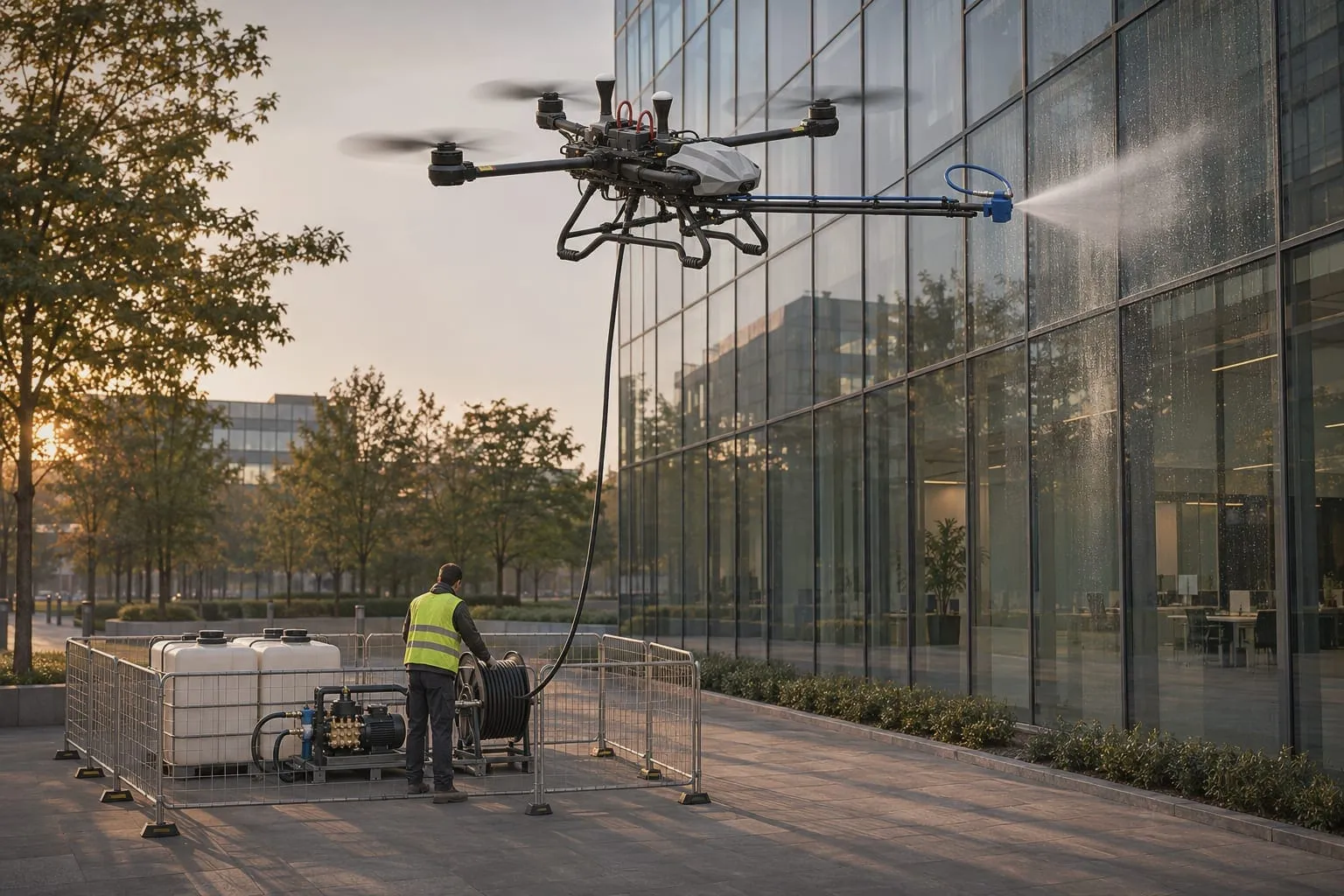
Short answer: A tethered cleaning drone does not carry its water. A ground pump pushes water, or cleaning liquid, through a high-pressure hose to a spray bar on the aircraft; some kits add a power tether from a ground unit so flight time no longer depends on the battery. Height is limited by hose length, the weight of hose and water hanging in the air, and pressure lost along the pipe. This is what that means for a cleaning company in 2026.
How much does the hanging hose weigh?
Do this sum before you buy. An 8 mm inside-diameter hose holds about 0.05 L of water per metre (π × 0.004² × 1 m).
| Height | Water in the hose | Pressure from the water column |
|---|---|---|
| 20 m | 1.0 kg | 0.20 MPa |
| 50 m | 2.5 kg | 0.49 MPa |
| 100 m | 5.0 kg | 0.98 MPa |
Example: at 50 m the water alone is about 2.5 kg, before the weight of the hose itself, which you take from the supplier’s sheet. The Clean 30P lists a 30 kg maximum payload, so the spray bar, hose and water all come out of that figure. The column pressure is small against the 8–30 MPa of the 30P ground pump, but long hoses lose more along the run, so ask for the supplier’s pipe table. The 8 mm bore is an assumption.
How does a tethered facade cleaning drone get its water supply?
The six parts, from the ground up:
| Part | Job | Published example (manufacturer figures) |
|---|---|---|
| Water source or tank | Feeds the pump | 2 × 200 L tanks in one kit |
| Purifier (optional) | Spot-free rinse water | 1,000 L/h pure water |
| Booster pump | Pressure | 110–160 bar, 500 L/h in one kit |
| Hose and reel | Carries water up | 80 m hose in the same kit |
| Drone and spray bar | Places the jet | Nozzles of 0°, 15°, 25°, 40° |
| Power tether (optional) | Ground power | 3 kW airborne module; 8 hours supply |
How high can a tethered cleaning drone reach?
Manufacturer figures differ because their hoses, loads and pumps differ:
| System | Stated working height |
|---|---|
| Clean 30P (DEWKITE) | up to 50 m |
| Clean 65 (DEWKITE) | up to 100 m |
| Foxtech T-M400C | 60 m with an 80 m hose |
| Lucid Bots Sherpa | 54 m (180 ft) |
| Infinit T50 kit | 45 m standard, 120 m extended |
The ceiling is a package of hose, payload and pump, so give the supplier the building height and ask for the configuration.
Tethered or self-contained: which one for which job?
| Clean 30P | Clean 30T | Clean 65 | |
|---|---|---|---|
| Water | Ground pump and hose | 30 L on board | 62 L tank or hose |
| Pressure | 8–30 MPa | 0.8–1.8 MPa | See product page |
| Spray distance | 6–10 m | 3–5 m | See product page |
| Max height | 50 m | Not stated | 100 m |
Read the choice this way. Where a hose can be laid, the 30P and the Clean 65 keep working until the ground tank runs out, and the 65 has no flight-time cap if you add a tethered power unit. Where a hose cannot go, the 30T works from its own tank but must come down after each 30 L.
What ground equipment does a drone cleaning crew need?
| Item | Why | How to size it |
|---|---|---|
| Drone | Carries the spray bar | Payload and height of the job |
| Booster pump | Pressure | Our list shows 5.5 kW, up to 32 L/min (13 kW also listed) |
| Hose and reel | Water path | Height + ground run + reserve |
| Generator | Pump and tether power | Add loads, then add margin |
| Water tank or supply | Feed | Litres per hour × hours |
| Purifier (optional) | Spot-free glass | Local water hardness |
| Spare batteries | If not tethered | Per shift |
| Fencing, signs | Public safety | Site risk assessment |
| Insurance and permits | Liability | Local authority |
Example: the booster pump at about 5.5 kW plus a manufacturer’s ground station at 3.52 kW is about 9 kW. Dividing by an assumed 0.8 power factor gives roughly 11 kVA, so choose a 12 kVA generator or larger. The figures are an example, not a sizing rule.
Do I need purified water?
For glass facades, many crews finish with purified or deionised water so panes dry without marks. Infinit lists an optional unit for the T50 kit that connects to the mains and changes its filters every 24–36 months. For roofs and solar fields it is usually unnecessary.
What are the disadvantages of a tethered drone?
The hose ties down the working area and can snag or drag, someone on the ground must manage it, and the ground unit moves when the wall changes. Manufacturers state that on-board batteries take over if the power tether is cut. Prices and payback are in the cleaning business guides; dealers can ask about pump sets and parts through the dealer programme.
Questions dealers ask
- How does a tethered facade cleaning drone get its water supply?
- Through a lightweight hose from a ground pump rig. Water is pushed up the hose to the spray bar, so the drone never lands to refill.
- What is a tethered drone?
- The aircraft is joined to ground equipment by a cable or hose. That line can deliver water, electricity or both; with power sent up the cable, the drone can hover for a whole shift instead of one battery.
- What are the disadvantages of a tethered drone?
- The hose limits where the drone can go, can snag or drag, needs a ground helper to manage it, and the ground unit has to move when the facade changes. Manufacturers say on-board batteries take over if the power tether fails.
- How high can a tethered cleaning drone reach?
- Published figures range from 45 to 120 m depending on the kit: Clean 30P 50 m, Clean 65 100 m. Ask the supplier for a hose layout for your building height.
- Do I need purified water for drone window cleaning?
- For spot-free glass, many crews add a purified or deionised water unit so the glass dries without marks. It is optional on roofs and solar panels.
References
- [1]AeroClean T-M400C Tethered Cleaning and Power Solution. Foxtech.
- [2]AeroClean T120 Duo Tethered Aerial Cleaning and Power Supply System. Foxtech Robot.
- [3]AeroClean T50 Drone Cleaning Kit. Infinit Drones.
- [4]Sherpa Cleaning Drone. Lucid Bots.