Guides
Direct Rice Seeding by Drone in 2026: Seed Rates, Hectares per Day and the Business Case
Seed rates, work rates and cost per hectare for rice direct seeding by drone in 2026, with PhilRice and FAO sources and a contractor example you can adapt.
- Prepared by
- DEWKITE Sales Team
- Published
- Reading time
- 3 min
- Sources
- 4
Key takeaways
- 1The research and extension figure for drone-seeded rice is 40 kg of seed per hectare, against 80–120 kg that one Philippine farmer used before.
- 2A PhilRice demonstration costed manual broadcasting at PhP5,460 per hectare and drone seeding at PhP2,370, mostly from seed and labour savings.
- 3Transplanted rice can still out-yield direct-seeded rice in trials, so the case rests on labour and timing, not on yield.
- 4A contractor needs a hopper machine with a spreader; the 50 L class suits most paddy work, and a bigger drone matters only on very large blocks.
- 5Weeds and water control decide success: a direct-seeded field needs a herbicide plan before the first seed is spread.
Contents
Short answer: Drones sow rice at about 40 kg of seed per hectare, and the main saving is seed plus labour: PhilRice costed manual broadcasting at PhP5,460 per hectare and drone seeding at PhP2,370 per hectare. A contractor earns by charging per hectare for a job that a hand-sowing crew needs a day to finish.
What does drone seeding cost against hand broadcasting?
Start with the PhilRice per-hectare account, because it shows where the money goes. Figures are in Philippine pesos and come from a PhilRice demonstration.
| Cost item (per hectare) | Manual broadcasting | Drone seeding |
|---|---|---|
| Seed | 120 kg, 3 bags at PhP1,520 = PhP4,560 | 40 kg, 1 bag = PhP1,520 |
| Labour or drone rent | 3 labourers = PhP900 | drone rent PhP850 |
| Total | PhP5,460 | PhP2,370 |
| Saving | PhP3,090 per hectare |
Two-thirds of the saving is seed, because broadcasting wastes 80 kg of seed that the drone does not. The same page reports a 2022 dry-season experiment with 6.85 t/ha for the drone-seeded plots and 6.38 t/ha for hand-broadcast plots. Treat that as one experiment, not a promise.
How much seed per hectare does a drone spread?
Use 40 kg per hectare as the starting rate. PhilRice names 40 kg as the recommended rate and says the farmer it profiled used 80–120 kg before. The Tamil Nadu trial recorded in FAO AGRIS tested 30, 40, 50 and 60 kg per hectare by drone and found 40 kg comparable to a drum seeder at 30 kg, with 20 kg less seed than manual broadcasting at 60 kg and a 13% yield increase over it.
You may see far higher figures on spreading charts, since those cover many products at once. For rice, calibrate your own spreader on a test strip and weigh what falls. Seed variety, pre-soaking and local advice change the number.
How many hectares a day can a drone seed?
Work it from the load, not from a brochure. Example only: a 70 L spreading hopper such as the one on the Agri 50 holds roughly 38 kg of paddy seed if you assume about 0.55 kg per litre. At 40 kg per hectare that is close to one hectare per load. If a load takes 25 minutes door to door including refill and battery swap, a crew with three battery sets reaches about 15 hectares in a working day. The PhilRice operator’s 30 minutes per hectare gives 16 hectares in 8 hours, so the two ideas agree.
What can a seeding contractor charge?
Charge per hectare from your own costs. Example, not a quote:
| Line | Value |
|---|---|
| Hectares per day | 15 |
| Crew | 2 people, US$30 each per day |
| Fuel, transport and charging | US$25 per day |
| Machine cost per day | US$40 (machine, spares, insurance over a season) |
| Daily cost | US$125 |
| Cost per hectare | about US$8.30 |
| Price | US$14 per hectare |
| Daily margin | 15 × (14 − 8.30) = about US$85 |
A 100-hectare season contract at that price earns about US$570. That is small, which is why contractors also spray and spread fertiliser with the same machine and sell the first-season seeding as the door opener.
Is drone seeding better than transplanting?
Not on yield. In the Tamil Nadu trial, transplanted rice had higher growth, yield parameters and grain yield than the other methods, but it was economically inferior to direct seeding. The argument is about labour: transplanting needs a large crew in a short window, while a drone team seeds a block in a day. Direct seeding fits farms where labour is scarce and water is controlled.
What can go wrong with direct seeding?
Plan these before you quote:
- Weeds: direct-seeded rice is more exposed to weeds, so book a herbicide pass; the product label and local rules apply.
- Uneven stand: wind and poor calibration give thin strips. Fly lower and slower in wind.
- Water: seeds need moist but not flooded soil, so agree the field water schedule with the farmer before the flight.
- Birds and snails: local pests can remove seed; ask the extension office what is common.
For dealers in rice countries, a seeding service is a strong demonstration product: the farmer sees the cost line in a single table. Read drone seeding cost per hectare for the general method and the dealer program for supply terms.
Questions dealers ask
- What seed rate does a rice-sowing drone need?
- Start at 40 kg per hectare, the rate PhilRice recommends for drone and mechanised seeding. In a Tamil Nadu trial, drone sowing at 40 kg matched a drum seeder at 30 kg for growth and yield.
- How many hectares a day can one drone seed?
- A PhilRice demonstration operator quoted about 30 minutes per hectare for crop establishment. Real output depends on hopper size, refills and field shape, so plan from your own trial, as in the example here.
- Is drone seeding cheaper than transplanting?
- In the trial, transplanting gave higher growth and yield but was economically inferior to direct seeding. Labour is the main saving, since a transplanting crew is replaced by a small seeding team.
- Which drone suits rice seeding?
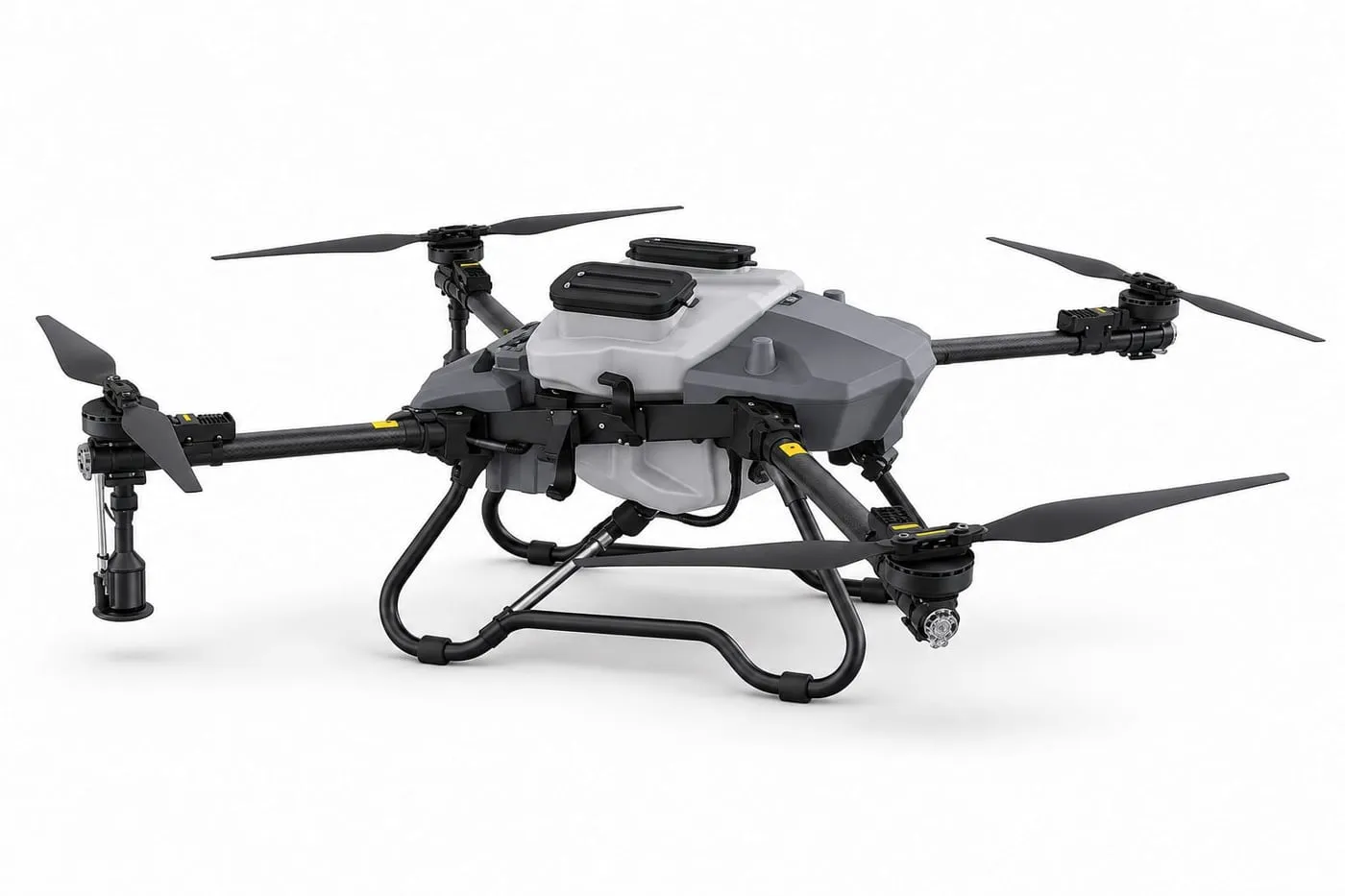
- A machine with a seed spreader. The Agri 50 carries about 70 L of spreading volume, the Agri 30R / 50R switch between spraying and spreading, and the Agri 100 suits very large blocks.
- Does direct seeding cause more weeds?
- Direct-seeded rice is generally more exposed to weeds than transplanted rice, because rice and weeds germinate together. Plan pre- or early post-emergence herbicide and follow the product label and local rules.
References
- [1]Agri drone for direct seeding demonstrated. PhilRice.
- [2]Mechanized direct seeding cuts farmers’ costs. PhilRice.
- [3]Farmers urged to practice recommended seeding rate. PhilRice.
- [4]Exploring the feasibility of using drones for seeding of rice (Oryza sativa L.). FAO AGRIS.