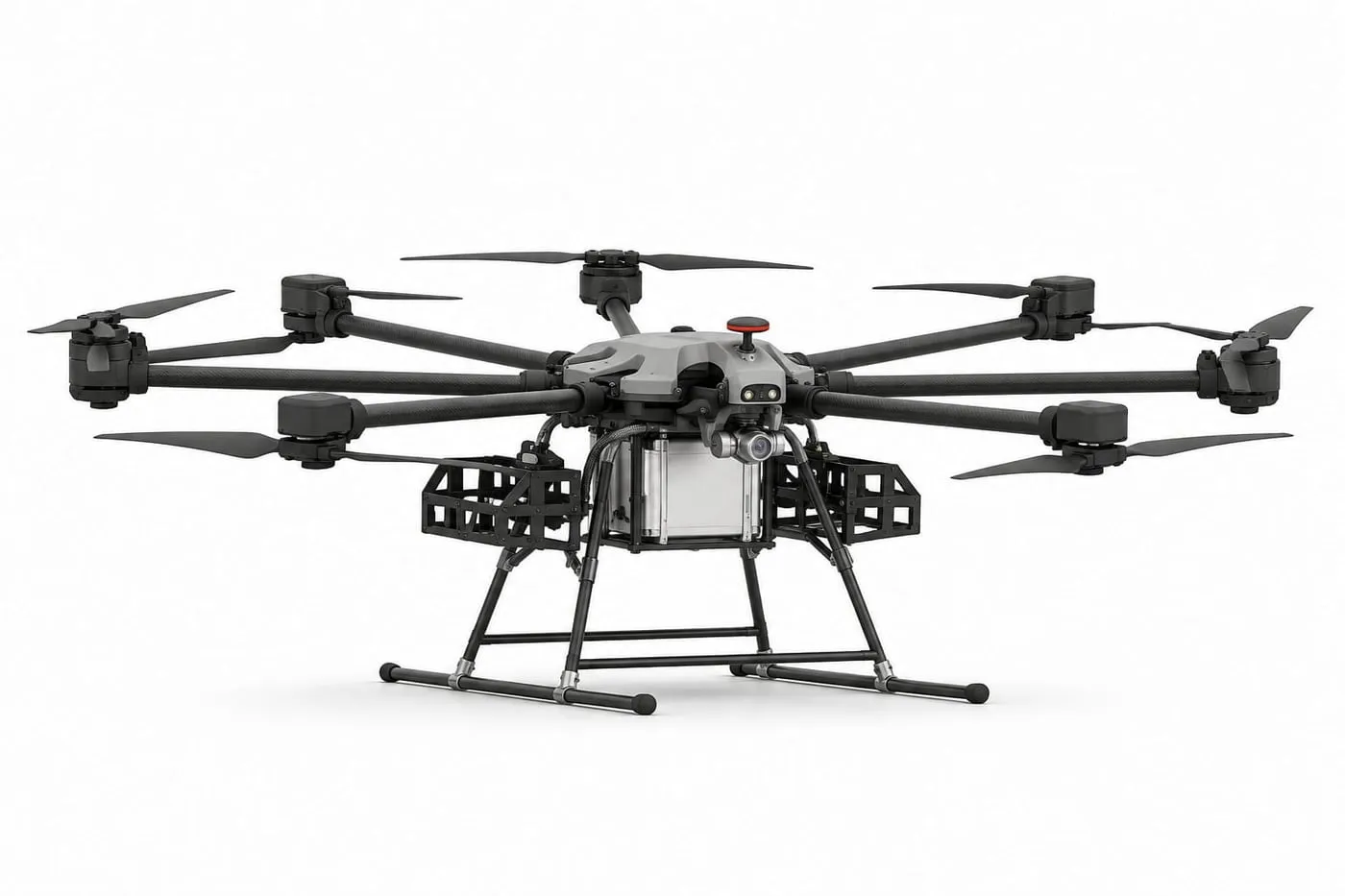
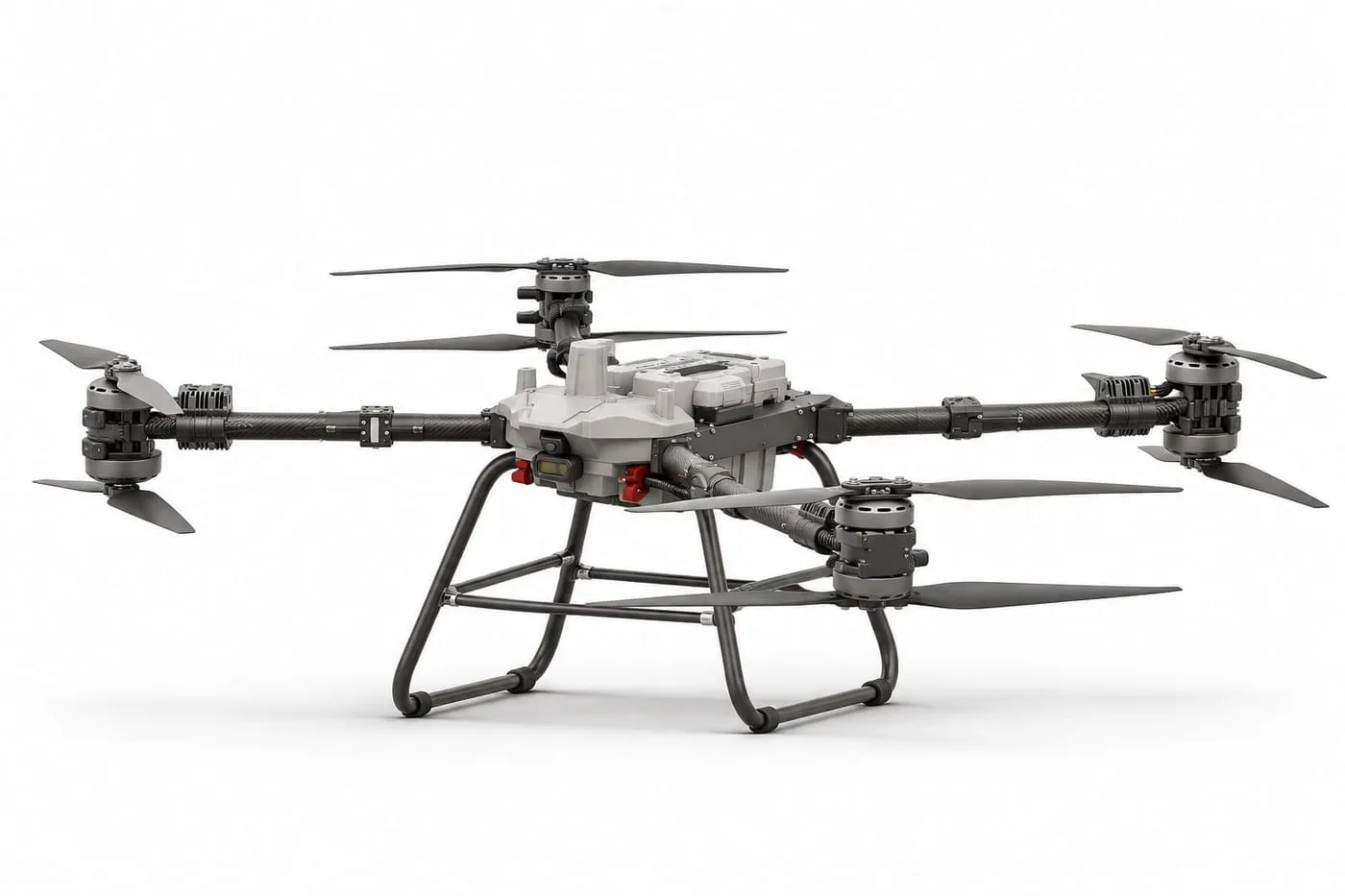
Guides
Heavy Lift Drone for Sale: 50, 100 and 200 kg Classes Compared (2026)
Heavy lift drone for sale in 2026: 50, 100 and 200 kg classes compared on payload, flight time and reference FOB price, what payload means, and red flags.
- Prepared by
- DEWKITE Sales Team
- Published
- Reading time
- 3 min
- Sources
- 2
Key takeaways
- 1A heavy lift drone in the 50 kg class is usually a 50 L spray drone, the 100 kg class a 100 L sprayer or a cargo drone, and 200 kg is a cargo class.
- 2Payload is not one number: tank litres, rated load, maximum load and take-off weight are four different figures.
- 3Our reference FOB prices run from about US$ 8,900 for the 50 L class to US$ 56,900 for the Cargo 150 / Cargo 100, one unit minimum.
- 4Flight time with a full load is far shorter than the headline number, so ask for the load and conditions behind it.
- 5Check the weight class in your aviation authority rules before buying, because heavy aircraft often need extra permission.
Contents
Short answer: Heavy lift drones come in three working classes: 50 kg (a 50 L sprayer), 100 kg (a 100 L sprayer or a cargo drone) and 200 kg (a cargo drone). Reference FOB prices run from about US$ 8,900 to US$ 56,900 depending on class and configuration, with one unit as the minimum order. Compare the rated load and flight time at that load, not the headline kilograms.
How do the three classes compare?
| Class | Model | Headline figure | Listed endurance | FOB reference |
|---|---|---|---|---|
| 50 kg | Agri 50 | 50 L tank, 22 ha/h | Per battery | US$ 8,900–21,100 |
| 100 kg | Agri 100 | 100 L tank, 35 ha/h | Per battery | US$ 22,700–29,100 |
| 100–150 kg | Cargo 150 / Cargo 100 | Max 150 kg, rated 120 kg | 62 min, 44.6 km range | US$ 46,500–56,900 |
| 150–200 kg | Cargo 200 / Cargo 200S | Max 200 kg, rated 150 kg | 30 min, 36 km range | US$ 31,400–45,300 |
| 150 L sprayer | Agri 150 | 150 L tank, 40 ha/h | Per battery | US$ 28,900–34,800 |
Prices are public-platform reference ranges, not a quote. The Cargo 200 range sits below the Cargo 150 because the figures come from different listings and configurations, so always compare quotes on the same battery, controller and spares.
What does payload really mean?
One headline “payload” can mean four things:
| Figure | Meaning |
|---|---|
| Tank size (L) | Volume of liquid; about 1 kg per litre of water |
| Rated load | Weight the maker designs for normal work |
| Maximum load | Weight the drone can lift at the limit, usually with less flight time |
| Take-off weight | Drone, batteries and load together |
Example from a public data sheet: DJI lists its Agras T100 with a 100 L spray tank and 100 kg operating payload, a 175 kg maximum take-off weight, and a lifting module of 100 kg (80 kg with dual batteries). The headline number changes by configuration. Ask every supplier for the same four figures.
Which class suits which buyer?
Best for a spray start-up: the 50 L class. It carries 50 L and covers about 22 ha/h as listed, and costs under US$ 21,100 at the top of the range.
Best for contractors on large fields: the 100 L class. The Agri 100 covers about 35 ha/h with a 100 L tank, so fewer refills and more hectares per battery change.
Best for moving loads over hills, rivers or plantations: a cargo class. The Cargo 150 / Cargo 100 has 62 min listed flight time and 44.6 km range; the Cargo 200 has 30 min and 36 km.
What should a buyer check?
- Flight time at full load, not the empty figure. The Cargo 200 lists 30 minutes; ask at which weight.
- Battery type, cycles and charging power. A 100 kg class drone needs a generator or strong grid supply.
- Spares and warranty: 12 months on main parts and 3 months on wear parts is the industry-standard split we use.
- Weight class in your rules: aviation rules are written by weight, for example the US small-drone rule in 14 CFR Part 107. Check yours before buying.
- Training for pilots and a plan for service.
What are the red flags in a listing?
- A kilogram figure with no battery, weather or altitude stated
- A price far below every other quote in the same class
- No data sheet, no spare-parts list or no named model
- A “payload” that is in fact the tank volume or the maximum take-off weight
- A supplier who will not give flight time at full load
How does a dealer sell heavy lift?
Heavy machines have fewer buyers but a higher ticket, so keep one demo unit, show a real load, and start with spray contractors, estates and builders. See cargo drone for sale and the guide to heavy lift drone business. Product pages: Agri 100, Cargo 150, Cargo 200. Dealer terms are on the dealer programme page.
Questions dealers ask
- How much does a heavy lift drone cost?
- From about US$ 8,900 for a 50 L sprayer up to US$ 56,900 for the top of the Cargo 150 / Cargo 100 range. In between: 100 L sprayer US$ 22,700–29,100, Cargo 200 US$ 31,400–45,300. All are FOB reference ranges; a quotation fixes the price.
- What is the heaviest thing a drone can lift?
- Within our range the answer is the Cargo 200, with a 200 kg maximum load and a 150 kg rated load. For liquid, the Agri 150 holds 150 L. Bigger aircraft exist but belong to another class.
- What drone can lift 200 kg?
- The Cargo 200 / Cargo 200S: 200 kg maximum, 150 kg rated, 30 min flight time and 36 km range as listed. Before you sign, ask what load the 30 minutes was measured at.
- Can a drone lift 50 kg?
- Yes. A 50 L spray drone such as the Agri 50 carries about 50 kg of liquid. For lifting objects rather than liquid, check the rated load of the model, not the tank size.
- Is the tank size the payload?
- Not exactly. One litre of water weighs about one kilogram, so a 100 L tank is about 100 kg of liquid. DJI lists its Agras T100 with a 100 L tank, 100 kg operating payload and 175 kg maximum take-off weight, which shows how many numbers sit behind one headline.
References
- [1]DJI Agras T100: Specs. DJI Agriculture.
- [2]E-agriculture in action: drones for agriculture. FAO and ITU.