Guides
Firefighting Drone for Sale in 2026: What a Fire Department Should Ask For
Buying or selling a firefighting drone in 2026: the spec checklist, reference prices, a demonstration plan and how a dealer approaches a fire service.
- Prepared by
- DEWKITE Sales Team
- Published
- Reading time
- 4 min
- Sources
- 4
Key takeaways
- 1A firefighting drone is bought on a short list of numbers: payload, flight time with load, how the agent is delivered (pods or hose), protection rating and wind limit.
- 2Public reference prices for a heavy firefighting drone run from about US$ 63,300 to US$ 125,000 (FOB, one unit), with the final price on a quotation.
- 3A fire service buys through a procurement process, not a checkout page, so a dealer needs a spec sheet, a demonstration day and a training plan ready.
- 4Say what the drone is and is not: we describe payload and delivery method; we do not claim any fire-performance certification.
- 5Add 10–15 % to the aircraft price for spare batteries, freight, insurance and training when you build a quotation.
Contents
Short answer: A firefighting drone for sale in 2026 is judged on payload, flight time with load, delivery method (pods or hose), IP rating and wind limit. Public reference prices for heavy models run from about US$ 63,300 to US$ 125,000 per unit, FOB. A fire service buys through procurement, so the dealer who wins brings a spec sheet, a demonstration day and a training plan.
What does a fire service actually buy?
Before the checklist, here is the purchase as a dealer would quote it. These are reference ranges from public listings; the final price is always on a quotation.
| Configuration | Reference price (FOB, 1 unit) | Delivers | Fits |
|---|---|---|---|
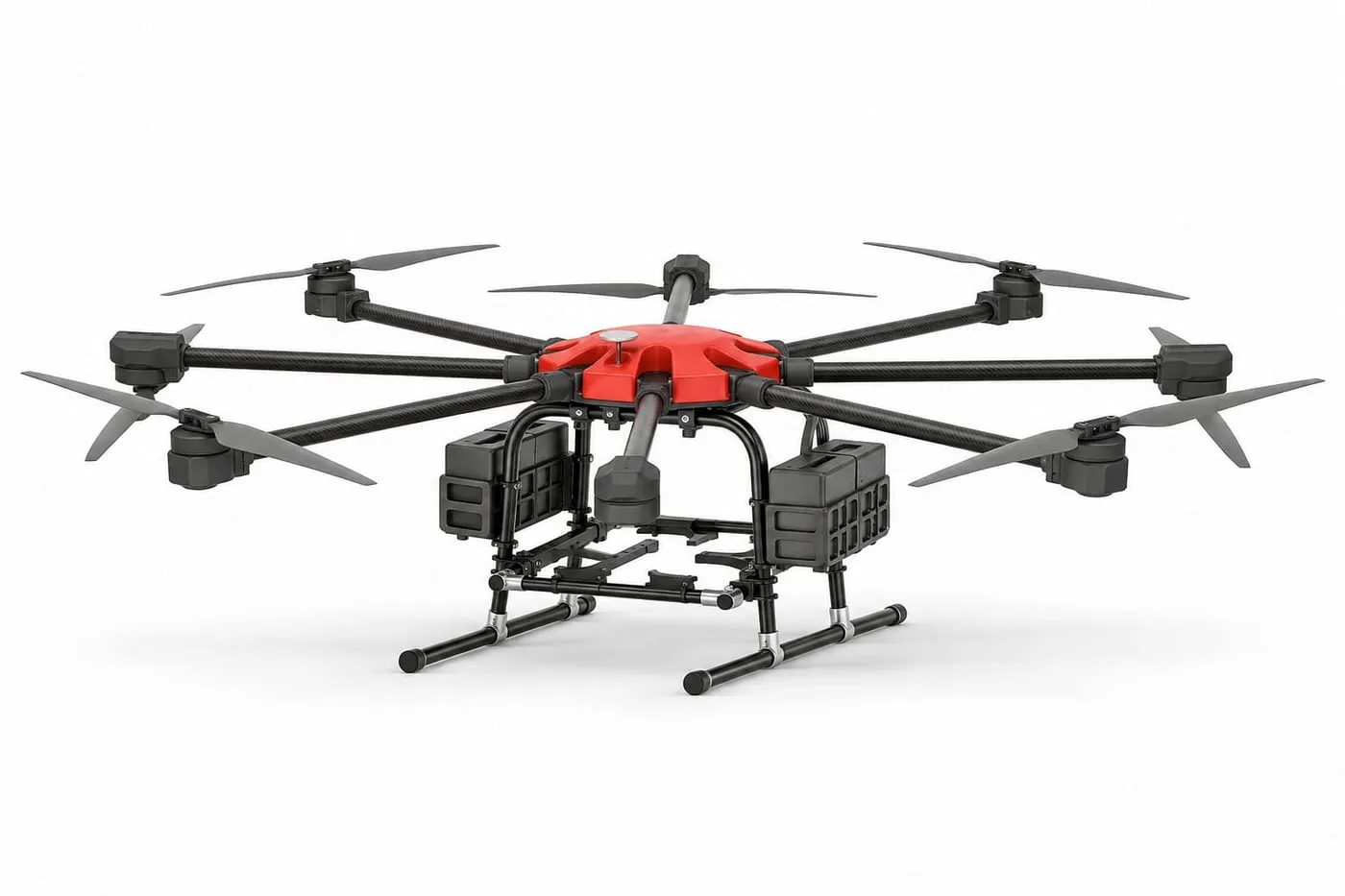
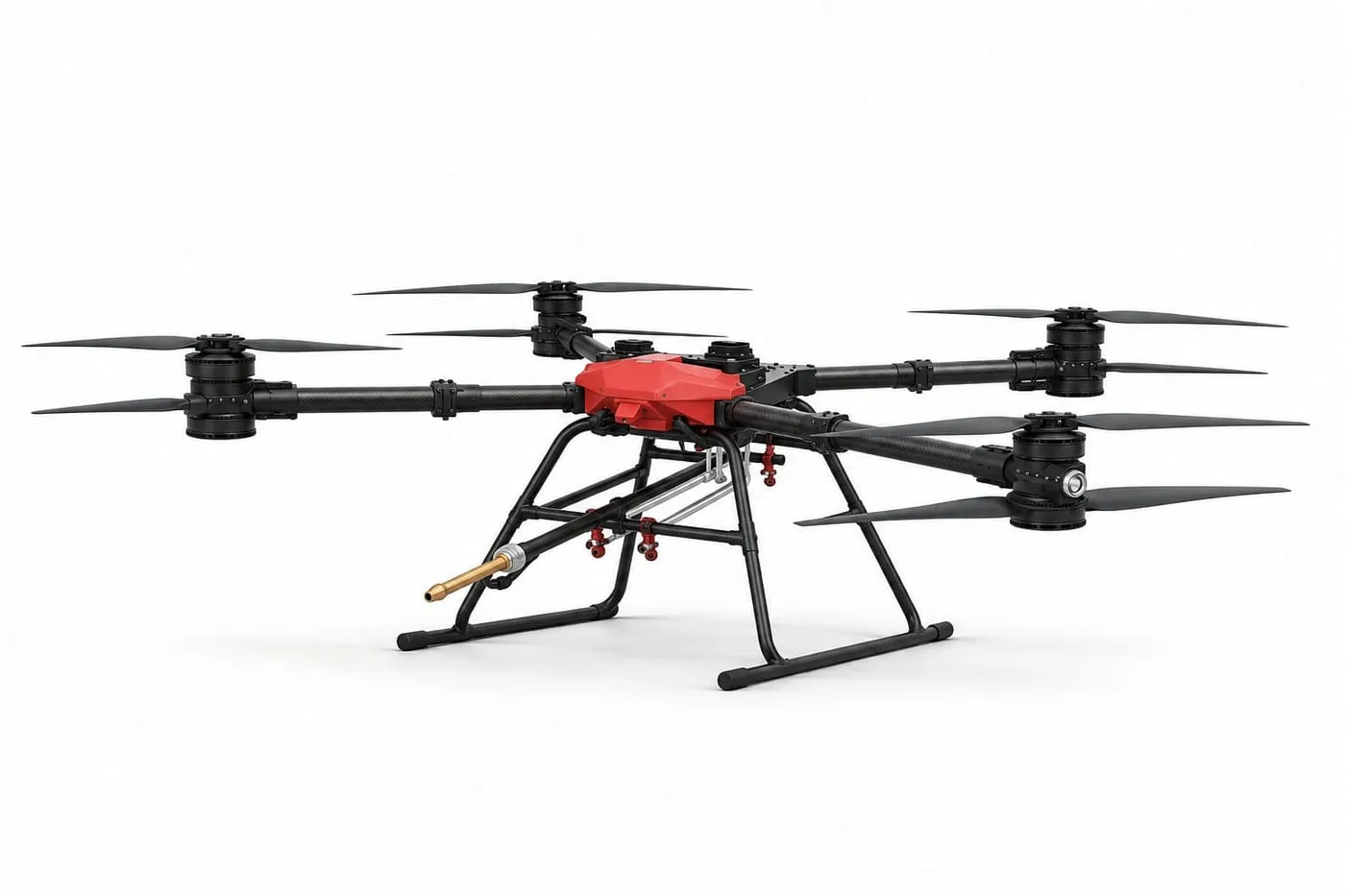
| Fire 120 / Fire 100 | US$ 63,300–83,600 | 4 pods of 23 kg or a hose nozzle | Fire services, large industrial sites |
| Fire 200 | US$ 63,300–125,000 | 4 pods of 23 kg or a hose nozzle, up to 200 kg load | Services that want the heaviest lift |
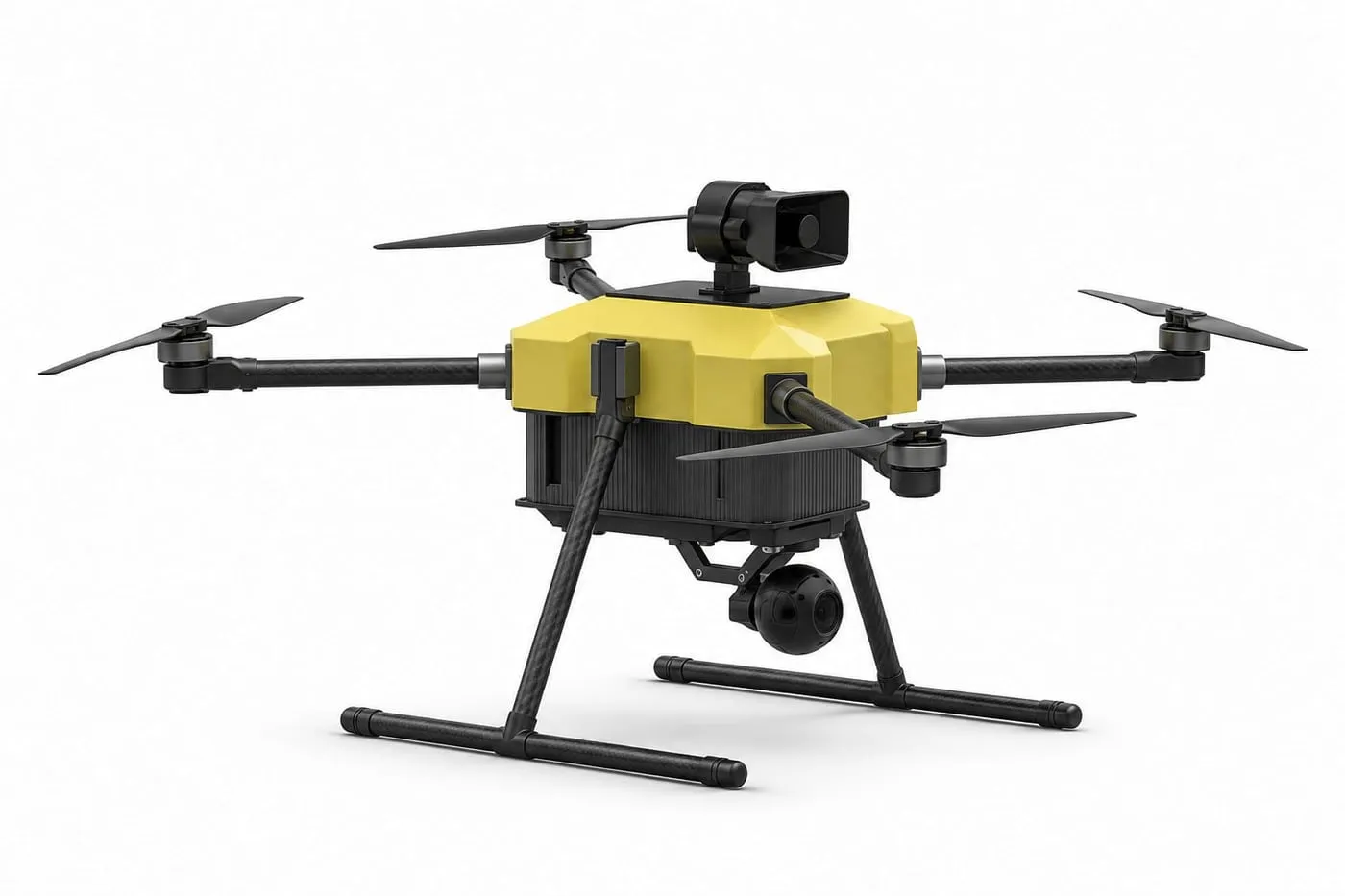
| Observation drone (Vision 4 / Vision 9) | US$ 3,900–11,400 | Camera view, not agent | Scouting before a heavy drone is sent |
Example (assumptions, not a quote): one Fire 120 at US$ 75,000, a second battery set at 10 % (US$ 7,500), freight and insurance at 6 % (US$ 4,500) and a two-day training course. Aircraft plus extras come to about US$ 87,000 before training and local taxes.
What specs should a fire department ask for?
Ask for the numbers below in writing, and ask whether each is measured with load or without it. A fire service compares them line by line, so every blank in your data sheet is a question mark.
| Spec to request | Why it matters | Our listed value (Fire 120) |
|---|---|---|
| Rated and maximum payload | Sets how much agent or hose weight goes up | 120 kg |
| Flight time, with and without load | Unloaded time is always the longer figure | Up to 63 min (unloaded) |
| Delivery method | Pods are quick; a hose gives sustained flow | 4 pods of 23 kg, or hose nozzle |
| Pod spread | Tells the crew where the agent lands | 25 m diffusion radius listed |
| Protection rating | Rain, spray and water from the nozzle | IP67 |
| Wind limit for take-off and landing | Fires often burn in wind | Level 7 |
| Control range and obstacle sensing | Safe flying near buildings | 10 km; dual obstacle radar and RTK |
| Warranty and spares | Downtime during a season matters | 12 months main parts / 3 months wear parts |
Two options sit beside these specs. A thermal camera helps a crew see hot spots through smoke, and makers of tethered systems describe it as useful for finding heat sources and the risk of reignition (Elistair); confirm what camera options we can supply for your market before you write it into a bid. A tether keeps an observation drone in the air without battery swaps, but it is a separate class of product from our untethered heavy-lift machines.
How do you reach a fire service as a dealer?
Start with the people who write the purchase specification: the chief, the fleet and equipment officer and the procurement office. NIST publishes standard test methods that help response organisations compare robots, including aerial systems, on measured capability (NIST). Ask whether the buyer plans to use a test of that kind, and offer to run the same exercise on your demonstration day.
A demonstration plan that works for a first meeting:
- Briefing (1 hour): show the data sheet, the delivery options and the price range.
- Dry run (half a day): a flight at the training ground with a water-filled pod or the hose nozzle.
- Crew session: let two of their people hold the controls under your pilot.
- Written follow-up: price valid for a stated period, delivery time, training days and spares list.
For firefighting at height, remember how a high-rise is defined: Fly4Future describes it as a building of seven or more floors including the ground floor, where ladders and lifts reach their limits (Fly4Future). Do not promise a reach in metres; give the aircraft’s specs and let the crew test.
Can a dealer earn on a drone this expensive?
Yes, but the money is in the package. Besides the aircraft, you sell batteries and chargers, a spares kit, training, annual checks and the next order from neighbouring services. A dealer who holds a small parts stock and a trained technician is the only supplier a fire service can call on a Saturday.
Read the other pages in this series before you quote: firefighting drone price, how fire services buy and high-rise firefighting drones. Our dealer programme lists the terms, and the Fire 120 and Fire 200 pages carry the full spec tables.
What should you not promise?
Do not promise a certified fire rating, a rescue capability or a legal right to fly. We give listed payloads and the documents we hold. Flight approval, pilot licences and operating limits are set by the local civil aviation authority, and the fire service’s own procedures apply on top.
Questions dealers ask
- What is the price of a firefighting drone?
- Heavy models sit between about US$ 63,000 and US$ 125,000 per unit, FOB, in the public listings we checked. For the Fire 120 our reference range is US$ 63,300–83,600; for the Fire 200 it is US$ 63,300–125,000. The price depends on payload, batteries and accessories, and the final figure is on our quotation.
- Where can a fire department buy a firefighting drone?
- Usually through a local dealer or an agent that can quote, deliver, train and service the aircraft. Public bodies often have to follow a tender or a quotation round, so the supplier must supply a data sheet, a price valid for a stated period and a delivery plan in writing.
- Who is allowed to fly a firefighting drone?
- That is set by the local civil aviation authority and by the fire service’s own procedures. In the United States, for example, the FAA runs a public-safety page for agencies that start a drone programme. Ask the authority before you order, and plan pilot training into the purchase.
- Pods or a hose: which should a fire service choose?
- Pods drop a fixed amount of agent on one spot and need no ground line. A hose lifts a nozzle to height and uses the water supply from the fire engine, so the flow does not run out. Many buyers start with one method and keep the other as an option.
- Does a firefighting drone replace firefighters?
- No. It reaches places that are hard to reach, such as upper floors, roofs or steep ground, and gives the crew another tool. Crews, command and water supply still do the main work.
- Do you promise a fire rating or a certified extinguishing capacity?
- No. We give the listed payload, pod size and spray radius, and we send the documents we hold. If a tender asks for a named test or certificate, ask us for what exists before you commit.
References
- [1]Public Safety (drone programmes for public-safety agencies). Federal Aviation Administration (FAA).
- [2]Standard Test Methods for Response Robots. National Institute of Standards and Technology (NIST).
- [3]Firefighting drone: putting technology into action. Elistair.
- [4]Drones for Firefighting in High-rise Buildings. Fly4Future.