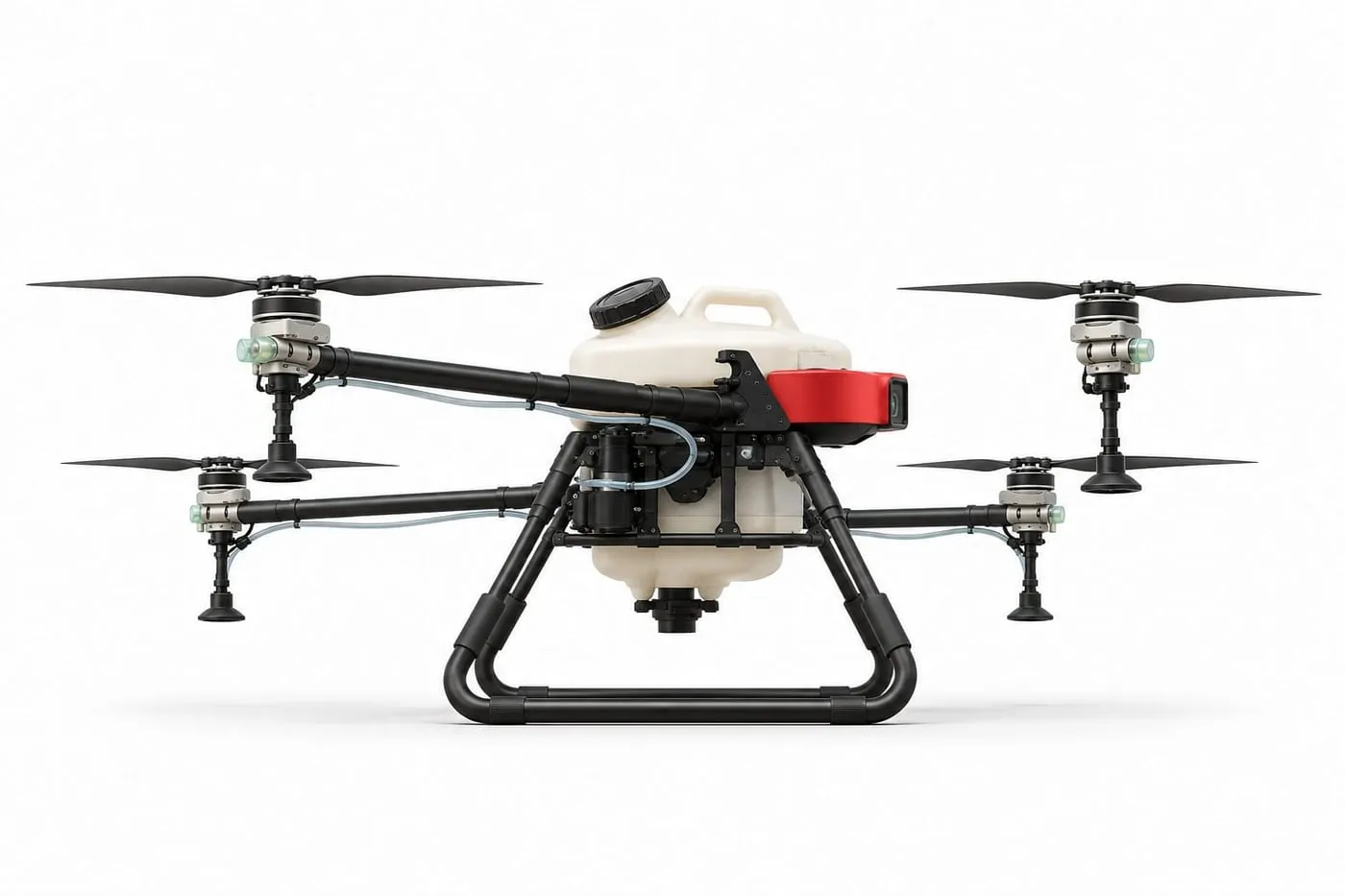
Guides
Drone vs Tractor Sprayer: Cost per Hectare Compared (2026)
Drone spraying vs tractor sprayer cost per hectare in 2026: custom rates, ownership cost, wheel-track yield loss, wet fields and when each method wins.
- Prepared by
- DEWKITE Sales Team
- Published
- Reading time
- 3 min
- Sources
- 7
Key takeaways
- 1On hire prices a ground sprayer is cheaper: Ohio's 2026 survey gives about US$26 per ha for a self-propelled sprayer against about US$37 per ha for a drone.
- 2Owning changes the picture: a farmer with a drone at about 405 ha a year pays about US$30 per ha, and a contractor at about 1,619 ha a year about US$18 per ha (Missouri model).
- 3A tractor sprayer driving through a standing crop loses yield in its wheel tracks: Purdue measured 2.5 % on average for a 60 ft boom in soybeans.
- 4Drones win on wet or soft ground, tall crops, small or odd fields and short windows; ground rigs win on big flat fields and high spray volumes.
- 5A dealer should sell the drone as a way to cover the gaps in a ground rig, not as a replacement for the tractor.
Contents
Short answer: On hire prices, a ground sprayer costs less per hectare than a drone: Ohio’s 2026 survey gives about US$26 per ha for a self-propelled sprayer and about US$37 per ha for a drone. Owning a drone narrows the gap: about US$30 per ha at roughly 405 ha a year, about US$18 per ha at 1,619 ha (Missouri model). Drones win where wheels cost yield or cannot go; ground rigs win on big, flat, high-volume jobs.
What does each method cost per hectare?
| Method | US$ per acre | US$ per ha (about) | Source |
|---|---|---|---|
| Pull-type sprayer, hired | 10.22 | 25.3 | Ohio 2026 |
| Self-propelled sprayer, hired | 10.63 | 26.3 | Ohio 2026 |
| High-clearance, late season, hired | 12.59 | 31.1 | Ohio 2026 |
| Manned aircraft, chemical, hired | 14.84 | 36.7 | Ohio 2026 |
| Drone, chemical, hired | 14.98 | 37.0 | Ohio 2026 |
| Own drone, farmer, 1,000 acres a year | 12.27 | 30.3 | Missouri model |
| Own drone, contractor, 4,000 acres a year | 7.39 | 18.3 | Missouri model |
Ohio’s drone figure comes from 42 responses and ranges from US$8 to US$20 per acre; the self-propelled figure comes from 105. Depreciation and interest are the biggest items in the owned-drone costs. These are US prices, so replace them with local quotes.
What does a wheel track cost in yield?
Between 1.3 % and 4.9 % of yield, depending on boom width, when the tractor drives through a standing crop. Purdue’s soybean fungicide trials in Indiana (2005–2006) measured an average yield loss of 4.9 % for a 30 ft boom, 2.5 % for 60 ft, 1.9 % for 90 ft and 1.3 % for 120 ft. Driving in the same tracks again adds no further loss, so the cost comes with the first pass of the season.
Example (assumed price): soybeans at 3.0 t/ha × 2.5 % loss = 0.075 t/ha. At an assumed price of US$400 per tonne that is about US$30 per ha. The US$400 is an example, not a source figure; put in your own yield and price. Count the loss only for sprays made through a standing crop; a drone has no wheels, so it has no such loss.
When is a ground sprayer still cheaper?
When fields are large, flat and dry, the window is wide or the product needs a high spray volume. Purdue’s guide says drones cannot currently compete with ground rigs where high carrier volumes are required, and Purdue’s soybean sheet says ground fungicide applications should use at least 15 gal/acre. On a farm like that, the tractor sprayer you already own is likely the cheaper way, so add a drone only where it fills a gap.
When does a drone win?
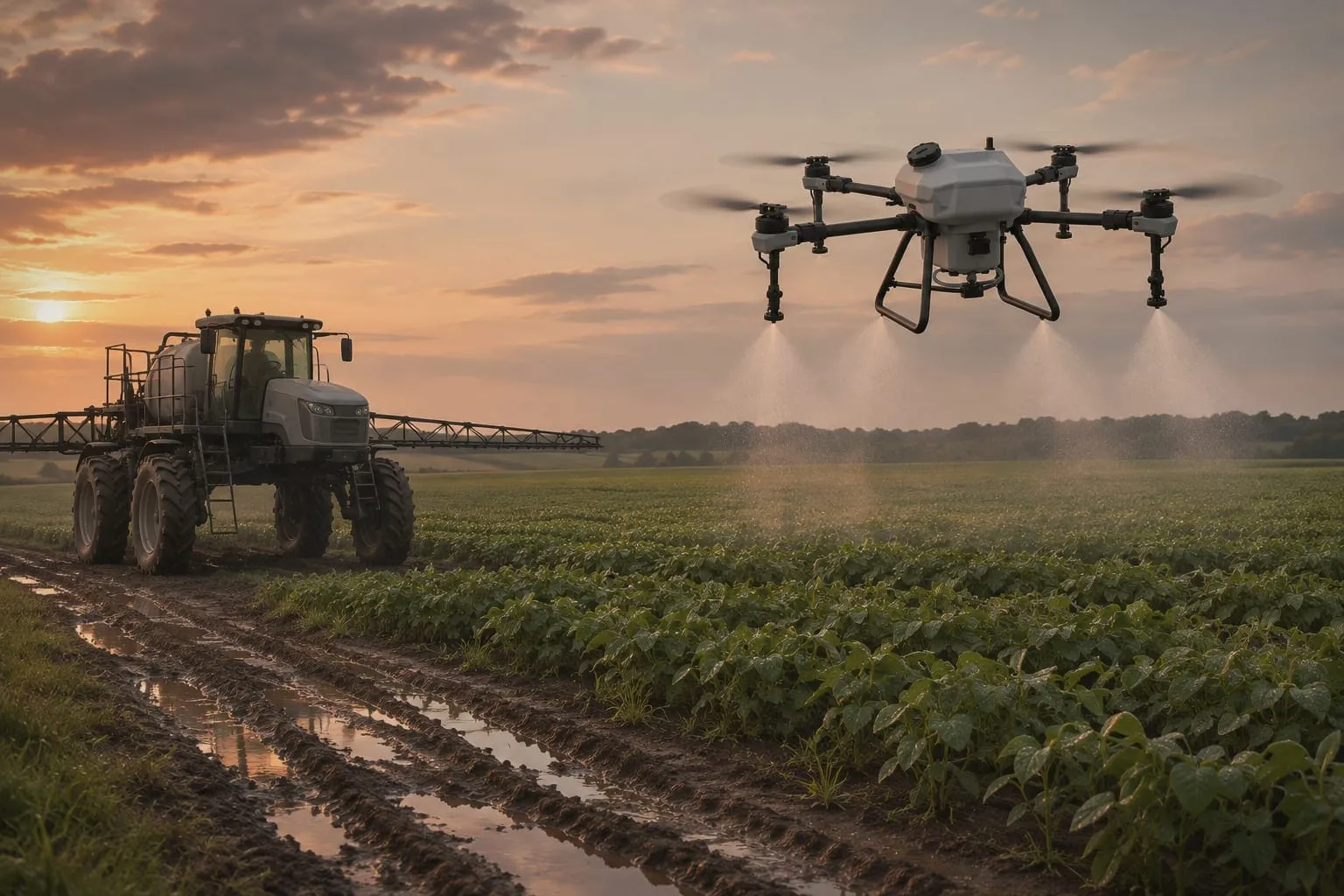
On wet or soft ground, in tall crops, on small or odd-shaped fields and when the window is short. Ohio State’s fact sheet says portions of a field that heavy ground sprayers cannot reach because the soil is too wet can be sprayed with drones, and that a drone may be the best choice to avoid soil compaction and crop damage from traffic. In those cases waiting for a dry day can cost more than the extra US$11 per ha a drone charges at hire prices.
What about the cost of the equipment itself?
A drone set costs a fraction of a ground rig. Missouri’s complete set for one farmer (a drone, equipment and three batteries) is about US$56,000, while Purdue notes that a farm needs a large land base to spread the cost of a US$650,000 self-propelled sprayer. Compare cost per hectare, not the invoice.
How much does a drone cost to buy?
For planning use public FOB reference ranges: Agri 30 from US$ 3,000, Agri 50 from US$ 8,900 and Agri 100 from US$ 22,700. The landed price is higher after freight, duty and batteries; see our cost-of-ownership guide.
What does this mean for a dealer?
Do not sell the drone against the tractor. Sell it as the machine that covers wet patches, tall crops and tight windows for a farm that keeps its ground rig, and give the farmer a cost-per-hectare sheet like the one above with local prices. For per-country rates, see the cost per hectare guide and the worth-it guide. Dealers can start with one unit through the dealer program.
Questions dealers ask
- How many people does a drone need compared with a tractor?
- Purdue describes two people per spray drone in the United States without a waiver, while a tractor sprayer usually has one driver. Add the extra person to the cost-per-hectare sheet if your rules ask for it.
- Can a drone replace my tractor sprayer?
- Rarely. Purdue says drones cannot currently compete with ground rigs where high carrier volumes are needed. Most farms add a drone for wet fields, tall crops and tight windows and keep the ground rig for volume work.
- Is drone spraying cheaper than a manned aircraft?
- About the same. Ohio's 2026 survey shows US$14.98 per acre for drone chemical application and US$14.84 for aircraft, and Kentucky's guide describes the drone price as similar to a manned aerial sprayer.
- Does a drone use less water than a tractor sprayer?
- Yes, a lot less. Purdue notes that ground fungicide applications should use at least 15 gal/acre (about 140 L/ha), while a drone typically applies about 2 gal/acre (about 19 L/ha). Follow the product label for the volume it allows.
- How many hectares a year make owning a drone cheaper than hiring?
- About 397 ha in Missouri's model, which compares owning with a US$16 per acre custom rate. Below that area hiring is cheaper; above it, owning wins.
- Which method costs less per hectare in India or Africa?
- We found no published local custom rates we can rely on, so do not copy Ohio's numbers. Ask three local providers for a drone price and a ground-rig price, then use the method in this guide.
References
- [1]Ohio Farm Custom Rates 2026. The Ohio State University Extension.
- [2]G1274 Economics of Drone Ownership for Agricultural Spray Applications. University of Missouri Extension.
- [3]Managing Fungicide Applications in Soybean (SPS-103-W). Purdue Extension.
- [4]Drones for Spraying Pesticides – Opportunities and Challenges. The Ohio State University CFAES.
- [5]The Evolution of Spray Drones: current challenges (PPP-154). Purdue Pesticide Programs.
- [6]The Evolution of Spray Drones: considerations before purchasing (PPP-154). Purdue Pesticide Programs.
- [7]AEN-174 Drone Sprayer Sizing for Agricultural Applications. University of Kentucky Cooperative Extension.